Desoldering Pump vs Hakko FR-301: Three Numbers
When you pull a badly soldered pin header off a board, the step that gets ignored is rarely the iron temperature. It is getting the solder out. A manual spring pump advertises 53.3 kPa in its listing title, while the official spec sheet for a powered vacuum desoldering tool says 81 kPa. They look one grade apart, yet the price difference is an order of magnitude. The catch is that those two kPa figures are not measured on the same scale, and comparing them straight across is a reliable way to buy the wrong tool.
Disclosure first: this article contains Amazon affiliate links, and I earn a commission if you order through them, at no extra cost to you. I actually went through Hakko's official FR-301, FR-410 and FR-300 product and specification pages, the N61 nozzle list, and the Amazon listings for five in-stock products (retrieved 2026-11-16). I cross-checked against the Jameco FR301-03/P listing and Hakko's UK and Ireland distributor pages. I did not buy these five tools or run a hands-on teardown; wherever the manufacturer publishes no number, I write "not specified" instead of estimating one.
TL;DR: (1) 53.3 kPa is a self-reported Suction Power on a manual spring pump listing, tied to a single press-align-release stroke; 81 kPa appears in Hakko's official spec table next to 11 L/min of continuous flow and a diaphragm pump. You cannot subtract them, and you cannot claim "81 is 50% stronger than 53". (2) The official spec sheet has no warm-up time, only a 350 to 500 C temperature range; the distributor phrase "improved temperature recovery time" gives no seconds either, so it is not a comparable parameter. (3) Nozzle diameter only makes sense alongside the model generation: FR-301 takes the N61 series in 0.6 / 0.8 / 1.0 / 1.3 / 1.6 mm with a 1.0 mm N61-08 fitted as standard, while the discontinued FR-300 uses the T18 series, and Hakko states explicitly that N61 nozzles do not fit FR-300. (4) Wattage is split by mains voltage: 100 V is 98 W, 120 V is 140 W, 220 V is 100 W, so the "110 W" in a listing title is just one row spoken loosely. (5) For a few through-hole joints with an iron already on the bench, a hand pump is enough. Multi-layer plated through-holes, dense pin headers and a run of fifteen or twenty joints justify a powered station that heats and pumps at the same time.
What I checked, and what the manufacturer never published
The primary sources here are four pages on Hakko's own site: the FR-301 specification page, the FR-301 nozzle page, the FR-410 specification page and the FR-300 discontinuation notice. On the retail side I opened five Amazon ASIN listings, confirmed each resolves to a real productTitle, and checked the buybox container for the outOfStockBuyBox marker. For a second opinion I used Jameco's FR301-03/P listing plus Hakko's UK and Ireland FR-301 / FR-4103 pages. They reproduce the official table closely enough to confirm that "81 kPa / 11 L/min" and "N61 is incompatible with FR-300" are not typos on a single page.
It matters just as much to name what is absent. The FR-301 spec page gives no warm-up time or heat-up time, no noise figure, and no per-joint cycle time. The 53.3 kPa on the hand pump has no stated measurement method, no indication of peak versus average, and no independent verification. I will not fill those gaps with "typically" or "roughly". If you need them, check the official page or request the manual. Once that filter is applied, only three numbers survive comparison: vacuum pressure (which must be read with flow), nozzle diameter (which must be read with model generation) and wattage (which must be read with voltage).
| Number | Manual spring pump | Hakko FR-301 | Directly comparable? |
|---|---|---|---|
| Vacuum | 53.3 kPa, self-reported, no flow figure | 81 kPa / 610 mmHg with 11 L/min | No, different measurement regimes |
| Nozzle | Listings usually give silicone tip heat rating, not bore | N61 series, 0.6 to 1.6 mm, 1.0 mm standard | No, one side has no figure |
| Power | No heater, no electrical draw | 98 to 140 W across six voltage rows | No, one side has no heater |
Number one: 53.3 kPa and 81 kPa are not the same kind of measurement
The MECCANIXITY 53.3 kPa listing (B0GRFR558X) is refreshingly literal: Suction Power: 53.3 kPa, Sealing Ring: Single-ring design, Size: 330 x 20 mm (L*W), and an instruction sequence that says to press the plunger to apply pre-pressure, align the nozzle with the heated joint, then release the plunger so the tool creates a vacuum and draws up the molten solder. A sibling listing (B0GRTM1TGB) says 40 kPa, 210 x 22 mm, dual seal rings. Here is the trap: the 330 mm and 210 mm in those titles are body lengths, not mmHg vacuum readings. Reading "53.3 kPa / 330 mm" as "53.3 kPa equals 330 mmHg" is simply wrong; 53.3 kPa converts to roughly 400 mmHg.
Hakko's FR-301 spec page speaks a different language. Vacuum generator is "Diaphragm pump", Vacuum pressure is "81 kPa (610 mmHg)", Suction flow is "11 L/min.", Heating element is "Ceramic heater", and Standard nozzle is "1.0 mm dia. (No. N61-08)". Against a standard atmosphere of 101.325 kPa, 81 kPa is about 80%; against 760 mmHg, 610 mmHg is also about 80%, so the two units are internally consistent. But the manual pump's 53.3 kPa has no companion flow row, because there is no motor at all, just one spring returning. One number describes a transient pressure difference from a single stroke; the other describes a working vacuum maintained by a pump while a heater stays hot. Their similarity is coincidence.
Why 11 L/min is the number that makes 81 kPa meaningful
Vacuum pressure tells you how large a pressure difference can be established. Flow tells you how much gas and molten solder can be moved through that difference every second. On a multi-layer plated through-hole, solder clings to the barrel and flux is smoking: what you need is continuous transport into a filter tube, not one sharp gulp. 11 L/min is Hakko's official rating for that capability. Jameco's FR301-03/P listing gives "81 kPa (610 mm Hg / 24 in. Hg)", "Suction Flow: 11 L/min" and a single-cylinder diaphragm pump as the vacuum source, matching the official table line by line. That is the independent second source.
The FR-410 spec page provides harder evidence that cross-model comparison is unsafe. FR-410 uses a double-cylinder vacuum pump, is rated Max. 80 kPa (600 mmHg) at 15 L/min, draws 190 W at the station and 140 W at the handpiece, runs 330 to 450 C, and carries a footnote: "The suction flow is measured at the filter case suction port of station." The measurement location is explicitly constrained. The FR-301 page carries no such footnote, so treating 15 versus 11 as "FR-410 is 36% stronger" is not justified. FR-410 also lists temperature stability of plus or minus 5 C at idle; the FR-301 page gives only the 350 to 500 C range.
Number two: nozzle bores from 0.6 to 1.6 mm, and several shapes
Hakko's nozzle page lists the N61 family in full. SS type: N61-01 at 0.6 mm, N61-02 at 0.8 mm, N61-03 at 1.0 mm. S type: N61-04 through N61-06 at 0.8, 1.0 and 1.3 mm. Standard type: N61-07 through N61-10 at 0.8, 1.0, 1.3 and 1.6 mm. Long type N61-11 to N61-14 covers 0.8 to 1.6 mm. Oval type N61-15 is 3 x 1 mm and N61-16 is 4 x 1 mm. FR-301 ships with the standard N61-08 (1.0 mm); FR-410 ships with the S type N61-05 (1.0 mm). Both say 1.0 mm, yet the part numbers are not interchangeable, so read the suffix when ordering spares.
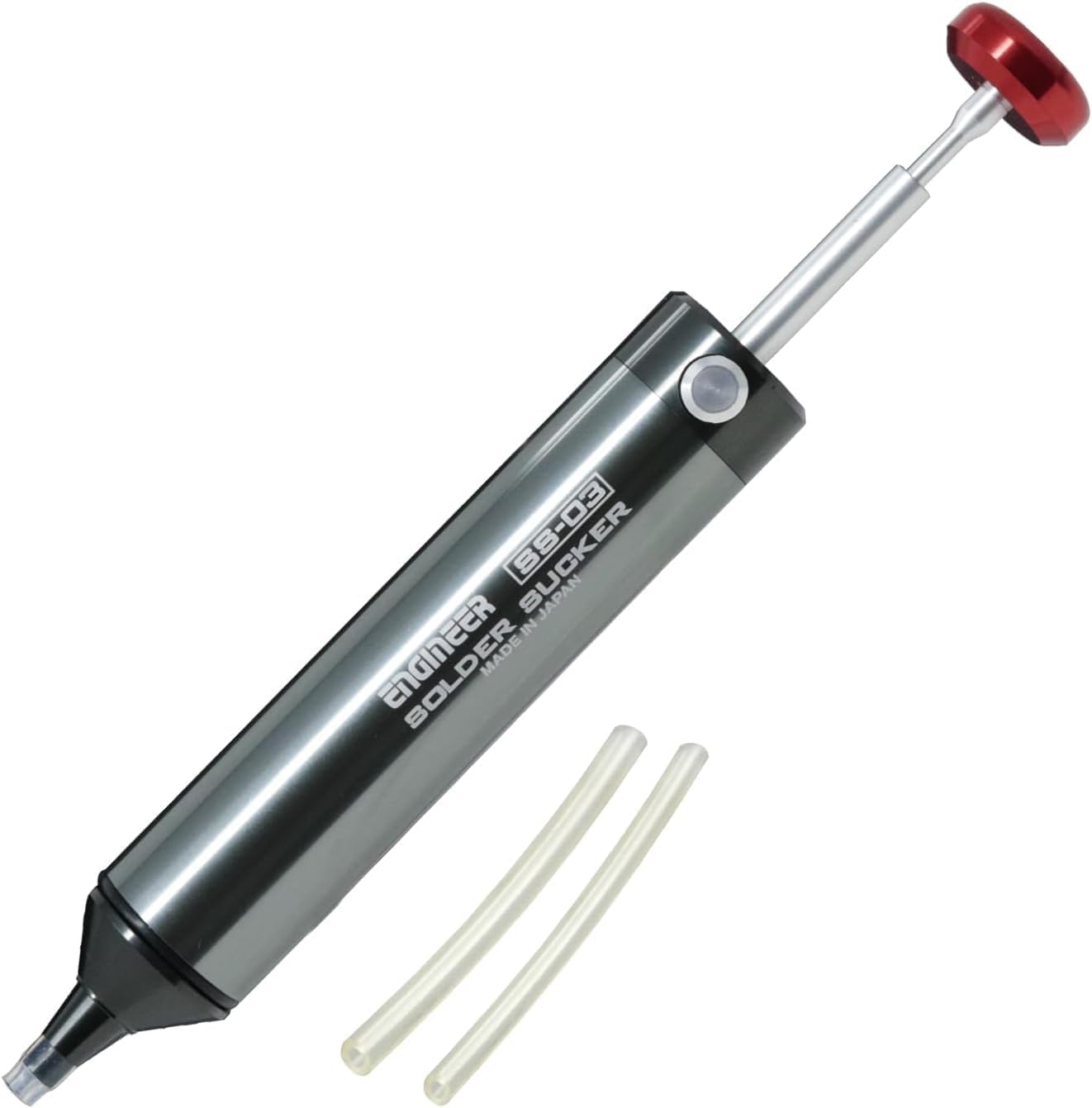
Bore choice follows pin diameter and pad size; smaller is not automatically better. Too small and the tip cannot cover the pad before the solder freezes; too large and you risk lifting the solder mask or disturbing adjacent parts. Hand pumps rarely publish a bore at all. The ENGINEER SS-03 listing gives a 153 mm body length, 20 mm diameter and a silicone tip rated to 350 C: those are body and material specifications, not nozzle inner diameter. If you genuinely need to match a bore to a pad, a powered station with a published nozzle table is the workable route.
The FR-300 generation break: N61 will not fit the old tool
People still search for "Hakko FR-300 desoldering gun" because older tutorials name it. The official FR-300 page now carries a DISCONTINUED badge, states that it was discontinued in 2017/12 with FR-301 as the successor, notes that the page reflects data at discontinuation and will not be updated, and says "Soldering tip/Nozzle T18 series are available". The FR-301 nozzle page is blunter: "These nozzles are not compatible with the discontinued FR-300 handy desoldering tool. N61 series nozzles cannot be used for FR-300." Hakko's UK and Ireland pages repeat the same restriction, giving a second and third independent source.
The practical consequence: N61 nozzles bought today are for FR-301 or FR-410. If you own a second-hand FR-300, shop for T18 series consumables and do not stock up on N61. It is a neat example of the same brand and the same "1.0 mm" figure being non-interchangeable across a generation change.
Number three: wattage is per-voltage, and 140 W is not a universal rating
The Power consumption row on the FR-301 spec sheet is not one number but six: 100 V 98 W, 110 V 122 W, 120 V 140 W, 220 V 100 W, 230 V 110 W, 240 V 120 W, all at 50/60 Hz. Jameco lists FR301-03/P as Input Voltage 120 VAC 50/60 Hz and Power Consumption 140 W, landing exactly on the official 120 V row. Cross-check passes. So the "110 W" you see in a listing title or third-party copy is most likely the 230 V row or casual shorthand, and it cannot be used to argue heating performance against 140 W. Confirm your local mains voltage and plug type first; compare wattage second.
One more wrinkle: FR-410's 190 W is the station, while the handpiece is separately listed at 140 W (24 V). Those two figures belong to different assemblies and should be neither added nor compared. Numbers tagged with an assembly name and numbers tagged with a voltage row are two distinct traps in the same table.
Warm-up time: the official spec sheet simply does not have it
My original plan was to write about vacuum pressure, warm-up time and nozzle diameter. After reading the FR-301 spec page line by line I changed the angle. The manufacturer gives Temperature range 350 to 500 C, no warm-up time and no seconds-to-temperature. FR-410 adds temperature stability of plus or minus 5 C at idle, which still is not warm-up time. Jameco's copy mentions "improved temperature recovery time" as a qualitative claim with no number attached. When a figure cannot be found, the honest answer is "not specified, check the official page or manual" rather than inventing "about 30 seconds".
This kind of gap is common. Marketing copy likes "fast heat-up and good recovery", while the spec table commits only to a temperature range and a stability tolerance. Treating "not published" as "no difference" is one of the easiest mistakes to make when reading a specification.
Five listings, checked one by one
All five were opened on 2026-11-16, each resolved to a real productTitle, and none showed an outOfStockBuyBox marker inside the buybox container. Every price below is marked "as of publication". My egress IP is in China, so the pages returned a mix of CNY and USD; treat these as rough magnitude only and trust the price you actually see.
First, the ENGINEER SS-03 manual solder sucker: Japanese-made aluminium body, silicone tip rated to 350 C, 153 mm x 20 mm, small enough for a field kit. Real drawbacks: the listing gives no kPa suction figure, so it cannot be quantified against the 53.3 kPa model; a single spring stroke means one hand on the plunger and one on the iron, and the timing takes practice; the silicone tip is a consumable. As of publication the page showed CNY 129.11.


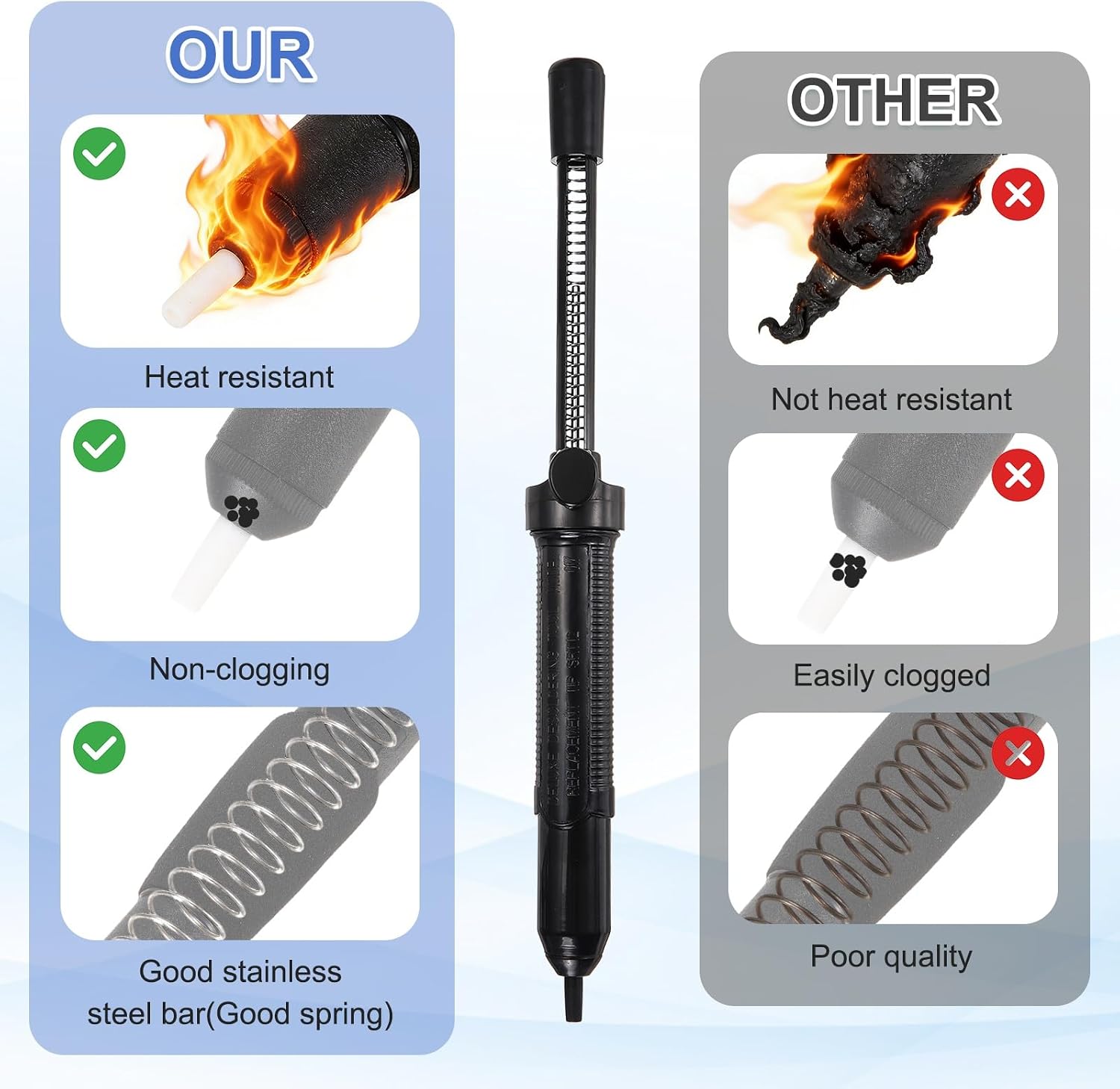
Second, the Weller 7874B ESD-safe manual desoldering pump: aluminium body with an ESD-safe positioning, a sensible choice beside static-sensitive boards. Real drawbacks: still purely manual, with no heater and no flow rating, and no published kPa suction figure for this model on the official side, so check the official page; plated through-holes on multi-layer boards will be a struggle. As of publication the buybox showed $29.29.


Third, the MECCANIXITY 53.3 kPa desoldering pump is the only hand pump here that puts suction in the title: Suction Power 53.3 kPa, single seal ring, plastic body, 330 x 20 mm. Real drawbacks: 330 mm is body length, not mmHg; the 53.3 kPa has no stated test conditions and no independent verification, so do not subtract it from 81 kPa; the listing offers no durability data for the plastic body or the single ring. As of publication the page showed CNY 90.01.


Fourth, the Hakko FR301-03/P portable desoldering tool has the most complete published specification: 81 kPa / 610 mmHg, 11 L/min, diaphragm pump, 350 to 500 C, N61-08 (1.0 mm) fitted as standard, 98 to 140 W depending on voltage, and 0.52 kg without the cord. Real drawbacks: it needs mains power and cannot be used away from an outlet; the filter is a consumable, with Hakko's parts page listing A5044 ceramic paper filters and B5104 pre-filters that need periodic replacement; as of publication no price was resolved in this ASIN's buybox, so check the listing; 0.52 kg excludes the cord and is not light for long sessions.


Fifth, the ZD-915 digital vacuum desoldering station is a bench unit with a built-in vacuum pump; the listing title says Built-in Vacuum Pump and Desoldering Gun for Electronics Repair. Real drawbacks: 110 W, 80 W and 60 W are scattered across comparison tables and recommendation slots rather than a manufacturer spec sheet, so do not treat any of them as the rated draw; it is not part of the N61 nozzle ecosystem, so check with the maker for consumable sizes; a bench station with a hose takes desk space, so measure first. As of publication the page showed CNY 934.08.


When a manual spring pump is enough
Single-sided boards or ordinary double-sided boards, a handful of through-hole parts, and a temperature-controlled iron already on the bench: a hand pump plus desoldering wick widths and ROL0 flux classification will usually finish the job. Add a little fresh solder to improve heat transfer, release the plunger as the iron brings the joint to liquid, then take the thin residue off with wick. In that scenario the recurring cost is consumables, and understanding solder wire alloy, core and diameter matters more than any kPa on the pump. On static-sensitive boards, sort out the three resistance numbers on an ESD mat before choosing a desoldering method; reversing that order is an expensive mistake.
The real limitation of a hand pump is not suction, it is timing. Molten solder returns to solid within a very short window, and you have to coordinate the iron, the plunger and your line of sight at once. As the joint count rises, so does the error rate.
When you need a powered vacuum station
Plated through-holes on multi-layer boards, large ground planes, dense pin headers and fifteen or twenty joints in a row are hard to reproduce consistently with single spring strokes. A powered station with a heated nozzle and continuous suction fuses "melt" and "remove" into one action, and the official 11 L/min plus the filter tube design exist precisely for repeated work. Concentrated flux fumes are worth considering alongside how to read a solder fume absorber's specifications. If you are still choosing an iron, the discussion of temperature control and thermal recovery in the Pinecil V2, TS101 and Hakko FX-888D comparison follows the same logic as "temperature range is not warm-up time" here.
The cost is equally plain: mains power, bulk, consumables, price, and a machine that solves exactly one problem. That is why my decision order is "joint type first, then whether continuous flow is needed", not "who has the bigger kPa".
Prices and the limits of this evidence
As of publication (2026-11-16), the figures I could read inside the buybox container were $29.29 for the Weller 7874B, CNY 129.11 for the ENGINEER SS-03, CNY 90.01 for the MECCANIXITY 53.3 kPa and CNY 934.08 for the ZD-915. No price resolved for the Hakko FR301-03/P buybox, so check the listing. The mixed currencies are an artefact of my egress IP being in China, with pages returning local currency by region. These are rough magnitudes, not a global price list; use the price you actually see at checkout.
To restate the evidence boundary: the hand pump kPa is self-reported by the listing, with no test conditions and no independent measurement; the official spec pages contain no warm-up time; FR-410's 15 L/min carries a measurement-location footnote and should not be converted into a strength ratio against FR-301's 11 L/min; and my stock check only establishes that the pages opened and the buybox showed no out-of-stock marker, not that any item stays available. Manufacturer pages remain the final authority, and where they publish nothing, I say so.
FAQ
Q: Can I compare a hand pump's 53.3 kPa directly with the FR-301's 81 kPa?
A: No. The first is a transient pressure difference from one spring return, with no flow figure or stated test method. The second is the working vacuum of a diaphragm pump, listed alongside 11 L/min of continuous flow, a ceramic heater and a 350 to 500 C range. Similar numbers do not create comparability, and computing "50% stronger" from them is a misreading.
Q: Is the 330 mm in the listing title a vacuum unit?
A: No. The B0GRFR558X specification says Size: 330 x 20 mm (L*W): 330 mm is body length and 20 mm is outer diameter; the 40 kPa sibling says 210 x 22 mm. Suction appears on its own line as Suction Power: 53.3 kPa. Mistaking the length for mmHg produces a completely wrong conversion.
Q: If I buy a used FR-300, can I fit N61 nozzles to it?
A: No. The official FR-300 page marks it discontinued in 2017/12 with FR-301 as successor and says T18 series nozzles are available. The FR-301 nozzle page states "N61 series nozzles cannot be used for FR-300", and Hakko's UK and Ireland pages repeat the restriction. Shop for T18 consumables for the older tool.
Q: Why do some pages say 110 W and others 140 W?
A: Because wattage is listed per voltage. The official FR-301 table gives 100 V 98 W, 110 V 122 W, 120 V 140 W, 220 V 100 W, 230 V 110 W and 240 V 120 W. Jameco's FR301-03/P says 120 VAC / 140 W, matching the official 120 V row. Identify your mains voltage first, then read that row.
Q: Does the manufacturer publish a warm-up time I can compare?
A: The FR-301 spec page gives no warm-up time, only a 350 to 500 C temperature range. FR-410 adds 330 to 450 C and plus or minus 5 C stability at idle, neither of which is warm-up time. Jameco's "improved temperature recovery time" is qualitative with no seconds attached. When a number is not published, check the official page or manual rather than inventing one.
Scope and disclosure
This is a specification-reading article, not a hands-on review. I did not buy or physically use any of these five tools. Every performance figure comes from manufacturer pages, distributor pages or retail listings retrieved on 2026-11-16, and the key conclusions have at least two independent sources. Prices, stock and promotions change, so the live listing always wins. Amazon links here are affiliate links and I earn a commission from qualifying orders, at no change to your price. Whether to buy at all should follow the order above: joint type, then whether continuous flow is needed, then nozzle and voltage row.
👉 Join Xiaomi MiMo Platform: Leading AI model platform with cost-effective inference
👉 Join Aliyun AI: Top AI products with exclusive coupons for business innovation
📌 This article was AI-assisted generated and human-reviewed | TechPassive — An AI-driven content testing site focused on real tool reviews
🔗 Recommended Tools
These are carefully selected tools. Using our affiliate links supports us to keep producing quality content:
As an Amazon Associate, I earn from qualifying purchases at no extra cost to you.