CO2 Monitors: NDIR, AQI, and Three Accuracy Ranges
I went through the official spec sheets, datasheets and user manuals of five desktop air monitors line by line (fetched 2026-11-17 from Aranet's datasheet and product page, Airthings' official specifications page, Temtop's spec blocks and the M10+ user manual, Sensirion's sensor pages, and the US EPA's official AQI breakpoint table). The thing that struck me afterwards is that these five machines' "accuracy" numbers cannot be compared with each other, and not because anyone is lying. It is because three different things get squeezed into one word: the range, the formula, and the window in which the formula is promised to hold.
One disclosure first: this article contains Amazon affiliate links, and I earn a commission if you buy through them. It does not change what you pay. I did not buy these five units and run them side by side, so wherever the manufacturer gives no number I write "not published" instead of deriving one. When I say I checked something, I mean I compared the official documents word by word, not that I measured the air.
TL;DR: ① Accuracy is not a number, it is a band: ±(a + b × reading). Aranet4's ±(30 ppm + 3%) is really ±42 ppm at 400 ppm and ±90 ppm at 2000 ppm. ② The window matters more than the formula: Airthings Wave Enhance's ±50 ppm ±5% only holds between 500 and 2000 ppm, and Temtop's ±(40 ppm + 5%) only covers 400 to 2500 ppm. A range that reaches 5000 ppm is not an accuracy that reaches 5000 ppm. ③ The sampling interval decides what you never see: Wave Enhance is fixed at five minutes, Temtop offers one minute or ten, Aranet4 can be set to 1, 2, 5 or 10 minutes. ④ The AQI has no carbon dioxide in it. EPA's index covers five pollutants, so the AQI on a screen is computed from PM2.5 using particulate breakpoints; Temtop's manual collapses it into three bands and puts the good-air ceiling at 12.0 µg/m³, while EPA's current table says 9.0. ⑤ All three auto-calibration schemes wait for the same thing: the room returning to fresh air. In a room that never ventilates, the baseline creeps up and the readings run low.
Three different "accuracies" on one spec sheet
Split these apart first, otherwise none of the comparisons below mean anything. The range is what the display can reach, the formula is how the error moves with the reading, and the window is the stretch where the manufacturer actually promises the formula.
| Model | CO2 range | Accuracy formula | Window where it holds | Sampling | Link |
|---|---|---|---|---|---|
| Aranet4 HOME | 0–9999 ppm | ±(30 ppm + 3% of reading) | 0–5000 ppm, 15–35 °C, 0–80% RH | 1/2/5/10 min | Bluetooth |
| Airthings Wave Enhance | 400–5000 ppm | ±50 ppm ±5% | 500–2000 ppm, 10–35 °C, 0–85% RH | 5 min fixed | Bluetooth |
| Temtop C1+ | 400–5000 ppm | ±(40 ppm + 5%) | 400–2500 ppm | 1 min / 10 min | Bluetooth |
| Temtop M10+ | 400–5000 ppm | ±(40 ppm + 5%) | 400–2500 ppm | not published | Bluetooth |
| Qingping Air Monitor Gen 2 | 400–9999 ppm | not published | not published | not published | Wi-Fi |
The last row is the counterintuitive one. Qingping's listing is generous with features and states the CO2 range as 400–9999 ppm, but neither the official page nor the listing gives a CO2 accuracy figure or a sampling interval. I did not miss it; the range is being treated as the whole specification. The same happens at Temtop: the M10+ manual lists accuracy for CO2, PM2.5, TVOC, temperature and humidity, then omits the sampling interval, while the C1+ documentation from the same company gives one minute and ten minutes as two modes. A single brand cannot keep its own vocabulary consistent, which is exactly why comparing across brands by the biggest number is a dead end.
The interesting part of the Aranet4 row is not the 30; it is "0–5000 ppm" and "15–35 °C". Its datasheet adds that above 5000 ppm the accuracy becomes 10% of reading but is not guaranteed, because the figure is extrapolated outside the calibrated window. That footnote belongs on your shopping list: the display can show 9999 ppm, but everything past 5000 is advisory.
Put ±30 ppm into 400 ppm and you get ±42
The constant in that formula is the limit when the reading is zero, and indoor air never reaches zero. Aranet's own FAQ says outdoor air already sits at 400–420 ppm. So the number you can never obtain in a real room is ±30 ppm; what you get is the width of the band at the reading you are actually looking at.
Run the three official formulas over the same room and the same breath, and the promised error width differs by a factor of two:
| Reading | Aranet4 ±(30+3%) | Temtop ±(40+5%) | Wave Enhance ±50±5% |
|---|---|---|---|
| 400 ppm | ±42 (±10.5%) | ±60 (±15%) | below range, not promised |
| 800 ppm | ±54 | ±80 | ±90 |
| 1000 ppm | ±60 | ±90 | ±100 |
| 2000 ppm | ±90 | ±140 | ±150 |
| 2500 ppm | ±105 | ±165 (window ceiling) | outside the window |
| 5000 ppm | ±180 | outside the window | outside the window |
This table answers an old question: why two units on the same desk show 870 and 1010. A 140 ppm gap, on readings around 900 ppm, still sits inside both units' own error bands. They are not contradicting each other. Neither is precise enough to resolve that 140 ppm.
Aranet's datasheet has a sentence that gets quoted less often: the figure is the typical limit for 95% of sensors in equilibrium at the time of sale, and a total error budget also has to account for long-term drift, which that same table lists as "not available". In other words, ±(30+3%) is a 95% statistical claim, not a per-unit guarantee. Splitting an accuracy figure into two columns like that is routine on measuring instruments; I pulled apart the same trap on digital calipers (E_MPE versus S_MPE), because instrument accuracy is almost never a single number.
A five-minute interval cannot see a two-minute peak
Carbon dioxide is a slow variable indoors. Aranet's datasheet gives a time constant of 100 seconds, meaning the reading reaches 63% of a step change after 100 seconds. But ventilation is a step event: a window open for three minutes, six people walking into a meeting room, a range hood starting up. Those events can be shorter than the sampling interval.
Wave Enhance's official specification fixes sampling at five minutes with no way to change it. Temtop's C1+ gives ten minutes in eco mode and one minute in performance mode, and the cost shows up in the battery: 70 days versus 30. Aranet4 lets you pick 1, 2, 5 or 10 minutes, and that cost is on the battery too, quoted per reporting interval: about 0.6 years at one minute, about 3.9 years at ten.
So "four-year battery" and "one-minute sampling" are two ends of the same slider on this class of device, not two features that both hold at once. The "up to 4 years" on a listing is the most frugal setting, and what it hides is that the unit wakes up once every ten minutes.
The AQI has no carbon dioxide in it
This is the one I want people to remember. EPA's AirNow page states that the AQI covers five pollutants: ground-level ozone, particle pollution (PM2.5 and PM10), carbon monoxide, sulfur dioxide, and nitrogen dioxide. Carbon dioxide is not among them. EPA's official breakpoint table confirms it: that table contains seven parameters, all of them the pollutants above under different averaging periods, and not a single row for CO2.
So what is the "AQI" on the screen? Temtop's M10+ manual answers directly: it computes an AQI for PM2.5 following EPA particulate standards, and splits it into three levels of its own — good 0–12, fair 12.1–55.4, poor 55.5–999.9 µg/m³.
The breakpoints are where it gets interesting. In that same EPA table, the 24-hour PM2.5 cutoffs are: good 0.0–9.0 µg/m³, moderate 9.1–35.4, unhealthy for sensitive groups 35.5–55.4, unhealthy 55.5–125.4. The 12.0 in the manual does not match the current 9.0, and EPA's six categories have been compressed into three, merging the 35.4 and 55.4 cutoffs.
This is not fraud; it is a proprietary three-band index borrowing the phrase "EPA particulate standards". The practical consequence for you is that any AQI needs two questions asked of it: which pollutant, and which revision of the table. If you cannot answer both, treat the number as a trend and not as a conclusion. Thermal cameras' NETD is another instance of the same confusion, a limit value marketed as accuracy whose definition is something else entirely (the NETD piece).
All three auto-calibration schemes wait for the same thing
All three units use automatic baseline calibration, and the mechanism is nearly identical: assume that at some point the sensor sees "the cleanest air available", take that as the low reference, and derive everything else upward from it.
Airthings is the most explicit: the sensor self-calibrates using an automatic baseline algorithm that "validates continuously based on the cleanest air the sensor is exposed to", updating weekly. Aranet describes an ABC algorithm and states that manual calibration requires putting the device in fresh air.
That is also the soft spot. If your bedroom or office has not genuinely ventilated for three months, the sensor has never seen a clean baseline, so it treats dirty as normal and the readings run low. You get a curve that looks better every week while the air has not improved at all. Aranet's FAQ recommends periodically taking the device outside. That is not a courtesy note; it is a precondition of the algorithm.
The temperature and humidity envelope is a precondition too. Aranet promises its accuracy only between 15 and 35 °C and 0–80% RH; Wave Enhance between 10 and 35 °C and 0–85% RH. An unheated room in winter, or a damp season that holds above 85% RH, is already outside the line. Temtop states a wider operating environment (0–50 °C, 0–90% RH), but its accuracy window is the narrow 400–2500 ppm one.
Aranet4: the one that writes accuracy as a formula
This is the spec sheet that reads most like an instrument's: accuracy as a formula rather than a single number, plus a time constant, a long-term drift entry, and a pressure-compensation altitude limit (manual calibration above 4000 m). It measures four things — CO2, temperature, humidity, barometric pressure — on an e-ink display, powered by two AA cells.
The product page is Aranet4 HOME.


Shortcomings the official documents state: 1) No Wi-Fi and no cloud, Bluetooth only, with a 10 m line-of-sight rating, so kilometre-range wireless needs an Aranet PRO base station. 2) It measures four things and nothing else: no particulates, no VOC, no formaldehyde, so in a newly renovated flat it cannot answer the question you actually have. 3) The "up to 4 years" figure is an extrapolation at ten-minute reporting with Bluetooth off; the same datasheet gives about 0.6 years at one-minute reporting. 4) Above 5000 ppm the accuracy degrades to 10% of reading and is explicitly not guaranteed. 5) The listing registers model number TDSPC003.001 while the current product code on the official site is TDSPC2H3.012, so check the page yourself before ordering.
Airthings Wave Enhance: the five-minute line is the one to read
Wave Enhance is positioned for bedrooms: CO2, VOC, humidity, temperature and pressure sensors, plus noise in dBA and light as two environmental channels. The battery is rated up to 17 months on two AA cells. The official page lists $159.99 as of writing.
The product page is Airthings Wave Enhance.


Shortcomings the official documents state: 1) In Airthings' own comparison table the Wi-Fi row is a cross for this model, so remote access requires a hub or one of the View units that include one; reviewers on the listing raise this repeatedly. 2) The accuracy window is only 500–2000 ppm, the narrowest of the five, so above 2500 ppm the ±50 ppm ±5% is no longer promised. 3) Sampling is fixed at five minutes and cannot be changed. 4) There is no radon measurement; that lives on Corentium and View. 5) The listing's "Sensor Type" field says Ionization while the official spec page describes NDIR, so do not read that field as a CO2 sensor type.
Temtop C1+: the one that drops the backlight and the particulates
The C1+ is the least expensive here and the most honest about scope: CO2, temperature and humidity only, CO2 from a Sensirion sensor, range 400–5000 ppm, accuracy ±(40 ppm + 5%) with 400–2500 ppm in parentheses. An 800 mAh cell, 70 days in eco mode and 30 in performance mode, Bluetooth to a phone.
The product page is Temtop C1+.

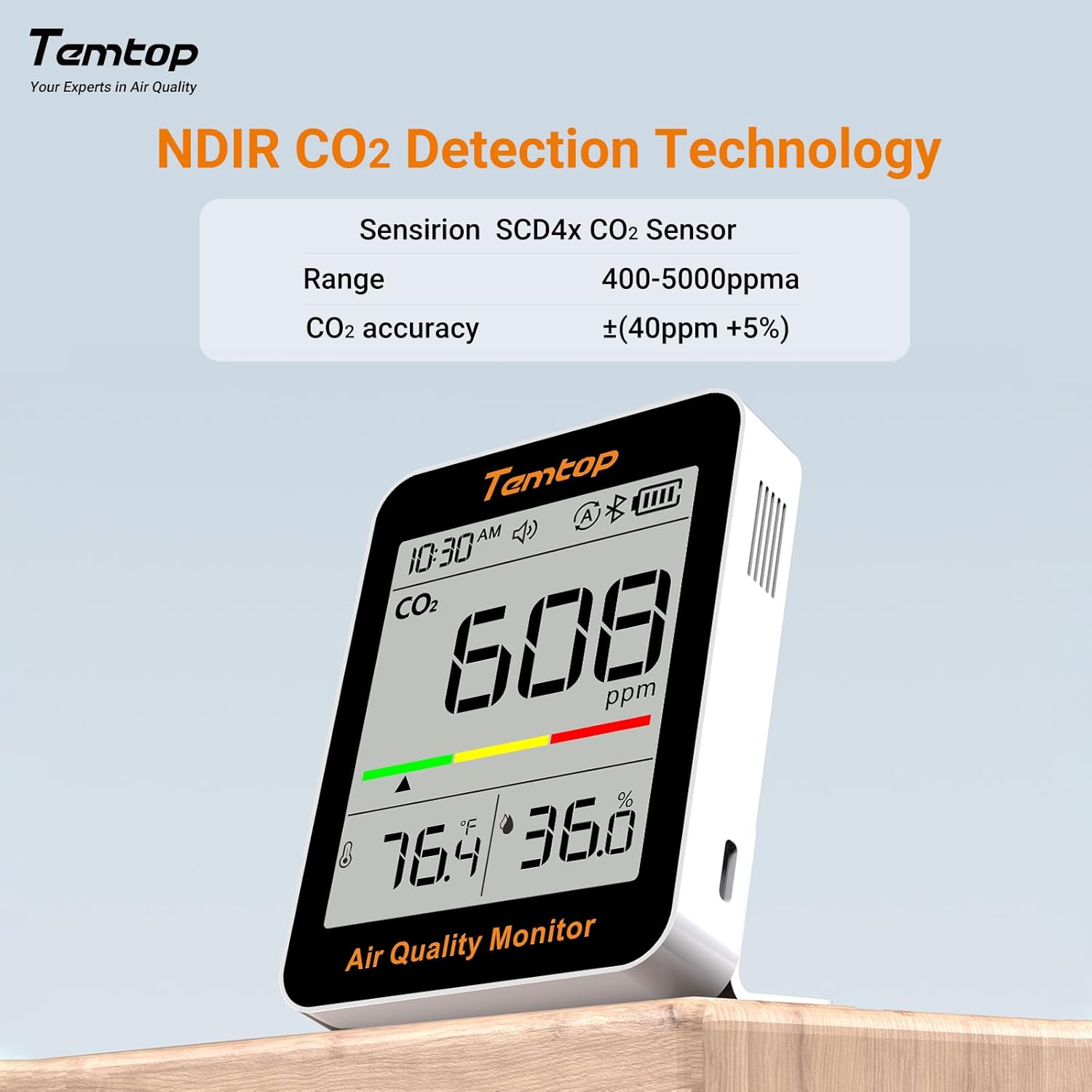
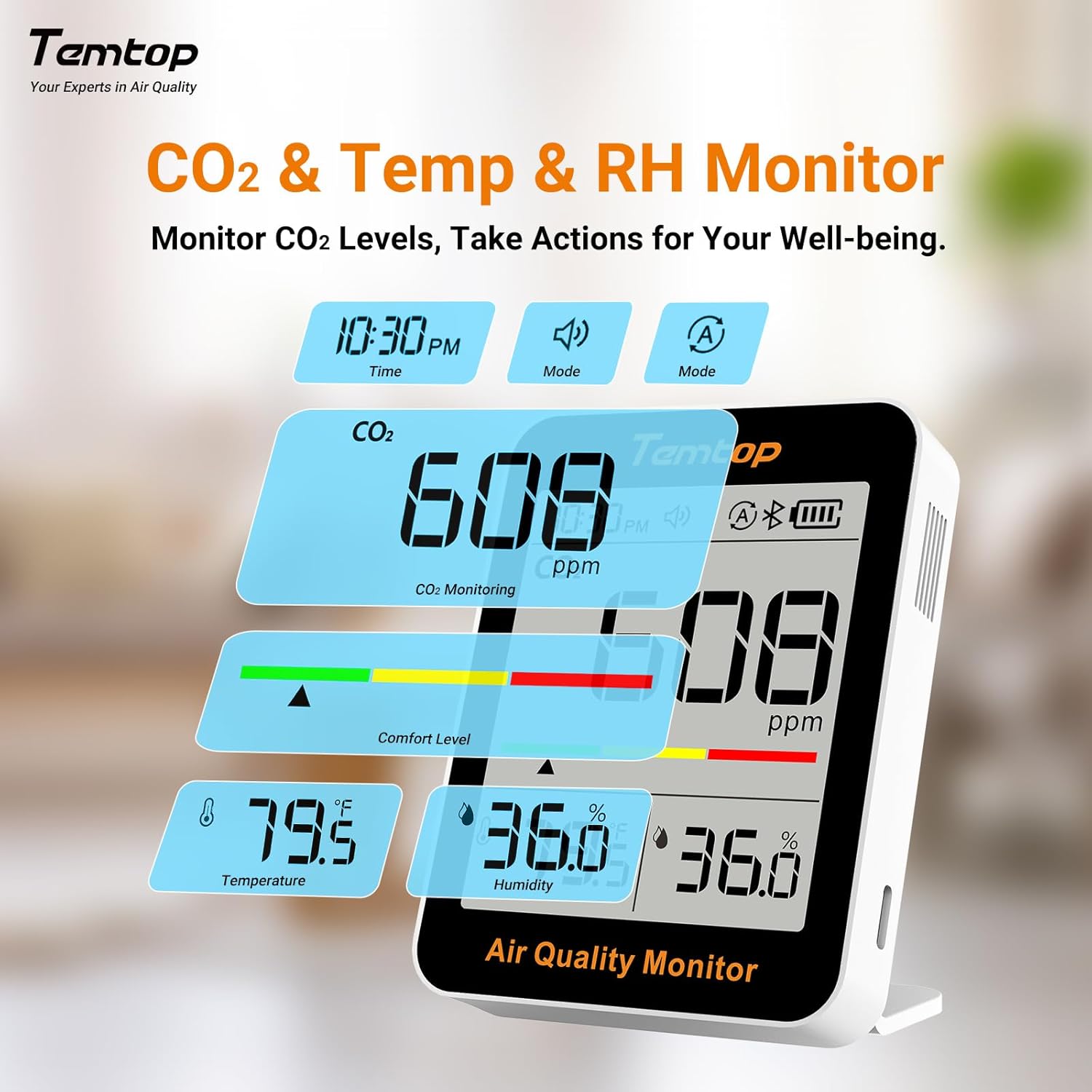

Shortcomings the official documents state: 1) The 3.3-inch segment LCD has no backlight, so at night or in a dim corner you have to lean in. 2) CO2 and temperature and humidity only, no particulates, so if your motivation is smoke or haze this unit cannot help; fume handling is a different problem (the fume absorber piece). 3) Bluetooth only, so leaving the room ends the data, and the official manual itself says to keep the device within Bluetooth range while using the app. 4) The accuracy window stops at 2500 ppm; the range keeps counting above that but the promise does not. 5) "High-precision Sensirion sensor" is a phrase on the listing; the sensor model and the system accuracy are two different things, since Sensirion's own SCD40 is specified at ±(50 ppm + 5%) between 400 and 2000 ppm before enclosure, airflow and calibration policy are added.
Temtop M10+: which revision of the breakpoints is that AQI using
The M10+ is a six-in-one: CO2, PM2.5, TVOC, temperature, humidity, plus an AQI computed from PM2.5. E-ink display, 2200 mAh, rated up to 60 days. Its CO2 accuracy matches the C1+, ±(40 ppm + 5%) over 400–2500 ppm.
The product page is Temtop M10+.


Shortcomings the official documents state: 1) The AQI is a three-band index derived from PM2.5, cut at 12.0 µg/m³ rather than EPA's current 9.0, with six categories compressed into three. 2) The manual instructs you to keep the room sealed for 10 minutes for more accurate results, which means the live number on screen is not the number the accuracy claim applies to. 3) While charging, the temperature reading carries a ±0.5 °C error and needs about 10 minutes after a full charge to recover; this is in a manual footnote. 4) The TVOC row gives only a 0–5 mg/m³ range, with no accuracy and no statement of which VOC equivalent it is. 5) The Bluetooth version has no remote access; Wi-Fi is a different model.
Qingping Air Monitor Gen 2: the price of a big screen and Wi-Fi is that cable
This one carries the fullest feature list of the five: temperature, humidity, CO2 (400–9999 ppm), PM2.5, PM10, eTVOC and noise, a 4-inch 254 PPI IPS touchscreen, 2.4/5 GHz Wi-Fi, 30 days of exportable history, and a replaceable PM sensor module.
The product page is Qingping Air Monitor Gen 2.


Shortcomings the official documents state: 1) The listing's own important notes say to keep it on USB power for daily use, with about 3 hours of runtime after a full charge, so "portable" does not hold. 2) The same notes state it does not measure formaldehyde, and the eTVOC figure is an estimated VOC index (0–500) or a converted concentration, not a measurement of one specific gas. 3) CO2 is given as a 400–9999 ppm range only, with neither accuracy nor sampling interval published. 4) The PM sensor is replaceable, the CO2 sensor is not. 5) The noise figure is a 36–95 dB range with no accuracy stated.
Pick by the question, not by the feature list
Translate the specs into situations and only five routes remain:
| The question you need answered | The unit | Why |
|---|---|---|
| Is this room ventilated, and I want a trustworthy CO2 baseline | Aranet4 HOME | Tightest formula, 1-minute sampling available, every figure carries its conditions |
| Bedroom sleep environment, plus noise and light | Airthings Wave Enhance | Noise and light are the extra channel, 17 months on batteries |
| Tight budget, just need one CO2 number to watch a trend | Temtop C1+ | Three parameters, 70 days, lowest price |
| Want particulates too, and accept AQI as a trend only | Temtop M10+ | CO2 plus PM2.5 plus TVOC on e-ink, 60 days |
| Remote access, history export, a big screen | Qingping Air Monitor Gen 2 | Dual-band Wi-Fi and 30-day export, paid for with a cable |
If I had to compress it to one sentence: use the accuracy window as the first filter, the sampling interval as the second, and put the screen and the app last. The first two decide whether the number is usable; the last two only decide whether you enjoy using it.
What this article does not cover
I did not buy these five units and run them side by side, so there is no "how far apart were five units in the same room" data here; that needs at least two units in hand at once. Every accuracy, range, window and interval comes from official documents fetched on 2026-11-17, and where the manufacturer publishes nothing I write "not published" rather than deriving it.
On pricing: this machine's egress IP geolocates to China, so Amazon returns prices in CNY, which is a different basis from US list pricing. The body therefore cites only manufacturer list prices (Airthings Wave Enhance at $159.99 as of writing); treat Amazon-side prices as whatever the checkout page says.
On health: this article is about instrument specifications only. The relationship between CO2 and ventilation is one topic; individual health advice is another, and the latter belongs to a professional. One safety note as well: these devices measure carbon dioxide, not carbon monoxide. Aranet states explicitly that it is not a medical end-tidal CO2 monitor, and none of them substitutes for a carbon monoxide alarm.
FAQ
Q: Is 900 ppm in my room a problem?
None of the official documents use the word "problem"; they give bands. Aranet's reference is 400–800 ppm well ventilated, 800–1200 moderately elevated, above 1200 possibly insufficient. Read the error band alongside it: 900 ppm is roughly ±57 ppm on an Aranet4, ±85 ppm on a Temtop, ±95 ppm on a Wave Enhance. The difference between 900 and 1000 is not resolvable on any of these units.
Q: Why do the readings look off for the first few days?
Because auto-baseline calibration has to learn. Airthings updates its baseline weekly; Aranet uses the ABC algorithm; both depend on the device seeing fresh air. If you unbox it into a sealed room, it learns that room as the reference and every later reading inherits the offset.
Q: Can one unit measure CO2 and PM2.5 equally well?
It can measure both, but check whether the two accuracy figures are stated separately. The M10+ gives CO2 at ±(40 ppm + 5%) over 400–2500 ppm and PM2.5 at ±10 µg/m³ (0–100) and ±10% (100–500); those are two independent sets of conditions and neither substitutes for the other. Qingping publishes ranges without accuracy at all, so ask before buying.
Q: Can these double as a carbon monoxide alarm?
No. Aranet's FAQ states plainly that it measures carbon dioxide, not carbon monoxide, and that a dedicated CO alarm is required. They are also not medical devices and must not be used for any diagnostic purpose.
👉 Join Xiaomi MiMo Platform: Leading AI model platform with cost-effective inference
👉 Join Aliyun AI: Top AI products with exclusive coupons for business innovation
📌 This article was AI-assisted generated and human-reviewed | TechPassive — An AI-driven content testing site focused on real tool reviews
🔗 Recommended Tools
These are carefully selected tools. Using our affiliate links supports us to keep producing quality content:
As an Amazon Associate, I earn from qualifying purchases at no extra cost to you.