Desktop CNC Routers: Z Travel, Pass Height and Cut Depth
The 4040-PRO MAX spec sheet lists a working area of 400 × 400 × 78 mm, and then, one line later, a "100 mm Z-pass height". Same page, same Z axis, two numbers, and the larger one is not travel.
The brand spells it out in the product Q&A: the 100 mm material pass height "describes clearance, not cutting depth or Z-axis travel". That sentence is an admission that three different quantities were sharing one word — and most listings hand you one of the three and let you guess the rest.
Disclosure: the product links below are affiliate links and this site may earn a commission on purchases made through them. That does not affect how the specifications are read here. I did not cut anything on these machines. There is no sawdust, no noise measurement and no surface-finish test in this article; every number comes from official product pages, official comparison tables and the Amazon listings, and anything I derived from them is marked as arithmetic.
⏳ TL;DR
| Machine | Official working area | Official pass height | Mounts in the box | The cell people misread |
|---|---|---|---|---|
| Genmitsu 3018-PROVer V2 | 290 × 180 × 40 mm | not published | ~42 mm | 40 mm is travel; clamps and bit length come out of it |
| FoxAlien Masuter Pro | 400 × 400 × 60 mm | not published | 52 mm + 65 mm | 12V/5A feeds motion, not the 775 spindle |
| Genmitsu 4040-PRO | 400 × 400 × 78 mm | not published | 42 mm + 52 mm | 75W ships on the frame, 710W ships in the bundle |
| Genmitsu 4040-PRO MAX | 400 × 400 × 78 mm | 100 mm | 65 mm | pass height exceeds travel by 22 mm |
| Genmitsu PROVerXL 4030S | 400 × 300 × 120 mm | 130 mm | 65 mm | 120 and 130 are two different quantities |
In three lines:
- The third number in the working-area cell is travel. "How thick a board fits" is pass height. "How deep one pass cuts" is depth of cut. None converts into the others, and official pages mix them freely.
- Pass height can exceed travel: 100 mm against 78 mm on the 4040-PRO MAX, 130 mm against 120 mm on the PROVerXL 4030S. The extra distance is how far the spindle can be raised, not how far the bit can descend.
- The 710W and 75W figures on one page are two different parts: the 710W trimmer runs off mains, while the 24V/4A supply (96 W) feeds steppers and the control board.
One machine, one page, four working areas
Start with the worst case. The Amazon listing for the 4040-PRO carries four different area figures on a single ASIN:
- bullet one: 15.7" × 15.7" × 3.1"
- an A+ module: 435 × 400 × 80 mm (17.13 × 15.75 × 3.15 in)
- a comparison carousel title: 17.1" × 15.7" × 3.1"
- the technical table: "XY Axis Effective Working Area 15.7 × 15.7 inch" and "Z Axis Effective Working Range 3.1 inch"
That is 35 mm of disagreement on X, and 1.3 mm on Z between 80 mm and 3.1 inches (78.7 mm). None of the four answers the question buyers actually have, which is how thick a board fits.
The brand's own spec table lists 400 × 400 × 78 mm, matching the Amazon technical table. So the 435 × 400 × 80 figure belongs to the marketing module only — not a fabrication, just the same machine described by different people in different modules, with nothing telling you which one to trust.
Four names for the third number
Lay the official vocabulary out and each term maps to one physical quantity:
- Travel: how far the Z axis moves between its lowest and highest points. This is what the third cell of a working-area figure actually reports.
- Pass height / clearance: the vertical gap between the table and the lowest point of the spindle (or bit tip) at its highest position. Stock, spoilboard, clamps and bit protrusion all have to fit inside it.
- Depth of cut: how much material one pass removes. It depends on spindle power, rigidity, feed rate and bit diameter — a process parameter, not a machine parameter.
- Stock thickness: the workpiece itself. It appears in no spec table, yet it decides whether the job is possible.
The official mixing is real. The 3018-PRO product page says "The effective engraving depth is 1.8 inches" (about 45.7 mm), and its working-area cell also reads 1.8 inches (45 mm) — a word with "depth" in it, used to describe travel. The 4040-PRO MAX takes the other route: 78 mm in the area cell, a separate 100 mm pass-height line, and a Q&A note that the 100 mm is clearance.
The only operational takeaway: when you see the third number, ask whether it is travel or clearance.
Pass height beats travel on three official machines
This is not a copywriting slip; it is a shape shared by three machines:
| Machine | Area cell, Z | Official pass height | Difference |
|---|---|---|---|
| Genmitsu 4040-PRO MAX | 78 mm | 100 mm | +22 mm |
| Genmitsu PROVerXL 4030S | 120 mm | 130 mm | +10 mm |
| Genmitsu 3018 REX | 60 mm | 91 mm | +31 mm |
Why can clearance exceed travel? Because the spindle can be mounted high or low on its carriage. Slide the mount up a notch and the bit tip sits further from the table: clearance grows, travel does not, and the deepest cut the machine can reach does not change either.
The reverse also happens — mount the spindle low and clearance shrinks below travel. There is no fixed relationship between the two, and the number a listing quotes depends on which mounting position the photos were taken in.
The 71 mm implied by "40% higher than the PRO"
The official 4040-PRO MAX copy reads "a massive 100mm Z-pass height (40% higher than the PRO)". Work backwards: 100 ÷ 1.4 ≈ 71.4 mm.
The 4040-PRO spec table, meanwhile, lists its working area as 400 × 400 × 78 mm.
That is a 6.6 mm gap. Two explanations fit: the 40% is rounded (71 and 78 could be pre-rounding values), or the 78 mm cell is not pass height at all. I cannot settle which, because no official page states both the PRO's travel and its clearance.
Referring to a sibling model as a benchmark is common in spec sheets, but when the benchmark itself is undefined, the number you extract is an order of magnitude at best. If pass height decides your purchase, buy the machine whose page actually prints pass height.
75W and 710W: two parts on one page
The 4040-PRO listing shows two spindle power figures, and readers routinely assume one is a typo:
- the bullet claims "robust 710W power output" and "6500-30000 RPM"
- the technical table says "Spindle Motor = 75W"
Both are correct, for different objects. The brand's spec sheet lists Spindle Power 75W (Upgradable), Max RPM 9000, Spindle Mount 42mm & 52mm — that is the small spindle on the frame. The 710W, 6500–30000 RPM, 65 mm body is a trimmer router added by the bundle.
The difference is not only wattage. The frame clamps at 42/52 mm; the trimmer needs 65 mm, so fitting it means changing the Z-axis module. The brand sells that module separately, titled "XZ-Axis Module of 4040-PRO ... for Carving Metal Wood Acrylic" — a hardware gate on the 75W-to-710W path that never appears in the main spec table.
Now look at the supply line. Both the 4040-PRO and the 4040-PRO MAX list 24V/4A, which is 96 W; a 710W spindle cannot run on 96 W. The PROVerXL 4030S page spells the split out: power supply "AC 110/230V, 48V 7A & 24V 8A", spindle "710W AC Spindle". Two supplies, two parts; the 24V rail feeds steppers and the board.
So when a listing says "power supply 12V/5A" or "24V/4A", do not convert that cell into cutting capability. It belongs to a different system than the spindle.
The collet line: what bit shanks fit on day one
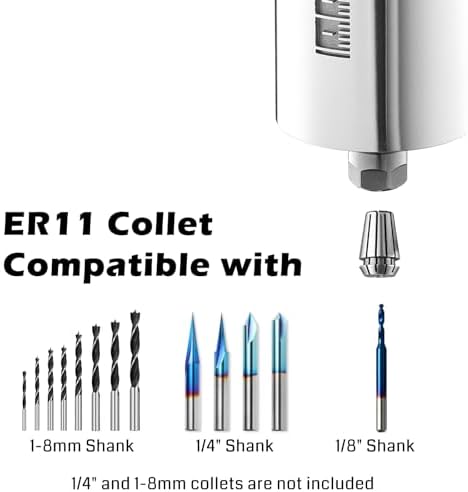
The 4040-PRO and 4040-PRO MAX box lists include exactly two collets: ER11 4 mm and ER11 3.175 mm. The bullet, meanwhile, says "Compatible with shank diameters ranging from 1-8mm to 1/4", but please note that 1/4" and 1-8mm collets are not in[cluded]".
In plain terms: out of the box you can hold 3.175 mm and 4 mm shanks. Anything at 6 mm or 1/4 inch (6.35 mm) needs a collet you buy separately.
Why shank diameter matters shows up in two calculations.
Surface speed v = π × D × n ÷ 60. At 20000 RPM, a 3.175 mm bit runs at π × 0.003175 × 20000 ÷ 60 ≈ 3.32 m/s; a 6 mm bit runs at 6.28 m/s, nearly double (arithmetic). Surface speed maps to edge temperature, so doubling bit diameter is not "cutting faster", it is "running hotter".
Chip load = feed rate ÷ (RPM × flutes). Taking two flutes and official feed figures:
- 3018 REX: 3000 mm/min ÷ (10000 RPM × 2) ≈ 0.15 mm per tooth
- 4040-PRO: 2000 mm/min ÷ (9000 RPM × 2) ≈ 0.11 mm per tooth
- PROVerXL 4030S: 5000 mm/min ÷ (30000 RPM × 2) ≈ 0.08 mm per tooth
That is a 1.8× spread in chip load (arithmetic). Higher RPM does not mean faster cutting: the 4030S spins three times faster than the 3018 REX and takes under 60% of the chip per tooth. This is the number that decides whether you hear a steady hiss or a scream plus scorched edges.
A 400 × 400 table on 12V/5A: power is not the bottleneck
FoxAlien's official specs for the Masuter Pro: working area 400 × 400 × 60 mm, 775 spindle at 10000 RPM, input 12V/5A, steppers rated 1.3 A, 12 V, 0.25 Nm.
12 V × 5 A = 60 W moving a 400 × 400 mm table. The 4040-PRO runs 24V/4A (96 W) with a 75W spindle and weighs 20.65 kg; the 4040-PRO MAX also runs 24V/4A at 24.6 kg.
Set the three side by side and a pattern appears: table size scales with structure weight, not with supply wattage. At the 400 × 400 class, 60 W and 96 W both move the axes fine; what decides whether you can cut is frame rigidity, rail type and spindle — not the voltage and current cell.
FoxAlien is specific about structure: "The Z-axis uses linear rails instead of the optical axis", with T8 lead screws on X/Y. That is why it feels steadier than its price class, and it is also its limit — X/Y are not ball screws.
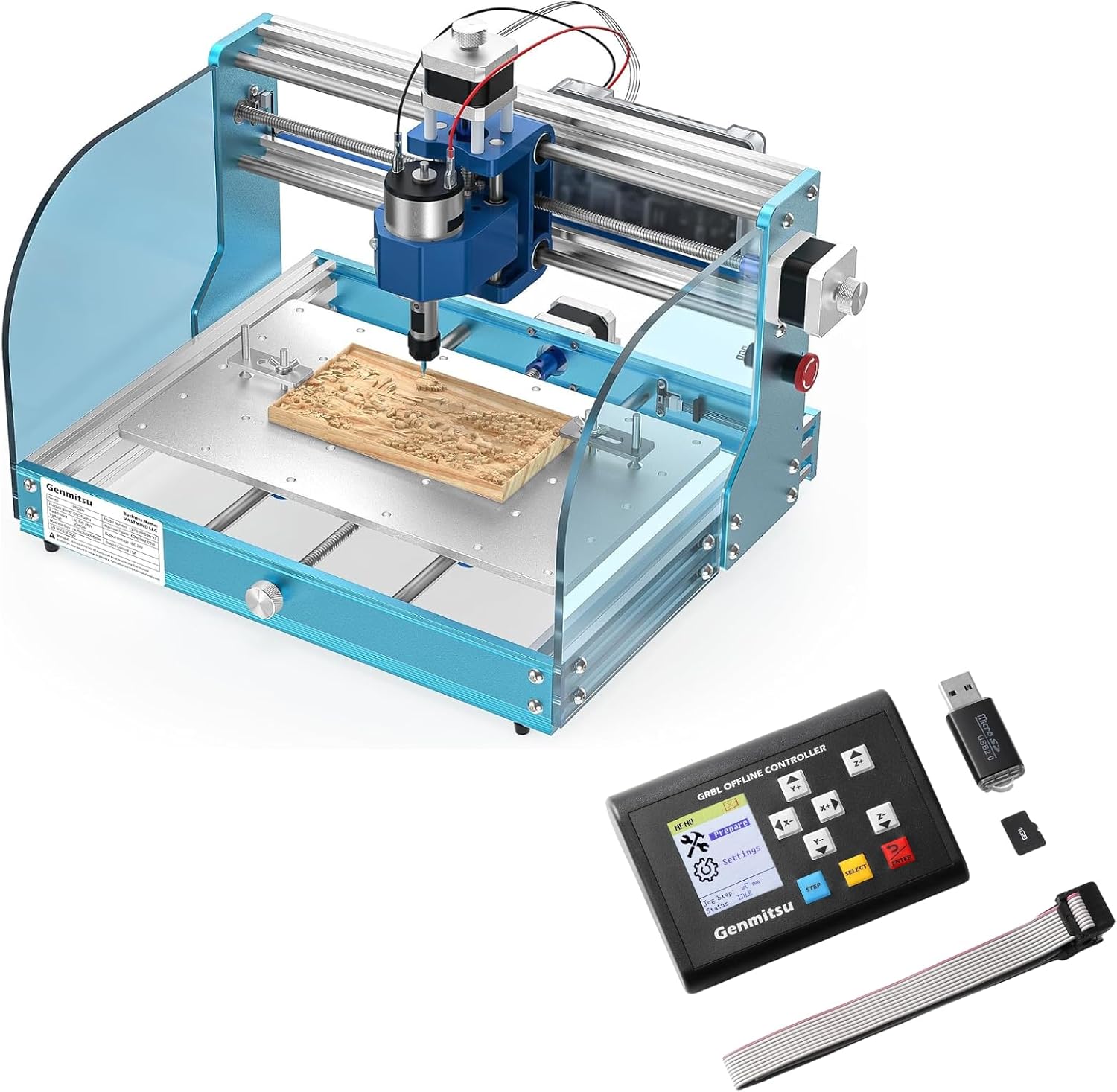
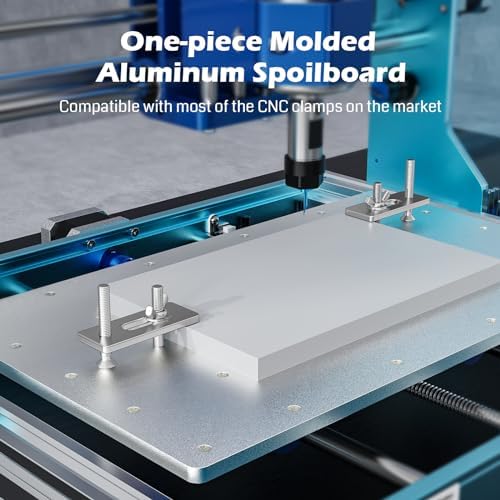
Genmitsu 3018-PROVer V2: 40 mm of Z and a blank Max Speed cell
The official comparison table gives it 290 × 180 × 40 mm (11.4" × 7.1" × 1.6"), a 32-bit board, TB67S109 drivers, linear shafts plus lead screws, 24V/4A, and 20–35 minutes of assembly.
Forty millimetres is the smallest third number in this article. Loading stock works like this: stock + spoilboard + clamp height + bit protrusion must all fit inside 40 mm. A 20 mm beech blank plus a 10 mm clamp leaves 10 mm for bit protrusion and safe clearance — too little protrusion and the collet nut hits the clamp, too much and rigidity drops.
Its weak points sit in the same table, just not in the headline:
- the X-Z assembly material is Plastic, where the 4040-PRO is all aluminium
- 4th-axis support is marked ×, while the 3018 REX in the same table is √
- the Max Speed cell is "—": the brand publishes no figure, while the 3018-PRO lists 1200 mm/min and the 3018 REX lists 3000 mm/min
In other words, on the brand's own comparison table, how fast this machine runs is blank. Buyers have to ask support or read third-party tests.
Product page: Genmitsu 3018-PROVer V2 (B0CW63WZ1Z)





FoxAlien Masuter Pro: 60 mm and two mounts
Official specs: active working area 15.75" × 15.75" × 2.36" (400 × 400 × 60 mm), 775 spindle at 10000 RPM, 12V/5A, steppers at 1.3 A and 0.25 Nm, 10–15 minutes of assembly.
What deserves attention is the mount set: 52 mm and 65 mm both ship. The brand states the 52 mm clamp takes the 60W spindle, the 300W spindle and the laser modules, while the 65 mm clamp is for "customized upgrade" — a 65 mm Makita router or a 1.5 kW spindle. The 69 mm clamp is sold separately.
That is more useful than any wattage figure, because it defines the upgrade path as "change the spindle" and states the physical precondition. The 4040-PRO's 42/52 mm pair closes that path: a 65 mm trimmer requires a new Z-axis module first.
The shortcomings are equally concrete: 60 mm of Z; no published running accuracy (there is no ±mm row at all) and no maximum feed rate; X/Y are T8 lead screws on V wheels rather than ball screws and linear guides.
Product page: FoxAlien Masuter Pro (B0B4NKR8PR)


Genmitsu 4040-PRO: 78 mm, 75W, 20.65 kg
Official specs: 400 × 400 × 78 mm, max speed 2000 mm/min, max RPM 9000, running accuracy ±0.1 mm, lead-screw drive, 75W spindle (upgradable), 42/52 mm mounts, 24V/4A, 20.65 kg, 673 × 663 × 336 mm, NEMA17 steppers, TB67S109, 32-bit, GRBL.
A sibling sits right next to it. The 4040-RENO lists 400 × 400 × 76 mm (2 mm less), belt drive on X/Y, 9000 RPM, 75W, 14.8 kg and under 20 minutes of assembly. Same "4040" badge, one on lead screws and one on belts, 5.85 kg apart.
This machine's weakness is attribution rather than any single number: the frame is 75W, yet the bundle adds a 710W trimmer, and the two spec sets live in different modules of the same page. Before ordering, confirm whether you are getting "frame + 75W" or "frame + 710W bundle", because the latter brings a different Z module and mount.
Product page: Genmitsu 4040-PRO (B0CZRZQDN8)


Genmitsu 4040-PRO MAX: same 78 mm, 22 mm more clearance
Official specs: 400 × 400 × 78 mm, 100 mm pass height, 2000 mm/min, 6500–30000 RPM, ±0.1 mm, 710W digital-display trimmer, 65 mm mount, 24V/4A, 24.6 kg, 660 × 666 × 390 mm, TB67S109, 32-bit, GRBL, under 30 minutes of assembly.
Against the 4040-PRO, the working-area cell is identical (400 × 400 × 78). Every difference lives elsewhere: 75W to 710W, 9000 to 30000 RPM, 42/52 mm to a single 65 mm mount, 3.95 kg heavier, and 22 mm more clearance.
Three shortcomings are printed on the official page but not in the hero copy:
- Z travel did not change: 100 mm of clearance is not 100 mm of cutting depth, and depth is still bounded by 78 mm of travel plus rigidity
- max feed is still 2000 mm/min, same as the cheaper PRO, unchanged by the bigger spindle
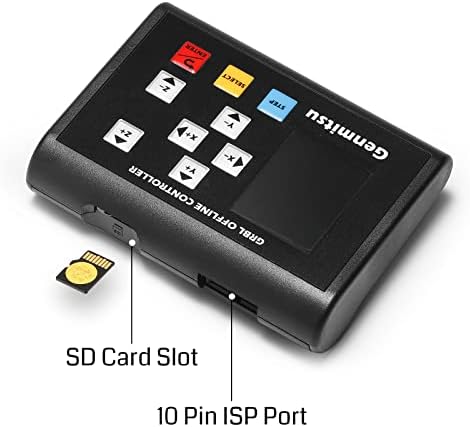
- the offline controller is sold separately, and the X-axis extension kit is not supported ("For axis extensions, use the compatible Y-axis extension kit; the X-axis extension kit is not supported")
Product page: Genmitsu 4040-PRO MAX (B0H8DK6GYP)


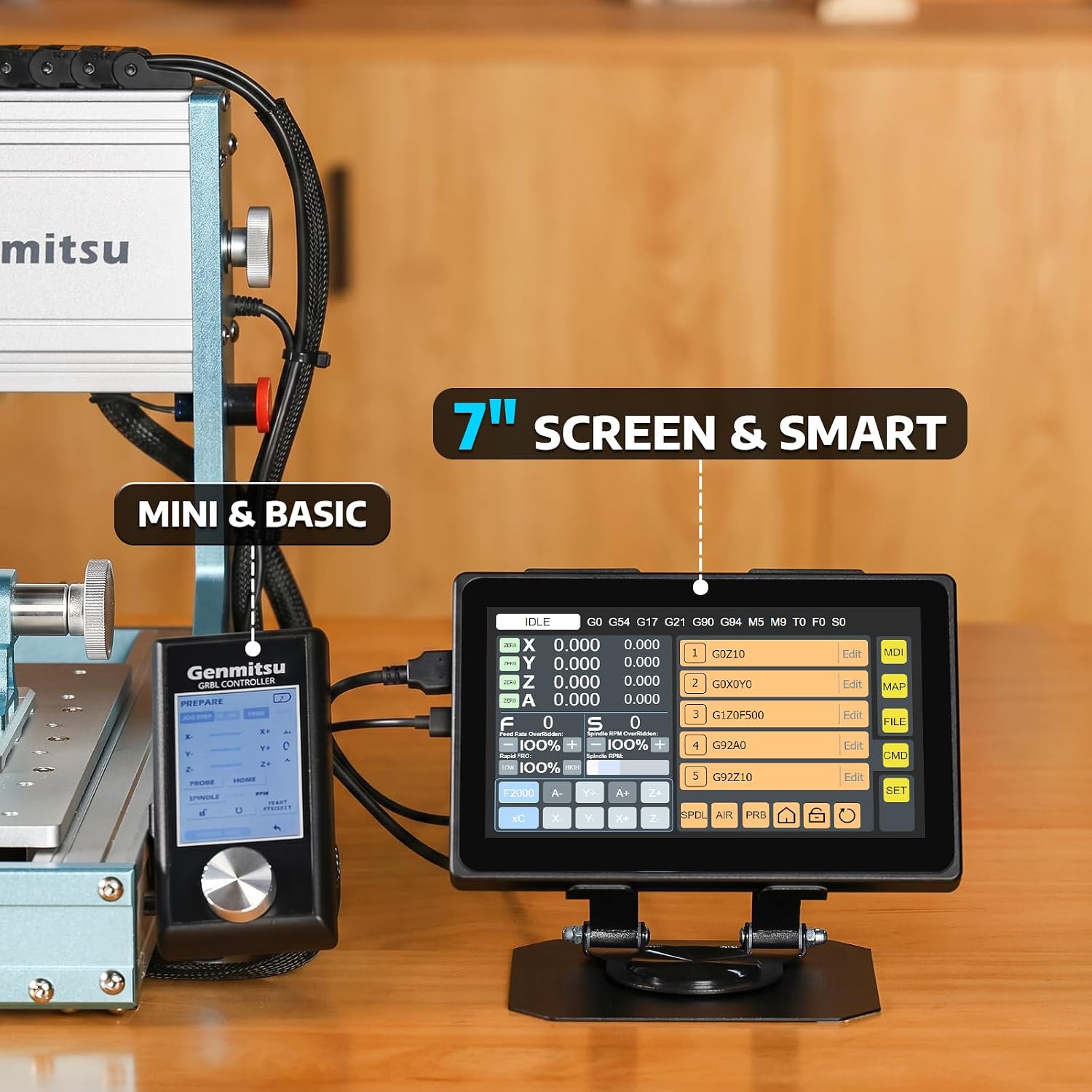


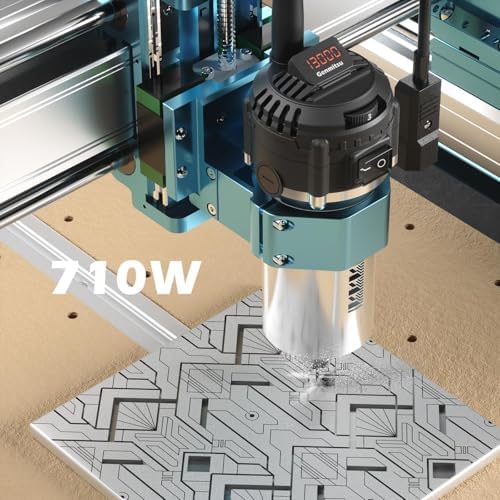


Genmitsu PROVerXL 4030S: 120 mm plus 130 mm of clearance
Official specs: 400 × 300 × 120 mm, 130 mm pass height, 710W AC spindle at 6500–30000 RPM, running accuracy ±0.05 mm, max feed 5000 mm/min, 32-bit MCU, NEMA23 57 mm open-loop steppers, Z on lead screw plus linear guide, X/Y on lead screws and V wheels, supply AC 110/230V with 48V/7A and 24V/8A rails, noise under 65 dB, 20–30 minutes of assembly.
It is the only machine here that publishes both travel (120 mm) and clearance (130 mm), and the only one printing ±0.05 mm in its spec table.
The three siblings differ by one letter, which makes the table worth reading closely:
| Model | Working area | Max feed | Accuracy | Drive | Spindle |
|---|---|---|---|---|---|
| PROVerXL 4030 (V1) | 400 × 300 × 110 mm | 2000 mm/min | ≤ ±0.10 mm | lead screw | 300W DC, 12000 RPM |
| PROVerXL 4030 V2 | 400 × 300 × 110 mm | 5000 mm/min | circular ≤ ±0.05, rectangle ≤ ±0.02 | 1204 ball screw | 400W DC, 10000 RPM |
| PROVerXL 4030S | 400 × 300 × 120 mm | 5000 mm/min | ±0.05 mm | Z lead screw + linear guide, X/Y lead screw + V wheel | 710W AC, 6500–30000 RPM |
The V2 splits accuracy into circular and rectangular values — the most informative version of that word in this article: the same "accuracy" behaves differently on an arc and on a right angle.
Weak points: X/Y are still V wheels on lead screws rather than ball screws (the V2 carries 1204 ball screws); steppers are open-loop NEMA23 57 mm (the V2 is closed-loop 76 mm); and the machine measures 693 × 658 × 590 mm, so measure bench depth and headroom first.
Product page: Genmitsu PROVerXL 4030S (B0GHQW4WMC)




The order of the four gates
I actually went through these in order when shortlisting, and the order matters — fail an earlier gate and the later numbers are decoration:
The four numbers live in four different places on a listing: clearance hides in A+ content or Q&A, mounts in the box list, drive type in the comparison table, accuracy in the technical table. That scatter is why these machines get bought wrong.
FAQ
Q: The working area says 400 × 400 × 78 — can I cut a 78 mm board?
No. 78 mm is Z travel, not cutting thickness, and not clearance. Fitting a 78 mm blank means stock, spoilboard, clamps and bit protrusion all inside the clearance (100 mm on the 4040-PRO MAX), and then the machine still has to be able to cut it. The brand's own wording is that pass height describes clearance, not cutting depth or Z-axis travel.
Q: The same page says 710W and 75W. Which is real?
Both, on two different parts. The frame carries a 75W spindle at 9000 RPM with 42/52 mm mounts; the bundle adds a 710W trimmer at 6500–30000 RPM with a 65 mm body. Fitting that trimmer to the frame requires a different Z module.
Q: For aluminium, which number matters?
Structure first, wattage second. Linear guides and ball screws, total machine weight and mount diameter govern vibration; power governs whether feed can be sustained. Brands describe metal capability as soft metals or soft aluminium, and 3018-class accuracy of ±0.1 mm means leaving stock for a finishing pass.
Q: Is 40 mm of Z enough?
Do the arithmetic. A 20 mm blank plus a 10 mm clamp leaves 10 mm for bit protrusion and safe height — fine for shallow reliefs and cutting through thin sheet, tight for deep pockets or 3D carving.
Q: The collet says 1–8 mm compatible — can I use a 6 mm bit?
Compatible is not included. The 4040-PRO and 4040-PRO MAX box lists contain only ER11 4 mm and ER11 3.175 mm, so 6 mm and 1/4 inch shanks need a separate collet. Check the collet size and the spindle's clamping range, not the word "compatible".
Q: Which of the five should I buy?
Walk the four gates. If Z is 40–60 mm and the work is thin sheet or PCBs, the 3018-PROVer V2 and Masuter Pro cover it; if you need 78 mm of travel and a larger table, the 4040-PRO and 4040-PRO MAX are the next tier; only when you need 120 mm of travel, 5000 mm/min and ±0.05 mm does the PROVerXL 4030S earn its price.
Boundaries and disclosure
- No machine was run for this article. There is no noise, chip or surface-finish data; none of the five machines is on this desk.
- All specifications come from official product pages, official comparison tables and Amazon listings fetched on 2026-11-18. Derived figures (surface speed, chip load, power ratios, clearance deltas) are labelled as arithmetic in the text.
- The 4040-PRO page carries both 435 × 400 × 80 mm and 400 × 400 × 78 mm. I used the official spec table and technical table (the latter), listed the former as-is, and did not pick a winner on the brand's behalf.
- The 71 mm implied by "40% higher than the PRO" is an order-of-magnitude figure only; no official page states the PRO's clearance, so it is not treated as fact here.
- Prices are omitted deliberately: the pages served to this machine showed region-converted prices, not what a reader will be charged. Check the listing and checkout for the real number.
- The 3018 REX clearance (91 mm) and the 3018-PRO feed rate (1200 mm/min) come from the brand's comparison table and product page; they are cited as reference points and carry no affiliate link.
👉 Join Xiaomi MiMo Platform: Leading AI model platform with cost-effective inference
👉 Join Aliyun AI: Top AI products with exclusive coupons for business innovation
📌 This article was AI-assisted generated and human-reviewed | TechPassive — An AI-driven content testing site focused on real tool reviews
🔗 Recommended Tools
These are carefully selected tools. Using our affiliate links supports us to keep producing quality content:
As an Amazon Associate, I earn from qualifying purchases at no extra cost to you.