Open-Back Headphones 2026: Ohms, dB/mW, Amps
An open-back studio headphone listing usually gives you three lines of specification: impedance, sensitivity, frequency response. The second line is the one that decides whether your interface can drive them, and it is also the line every manufacturer writes differently. Sennheiser prints "106 dB SPL (1kHz/1Vrms)". AKG prints "104 dB SPL/V @ 1 kHz". Audio-Technica prints "99 dB" and stops. Philips prints no reference at all.
So the same question gets three different answers.
Disclosure: the product links below are affiliate links and this site may earn a commission on purchases made through them, which does not affect the spec analysis. Nothing here is a listening test - there is no pair of these headphones on this desk, and every figure comes from an official spec sheet plus the arithmetic shown. Some readers see 250 ohms and assume hard to drive. Others see 106 dB next to 96 dB and assume the first is 10 dB easier. Both readings can be wrong: the first treats impedance as difficulty, the second subtracts two numbers measured against different references.
I actually read six official spec sheets line by line, and I did not listen to any of these. There is no pair of these headphones on this desk and no rig to measure sound pressure level, so everything below is answerable only to the official spec sheets. Six of them, copied into one table, converted with two formulas into "how many milliwatts and how many volts does 110 dB take", then checked against the headphone output an entry-level interface actually publishes. Where a manufacturer publishes nothing, the text says so instead of filling the gap.
⏳ TL;DR
- Impedance does not set difficulty; sensitivity does. The AKG K240 Studio (55 ohms) needs 72.4 mW to reach 110 dB. The beyerdynamic DT 990 PRO (250 ohms) needs 25.1 mW.
- Sensitivity comes in three formats: dB/mW, dB SPL/V, and no unit at all. The HD 599 is officially 106 dB SPL (1kHz/1Vrms), which is 93.0 dB/mW. Retailer pages copy that as "106 dB/mW" and are 13 dB off.
- Against Focusrite's official headphone figures (10 dBu into 300 ohms, 22 mW into 300 ohms), an entry-level interface cannot reach 110 dB on the HD 600. It lands about 5.2 dB short, near 105 dB.
- The open-versus-closed decision is about leakage, not sound. beyerdynamic's own FAQ says open-back models bleed into sensitive microphones and recommends closed-back for mic work.
- If you want one default: buy in the 50-ohm class (HD 599). Want a replaceable cable? HD 599, K240 or M50x. Only go HD 600 once you know your output can supply 4.5 V.
| Model | Impedance | Official sensitivity (verbatim) | As dB/mW | For 110 dB |
|---|---|---|---|---|
| Sennheiser HD 599 | 50 Ω | 106 dB SPL (1kHz/1Vrms) | 93.0 | 50.2 mW / 1.58 V |
| Sennheiser HD 600 | 300 Ω | 97 dB (1 V) | 91.8 | 66.5 mW / 4.47 V |
| beyerdynamic DT 990 PRO | 250 Ω | 96 dB (no reference given) | 96.0 or 90.0 | 25.1 mW / 2.51 V |
| Philips SHP9500 | 32 Ω | 101 dB (no reference given) | 101.0 | 7.9 mW / 0.50 V |
| AKG K240 Studio | 55 Ω | 104 dB SPL/V @ 1 kHz | 91.4 | 72.4 mW / 2.00 V |
| Audio-Technica ATH-M50x | 38 Ω | 99 dB (no reference given) | 99.0 | 12.6 mW / 0.69 V |
Impedance and sensitivity answer two different questions
Impedance answers "how much voltage does this power require". Sensitivity answers "how much power does this sound pressure require". Keep them apart and the numbers line up:
- Power needed:
P = 10^((110 - S) / 10)in milliwatts, where S is sensitivity converted to dB/mW. - Voltage needed:
V = √(P / 1000 × R)in volts rms, where R is rated impedance.
The DT 990 PRO prints 250 ohms, which reads as intimidating. The K240 Studio prints 55 ohms, which reads as easy. By the official numbers the second one needs 72.4 mW at 110 dB and the first needs 25.1 mW. The 4.5x higher impedance is the easier load, because its sensitivity is 4.6 dB higher and every 3 dB is a doubling of power.
The same table holds the opposite case. The SHP9500 sits at 32 ohms with 101 dB and becomes the cheapest load of the six at 0.50 V. The HD 600 sits at 300 ohms and 91.8 dB/mW and needs 4.47 V, which is 8.9 times the SHP9500. "High impedance is hard to drive" only survives while sensitivity stays roughly equal.
About the 110 dB target: it comes from 85 dB average plus 25 dB of transient headroom. That is this article's own convention, not a manufacturer standard. Move the target to 105 or 115 dB and every figure shifts together while the ranking stays put.
Manufacturers print sensitivity three different ways, and the gap reaches 13 dB
Put the six official sheets side by side and they are not even in the same coordinate system:
| Model | What the sheet says | Reference | As dB/mW |
|---|---|---|---|
| HD 599 | 106 dB SPL (1kHz/1Vrms) | 1 V input | 93.0 |
| HD 600 | 97 dB (1 V) | 1 V input | 91.8 |
| K240 Studio | 104 dB SPL/V @ 1 kHz | 1 V input | 91.4 |
| DT 990 PRO | 96 dB | not stated | 96.0 or 90.0 |
| SHP9500 | 101 dB | not stated | 101.0 or 86.1 |
| ATH-M50x | 99 dB | not stated | 99.0 or 84.8 |
The conversion between the two references depends only on impedance: dB/mW = dB SPL/V + 10 × log10(R / 1000). For the HD 599 at 50 ohms that is 106 - 13.0 = 93.0. For the HD 600 at 300 ohms it is 97 - 5.2 = 91.8. Both manufacturers print the reference in brackets, so both can be checked.
The three that print no reference are the problem. Audio-Technica's table says "Sensitivity 99 dB" and nothing else. beyerdynamic writes "Nominal sound pressure level 96 dB". Philips' official PDF says "Sensitivity: 101 dB". None of them says whether that is at 1 mW or at 1 V.
There is a consistency check available: compute both readings and see which one contradicts another number on the same sheet.
- SHP9500: read as dB/V at 32 ohms, it becomes 86.1 dB/mW and needs 251 mW for 110 dB, while the same datasheet rates maximum input power at 200 mW. It cannot ask for more power than it is rated to survive, so the dB/mW reading is the only coherent one.
- DT 990 PRO: read as dB/V it becomes 90.0 dB/mW and needs 100.5 mW at 110 dB, which lands exactly on the 100 mW power handling in beyerdynamic's own datasheet. No contradiction, just a perfect fit. Both readings survive, so this article marks it unresolved.
- ATH-M50x: read as dB/V it needs 407 mW against a 1,600 mW rating. Again no contradiction, so the check cannot decide.
Four of six resolve cleanly; two can only be given as a range. Printing the range is more useful than pretending to know. To settle it before buying, ask the manufacturer or read the footnotes of the datasheet.
Once converted to milliwatts and volts, the ranking changes
| Model | Impedance | Power needed | Voltage needed | Voltage rank |
|---|---|---|---|---|
| HD 600 | 300 Ω | 66.5 mW | 4.47 V | hardest |
| K240 Studio | 55 Ω | 72.4 mW | 2.00 V | 2nd |
| DT 990 PRO | 250 Ω | 25.1 mW | 2.51 V | 3rd |
| HD 599 | 50 Ω | 50.2 mW | 1.58 V | 4th |
| ATH-M50x | 38 Ω | 12.6 mW | 0.69 V | 5th |
| SHP9500 | 32 Ω | 7.9 mW | 0.50 V | easiest |
Three things worth noticing:
- The power ranking and the voltage ranking are not the same ranking. The K240 needs the most power (72.4 mW) but only the second-most voltage (2.00 V). The DT 990 PRO inverts it: 25.1 mW of power, 2.51 V of voltage. Voltage demand is power scaled by impedance, and only devices that run out of voltage get stuck.
- The extremes differ by 9.1x in power (72.4 / 7.9). That ratio decides whether you need a separate amp. The impedance spread is 9.4x (300 / 32) and explains less.
- The two lowest-impedance models are the easiest loads. SHP9500 and M50x both sit under 13 mW. Impedance and difficulty move together at the ends of this table and break apart in the middle, where the K240 outranks the DT 990 PRO.
Working backwards from the device: how far an entry interface gets
The headphones' demand is only half of it. Take the Focusrite Scarlett Solo 4th Gen, because its official spec page is unusually explicit about the headphone output:
- Maximum output level: 2.5 dBu into 33 Ω, 10 dBu into 300 Ω
- Maximum output power: 32 mW into 33 Ω, 22 mW into 300 Ω
- Output impedance: 50 Ω
Converted: 10 dBu = 0.775 × 10^(10/20) = 2.451 V; 2.5 dBu = 1.033 V. Then line them up:
| Model | Needs | Interface supplies | Verdict |
|---|---|---|---|
| HD 600 | 4.47 V | 2.45 V (300 Ω spec) | 5.2 dB short, tops out near 105 dB |
| DT 990 PRO | 2.51 V | 2.45 V | 0.2 dB short, effectively fine |
| K240 Studio | 2.00 V | 2.45 V | fine |
| HD 599 | 1.58 V | 1.03 V at 33 Ω, between the two specs | fine |
| ATH-M50x | 0.69 V | 1.03 V | lots of headroom |
| SHP9500 | 0.50 V | 1.03 V | lots of headroom |
One detail that gets skipped: the two 300-ohm figures do not reconcile. 2.451 V across 300 ohms is 20.0 mW, while the same table claims 22 mW into 300 ohms. A 10% gap means the two numbers come from different conditions, one a voltage limit and one a power limit. Quote "about 2.5 V" and do not back-calculate voltage from 22 mW.
The second detail is output impedance. At the published 50 ohms, damping factor (load divided by source) works out to 0.64 for the SHP9500, 1.1 for the K240, 0.76 for the M50x, 5.0 for the DT 990 PRO and 6.0 for the HD 600. Below 1, the amplifier has less control over the driver than the driver's own resistance, and the frequency response follows the headphone's impedance curve. That is why the same 32-ohm headphone can sound bass-heavy on one jack and thin on another, while high-impedance loads stay steady.
So "do I need an amp" is really "can my output deliver the voltage this headphone asks for". On the official numbers the whole question collapses into the 5 dB between 2.45 V and 4.47 V.
Open versus closed is a leakage decision, not a sound-quality decision
This part is not electrical, but it decides whether the purchase works. beyerdynamic's own FAQ on the DT 990 PRO page is direct: for use with a microphone they recommend closed-back headphones, because those isolate better from external noise and reduce leakage into the mic; open-back models offer a wider, more natural soundstage but may bleed into sensitive microphones and cause feedback at high volumes.
Audio-Technica describes the ATH-M50x from the other side: a closed-back design that gives "excellent sound isolation in loud environments". Put the two statements together and you get a rule you can act on:
- Listening while your mic is open in the same room (podcast, calls, screen recording): open-back leaks, so choose closed.
- Shared office or dorm where you need to block other people: closed.
- Listening alone to check mix detail: the open-back soundstage argument finally applies.
Neither manufacturer publishes an isolation figure in dB, so nothing quantitative belongs here. Anyone quoting "open-back leaks -25 dB" should be asked where that number came from.
Six models, one by one: official specs and the real shortcomings
Ordered by impedance, highest first. For each model: what the official sheet says, and what is wrong with that sheet.
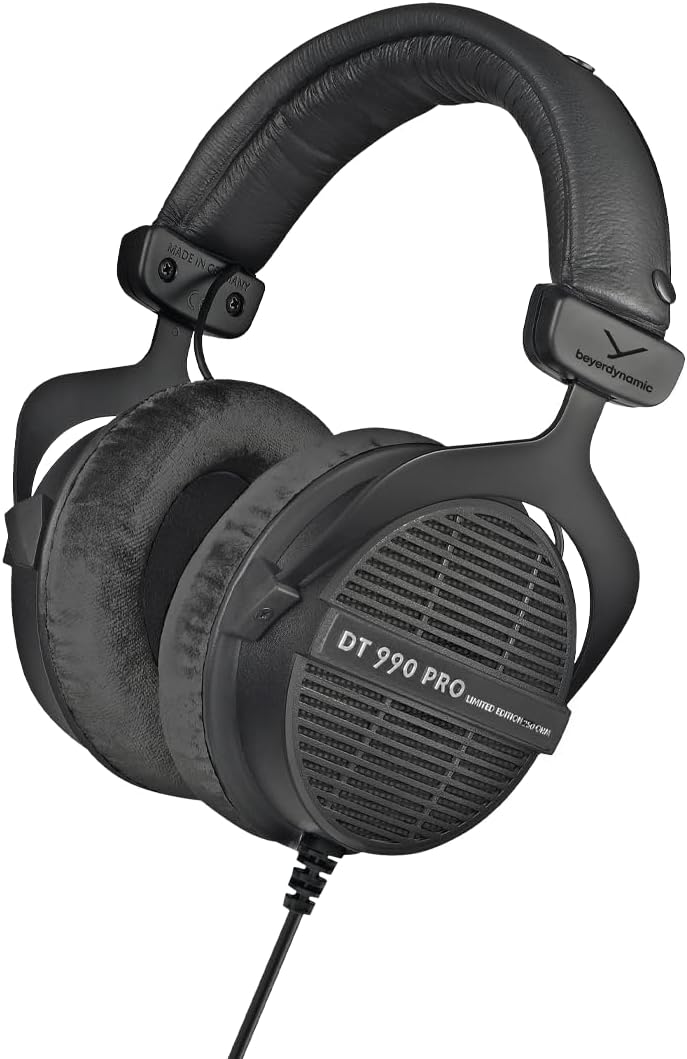
beyerdynamic DT 990 PRO (250 Ω) Official product page and datasheet: open, 250 Ω, nominal SPL 96 dB, 5-35,000 Hz, THD 0.2%, power handling 100 mW, 250 g without cable, headband pressure about 3.5-5.5 N, 3 m coiled cable. Four shortcomings. The FAQ states that classic DT models have fixed cables and only the PRO X line is detachable. The 250 Ω version ships with a coiled cable, which is clumsier on a desk than a straight one. Its 100 mW power handling is the lowest of the six (the M50x is rated 16x higher). And beyerdynamic itself calls the fit "firm".
Product page: beyerdynamic DT 990 PRO 250 Ω (B0011UB9CQ)




Sennheiser HD 600 Official spec page: open, 300 Ω, 97 dB (1 V), 12-40,500 Hz, THD <0.1% (1 kHz, 1 V), 260 g, 3 m cable, 3.5 mm plug. Shortcomings: 4.47 V for 110 dB is the highest of the six and beyond most motherboard and laptop jacks; the spec page lists no maximum input power, so headroom cannot be computed; a single 3 m cable is long for a desk; and the page names the connector but never says whether the cable is replaceable, so ask before planning a recable.
Product page: Sennheiser HD 600 (B00004SY4H)


AKG K240 Studio Official product page and spec sheet PDF: semi-open, 55 Ω, 104 dB SPL/V @ 1 kHz, 15-25,000 Hz, maximum input 200 mW, 30 mm driver, 240 g, 3 m cable, detachable mini-XLR, replaceable earpads, not foldable. Shortcomings: semi-open still leaks and AKG publishes no isolation figure; 72.4 mW at 110 dB uses 36% of the 200 mW rating, the tightest margin here; mini-XLR is a proprietary connector, so replacements come from AKG; and the official sheet says it does not fold.
Product page: AKG K240 Studio (B0001ARCFA)


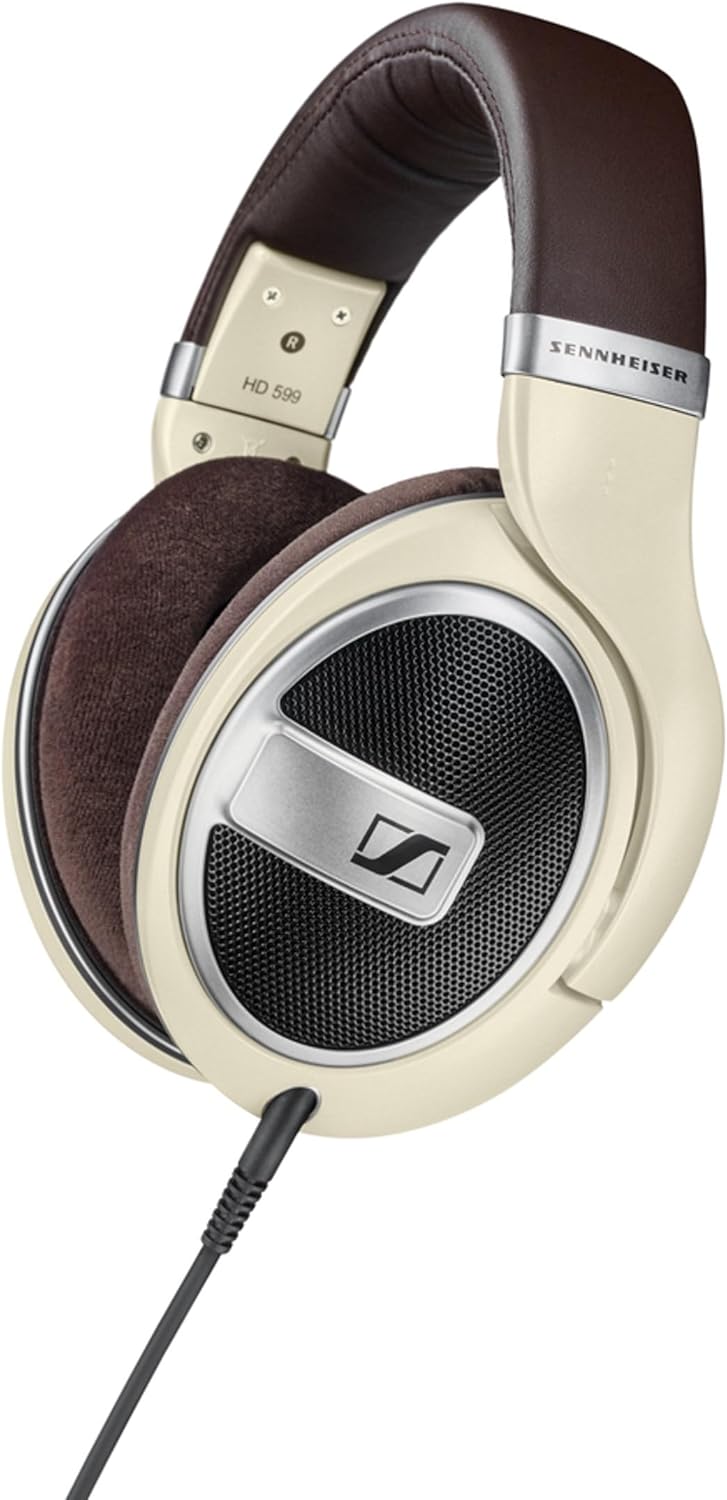
Sennheiser HD 599 Official spec page: open, 50 Ω, 106 dB SPL (1kHz/1Vrms), 12-38,500 Hz, THD <0.1% (1 kHz, 100 dB SPL), 250 g, both a 3 m and a 1.2 m detachable cable included, 38 mm driver. Shortcomings: the sensitivity unit is the most frequently miscopied in this group and 106 is dB/V, not dB/mW; the THD condition is 100 dB SPL rather than the 1 V other brands use, so cross-brand comparison is not clean; no maximum input power is published; and both cables are proprietary detachable parts rather than a plain 3.5 mm plug.
Product page: Sennheiser HD 599 (B01L1IICR2)


Philips SHP9500 Official product PDF: open, 32 Ω, sensitivity 101 dB, maximum input 200 mW, 12-35,000 Hz, 50 mm driver, detachable cable, 0.32 kg. Shortcomings: the official document contradicts itself, with a feature line promising "1.5 m cable for freedom" and the specification block listing a detachable 3.0 m cable; no reference is given for sensitivity, which can only be inferred from the 200 mW ceiling; 0.32 kg does not say whether cable and packaging are included; and no THD figure exists.
Product page: Philips SHP9500 (B00ENMK1DW)


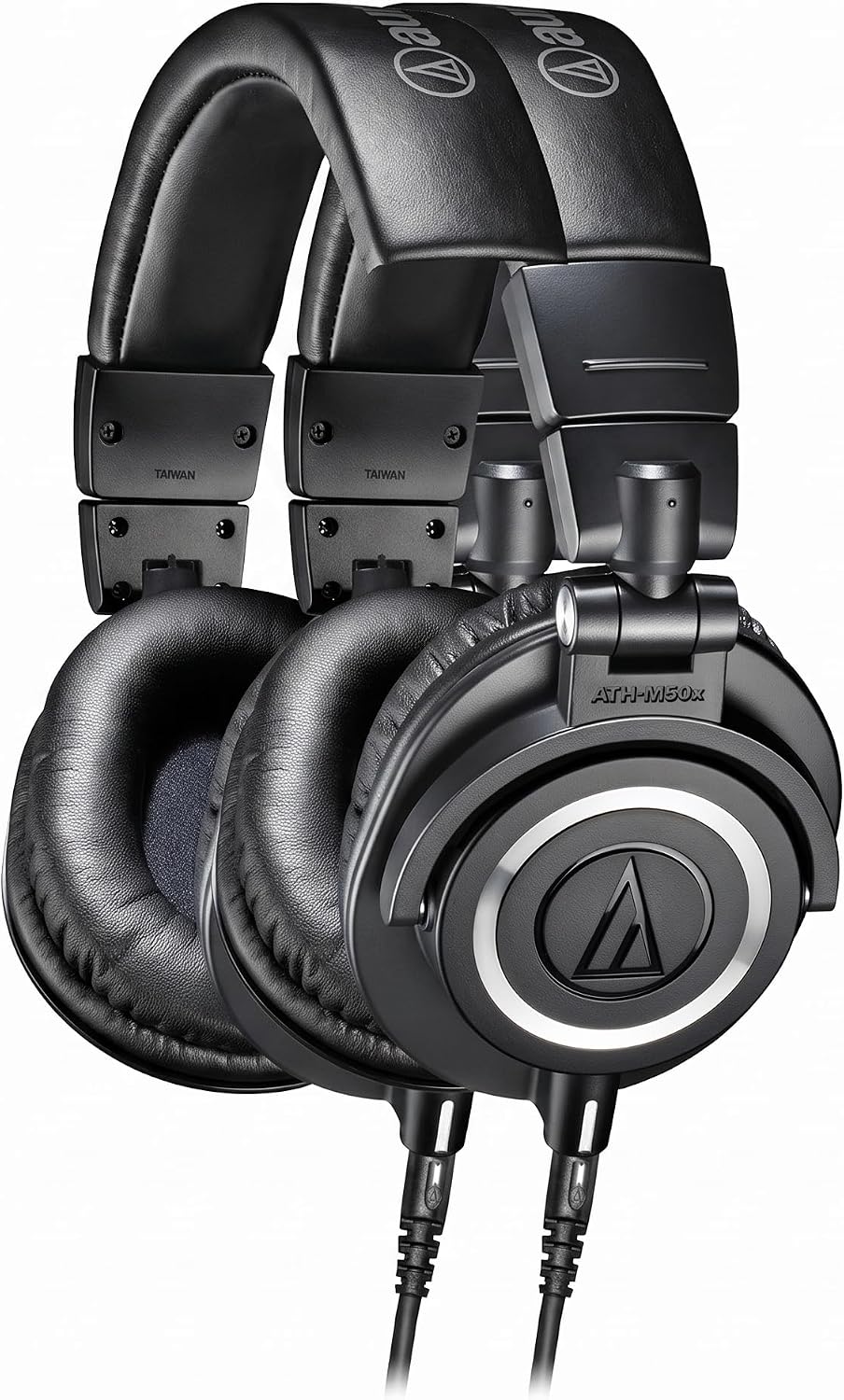
Audio-Technica ATH-M50x Official spec table: closed, 45 mm driver, 38 Ω, sensitivity 99 dB, 15-28,000 Hz, maximum input 1,600 mW at 1 kHz, 285 g without cable, three detachable cables, collapsible, 90-degree swiveling earcups. Shortcomings: no sensitivity reference; 285 g is the heaviest of the six; the 90-degree swivel breaks the seal during one-ear monitoring, which is exactly when isolation matters; and 1,600 mW is a survival rating, not a difficulty figure, though it is often marketed as one.
Product page: Audio-Technica ATH-M50x (B00HVLUR86)



The decision tree
Ask about the interface first, the room second, and the model last:
Each branch tests something different: the first is electrical (4.5 V or not), the second is acoustical (does leakage reach another person or your own mic), the third is maintenance (cables and earpads). Past those three gates only price and looks remain, and this article has no opinion on either.
Three practical details that get skipped
- Earpads wear out, and the three brands document it differently. beyerdynamic lists spare part EDT 990 V (order number 926.679), AKG's spec says replaceable earpads: yes, and neither Audio-Technica nor Sennheiser lists the item on the spec page. Decide now how you will replace them in two years.
- The cable connector decides whether an off-the-shelf cable works. The DT 990 PRO is fixed and needs service if it fails; the K240 uses mini-XLR; the HD 599 uses a proprietary detachable cable; the M50x ships with three detachable cables and is the easiest to replace.
- Maximum input power is not a requirement. The range across these six is 100 mW to 1,600 mW, a 16x spread, and it only says how much input the driver survives. Using it as a difficulty metric produces the opposite conclusion.
FAQ
Is 250 ohms always harder to drive than 32 ohms? No. On official numbers the 250 Ω DT 990 PRO needs 25.1 mW and the 55 Ω K240 Studio needs 72.4 mW, so the lower-impedance model is the heavier load. Difficulty follows converted sensitivity; impedance only converts power into voltage.
Can a laptop or phone drive the HD 600 directly? At this article's target the HD 600 needs 4.47 V, and most motherboards and laptops publish no headphone output level at all, so the claim cannot be checked. If you only have a 3.5 mm jack, the HD 599 class is the safer purchase.
Is 106 dB easier to drive than 96 dB? Depends on the reference. The HD 599's 106 dB is measured at 1 V and converts to 93.0 dB/mW, while the DT 990 PRO's 96 dB reads higher once converted to dB/mW. Subtracting the two printed numbers is meaningless.
Will open-back headphones leak into my recordings? Yes. beyerdynamic's own FAQ says open models bleed into sensitive microphones and can cause feedback at high volume, and recommends closed-back for mic work. For podcasting or calls, a closed model like the ATH-M50x fits better.
Do I need a separate headphone amp? Compute the voltage your headphone needs, then compare it with what your output publishes. A few dB short is survivable; 5 dB short, as with the HD 600 on an entry interface, means a different output stage. Buy amps by voltage, not by impedance.
Why are there no prices here? The fetch ran from a China-based egress, so the price and stock values returned by the product pages could not be trusted for attribution. Prices move daily; check the product page.
Scope and disclosure
- No listening was done. There is no pair of these headphones on this desk, so the article carries no sound impressions and no SPL measurements. Every figure comes from an official spec sheet plus the arithmetic shown above.
- The conversion targets are this article's own. The 110 dB target, 85 dB average and 25 dB headroom are stated in the text; changing the target moves every milliwatt and volt figure together without changing the ranking.
- Two uncertainties are flagged. The sensitivity reference for the DT 990 PRO and the ATH-M50x cannot be settled by the consistency check, so both readings are given. The SHP9500 resolves to dB/mW because of its 200 mW rating.
- Affiliate disclosure. Product links here are affiliate links; this site may earn a commission on purchases made through them, which has no bearing on the spec analysis.
- Sources: beyerdynamic product page and official datasheet PDF, Sennheiser support spec pages, AKG product page and spec sheet PDF, Philips official product PDF on documents.philips.com, Audio-Technica's official spec table, and Focusrite's official user guide spec page. All fetched 2026-11-18. No market data (sales, prices, category size) is cited: there is no paid data source in place, and public search results are not firm enough to state as fact.
Related reading: dynamic microphones, XLR, phantom power and gain budget covers the input side of the same budget, and the USB audio interface showdown has the rest of the Scarlett Solo figures used above.
👉 Join Xiaomi MiMo Platform: Leading AI model platform with cost-effective inference
👉 Join Aliyun AI: Top AI products with exclusive coupons for business innovation
📌 This article was AI-assisted generated and human-reviewed | TechPassive — An AI-driven content testing site focused on real tool reviews
🔗 Recommended Tools
These are carefully selected tools. Using our affiliate links supports us to keep producing quality content:
As an Amazon Associate, I earn from qualifying purchases at no extra cost to you.