Hearing Protection: Four Readings of One NRR Number
Everyone who buys a first pair of hearing protectors hits the same question: can the number on the box be subtracted straight from the noise level in the room.
No, and for more than one reason. The same foam plug labelled NRR 33 comes out as 26 under OSHA's arithmetic, 13 after NIOSH derating, and as a curve running from 34.8 to 43.7 dB in the manufacturer's own nine-row attenuation table. All three numbers sit in official documents. None of them is invented.
I pulled the official datasheets for six earplugs and earmuffs sold on Amazon, took the labels apart down to the octave bands, and sorted the results into six branches. This post contains Amazon affiliate links: if you buy through one I earn a commission and your price does not change. Every figure below is sourced, and where the maker published nothing I say so instead of filling the gap.
Start with the number you actually need
CDC and NIOSH are blunt about this. Most workplace exposures sit below 95 dBA, "most workers need 10 dB or less sound reduction to bring their exposure down to a safe level," and "Almost any hearing protector, when fit correctly, can reduce noise by 10 dB." NIOSH then gets specific: aim to bring protected exposure to 75–85 dBA, and it uses the phrase "Avoid overprotection." Cut too much and you stop hearing your name being called or a machine changing pitch, so you take the protector off, and protection drops to zero.
That inverts the whole buying decision. If the target is "just enough," then the 2 dB between NRR 33 and NRR 31 is not a decision input at a desk. Three things decide it instead: what the room actually measures, whether you will keep the thing on, and which scale the label is even using.
Three thresholds worth memorising:
85 dBA — NIOSH's recommended exposure limit, and OSHA's action level; cross it and a hearing conservation programme is required.
90 dBA — OSHA's permissible exposure limit, as an 8-hour time-weighted average.
100 dBA — NIOSH says double protection, earmuffs over earplugs, at this level or with impulse noise.
One more line that gets skipped: NIOSH states on the same page that active noise cancellation "should not be considered hearing protection unless labeled with an NRR." ANC headphones fight low-frequency hum; that is not the same as an ANSI-tested attenuation rating, and without an NRR on the box they are not protectors in the regulatory sense.
TL;DR
🎯 Measure first. Install NIOSH's sound level meter app and log an 8-hour average where you actually sit. If you cannot measure, pick the form factor for the worst case, but do not default to the highest number.
🧱 Workshop levels (95 dBA and up: air tools, vacuums, cutting): Moldex Pura-Fit 6800, disposable foam, NRR 33. If you hate rolling foam, 3M PELTOR X5A earmuffs, NRR 31.
🏢 Office and commute (below 85 dBA): Loop Switch 2 on Engage, 20 dB SNR, is enough. Save the 26 dB setting for cabins and subway cars.
🔁 Intermittent noise where you still need to hear people: 3M PELTOR Sport Tactical 500, NRR 25, electronic, clamps the bang and passes speech.
👓 Glasses, all-day wear, or side sleeping: Decibullz custom moulded, 31 dB with the foam tips and 25 dB with the single-flange silicone tips. Glasses break an earmuff seal, so plugs win here.
🧰 Fallback: if you cannot decide, buy the 3M PELTOR Optime 105 headband muff at NRR 30. Fastest on and off, lowest cost of being wrong.
One label, three numbers
Moldex's Pura-Fit datasheet is unusually complete: tested to ANSI S3.19-1974, NRR 33, CSA Class AL, followed by mean attenuation and standard deviation for nine bands from 125 Hz to 8 kHz. That table is what makes it possible to open up the number 33.
Start with OSHA. 29 CFR 1910.95 Appendix B gives two routes depending on your instrument:
- With a dosimeter that measures C-weighting: subtract the NRR from the C-weighted TWA, with no 7 dB adjustment.
- With a dosimeter that cannot do C-weighting, or with an A-weighted sound level meter: "Subtract 7 dB from the NRR" first, then subtract the remainder from the A-weighted TWA.
In the same appendix the 7 dB appears only on the A-weighted route. It is not a discount, it is the C-to-A conversion. Going from 33 to 26 is not a 20 percent haircut, it is a change of weighting network.
Then NIOSH. The 1998 criteria derate again by protector type: 25 percent for earmuffs, 50 percent for formable foam plugs, 70 percent for everything else. The 33 dB foam plug lands at (33−7)×0.5 = 13 dB.
Four readings side by side:
| Reading | Result | Basis |
|---|---|---|
| Label NRR | 33 dB | Moldex Pura-Fit datasheet, ANSI S3.19-1974 |
| OSHA A-weighted route | 26 dB | 1910.95 App B(ii)(B), NRR minus 7 |
| NIOSH foam derating | 13 dB | 98-126, (33−7)×0.5 |
| Per-band floor (my arithmetic) | 34.8–43.7 dB | datasheet mean minus SD |
The last row matters. 13 dB sits far below every band floor, which tells you 13 is not "the attenuation you get at some frequency" — it is a scalar built for compliance decisions. Equally, 34.8 to 43.7 is not "what you are guaranteed"; it is the lab figure pushed down by one standard deviation per band. Each number answers a different question, and mixing them produces the popular but wrong conclusion that a 33 dB plug is "really only worth 13." OSHA never claimed 13 dB was what happens inside your ear canal.
NRR and SNR are not the same ruler
3M spells the difference out on its own Chinese product page: "NRR: tested per ANSI 3.19-1974. EN SNR: tested per EN 352; octave-band and HML results are in the test report or manual."
The same X5A earmuff carries three different numbers on three official pages: NRR 31 dB on the US product page; EN SNR 37 dB and GB SNR 36 dB on the Chinese page; and "Attenuation Rating (SNR) 31 Decibel" in the spec table of the Hong Kong page.
All three were written by the same company. This is not necessarily a transcription error — it is the SNR field being populated from different test regimes on different regional sites, while the buyer sees one three-letter abbreviation. For anyone writing a buying guide it is the easiest place to crash: copy the NRR from site A and the SNR from site B, put both in one table, and start subtracting.
The practical consequence: there is no fixed conversion between NRR and SNR. On the X5A, NRR 31 against EN SNR 37 is a 6 dB gap, so the folk rule "SNR minus 3 equals NRR" fails on this product. Loop publishes SNR only — Switch 2 is 20, 23 and 26 dB across its three settings — so subtracting 26 from Moldex's 33 is like subtracting Celsius from Fahrenheit.
Opening 33 dB into nine bands
Moldex publishes nine rows with both the mean and the standard deviation. Subtract the SD and you get a conservative per-band figure. This is my arithmetic on their published columns, not a number they print:
| Band | 125 | 250 | 500 | 1k | 2k | 3.15k | 4k | 6.3k | 8k |
|---|---|---|---|---|---|---|---|---|---|
| Mean m | 42.4 | 43.5 | 45.9 | 39.8 | 36.8 | 44.5 | 46.6 | 48.1 | 47.4 |
| SD s | 4.9 | 4.2 | 4.9 | 3.4 | 2.0 | 3.7 | 2.9 | 4.6 | 4.7 |
| m − s | 37.5 | 39.3 | 41.0 | 36.4 | 34.8 | 40.8 | 43.7 | 43.5 | 42.7 |
The low point is 2 kHz at 34.8; the high point is 4 kHz at 43.7. That is an 8.9 dB spread.
This is not measurement noise, it is the physics of the device: low frequencies are blocked by mass and seal, high frequencies by material absorption, and the middle is where every plug is merely adequate. 2 kHz happens to sit in the region that carries a lot of speech intelligibility, so a plug rated NRR 33 is nearly 9 dB weaker at blocking voices than it is at 4 kHz.
A single number necessarily throws that away. The point of reading the label is to know what was thrown away, not to expect the label to contain everything.
The decision tree
Branch 1: you have not measured anything. Measure. CDC points to NIOSH's sound level meter app for a first pass, and you want the stretch of time you actually spend there, not a second in the corridor. Do not skip this.
Branch 2: below 85 dBA (open office, commute, home). You need about 10 dB, not 26. Loop Switch 2 on Engage (20 dB SNR) already sits at the top of that range; the Quiet setting is for cabins, subway cars and the renovation next door. The classic mistake in this branch is buying NRR 33 foam for an office, then pulling it out because you cannot hear a colleague.
Branch 3: 85–100 dBA (vacuum, cutting, a long print run, a shop floor). You need 15–25 dB. Two equivalent routes: disposable foam at NRR 33 that you forget about, or earmuffs around NRR 30 that come off in a second. Pick by how often you take them off — frequent removal favours muffs, two-hour stretches favour plugs.
Branch 4: 100 dBA and up, or impulse noise (air hammer, hammering, gunshots). NIOSH says double protection, muffs over plugs. The counterintuitive part: the two layers do not add. Training material commonly estimates the pair as the higher protector's NRR plus 5 dB, not 30 plus 33. Double protection buys a ceiling, not a doubled number.
Branch 5: intermittent noise, and you need to hear speech. Electronic muffs that clamp the impulse and pass voices, or a plug with a mechanical dial. The precondition is an NRR on the box; NIOSH explicitly does not count ANC headphones without one.
Branch 6: glasses, all-day wear, or side sleeping. Plugs first. CDC is direct about this: eyewear, even ordinary glasses, can break the seal of an earmuff and let sound leak in. Custom moulded plugs (Decibullz) beat a higher-NRR muff here because they sidestep the seal being pried open.
Fallback: you cannot judge any of it. Buy a headband muff rated around NRR 30. Fastest to put on, no insertion technique required, cheapest mistake — then switch form factor once you have measured.
The six, one by one
Moldex Pura-Fit 6800
Disposable foam, official NRR 33, ANSI S3.19-1974, CSA Class AL, 200 pairs to a box. It is the only product here that publishes the full nine-band table, the standard deviations, and the test lab (Michael & Assoc.), which is why every band calculation in this post starts from its datasheet. Tapered green plug, uncorded, individually wrapped — the right thing when your hands are dirty. The Amazon listing is the 200-pair box, so check the pack size against your actual usage: Moldex Pura-Fit 6800 foam earplugs.


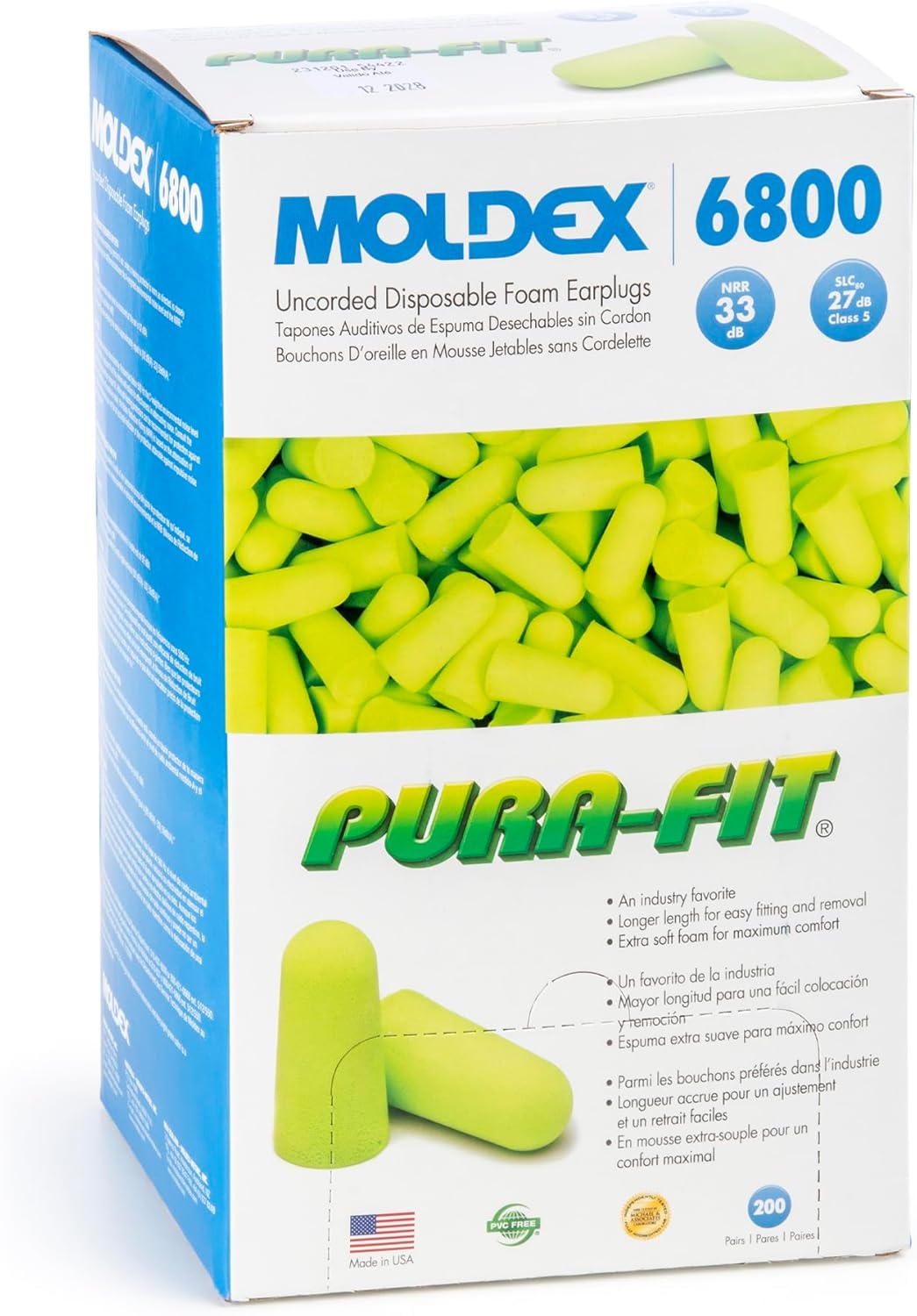


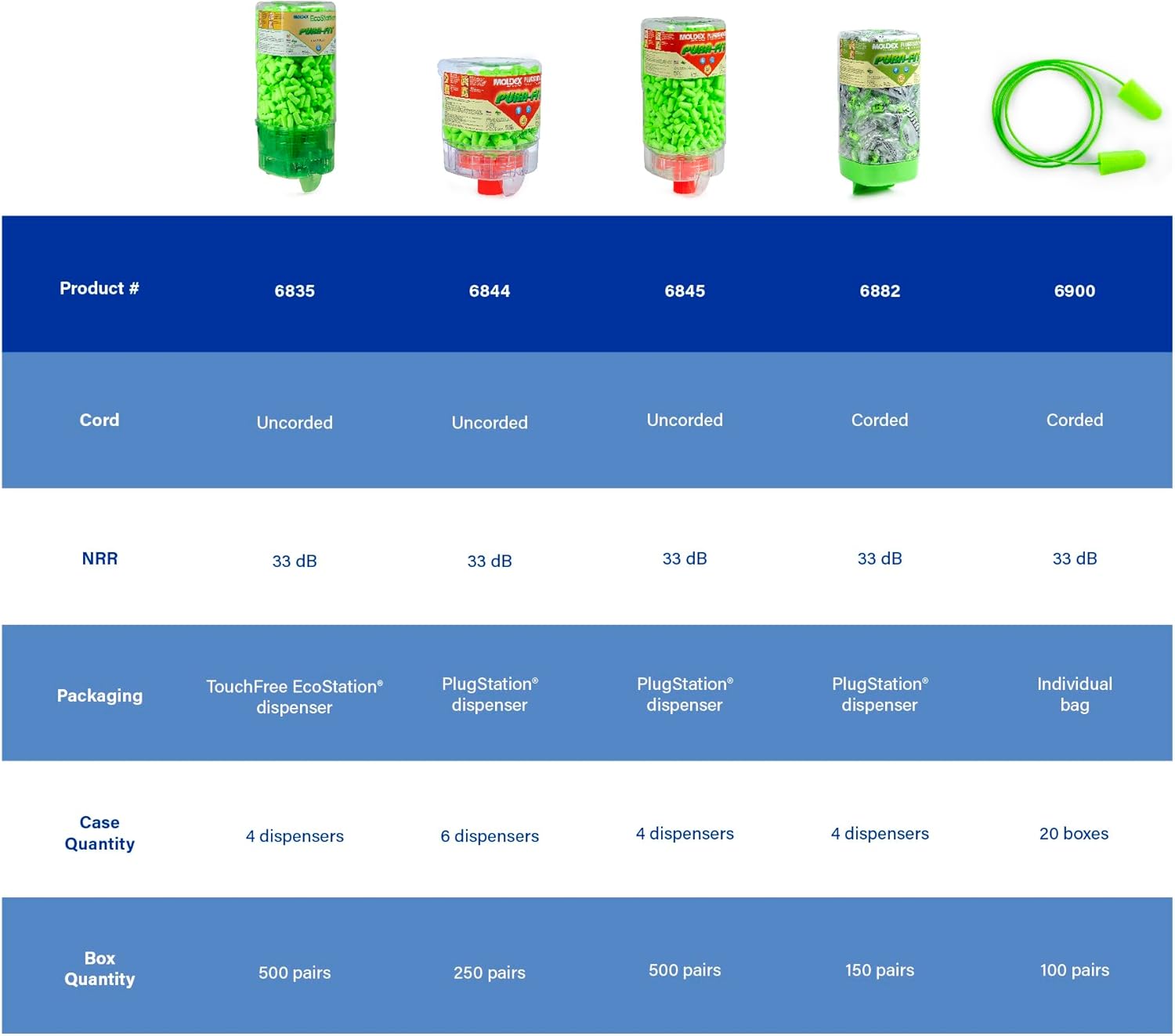

What is wrong with it: it only works rolled and inserted, so it is unusable with greasy hands — CDC flags exactly this and suggests pre-formed plugs for that case; performance depends heavily on insertion depth, and a shallow fit is a placebo; it is consumable, so long-run cost exceeds a reusable pair; and 200 pairs is far more than one household needs.
3M PELTOR X5A
The highest label in this group, NRR 31, 351 g per 3M's spec, slow-recovery high-density foam, replaceable hygiene kit. Its value is not the extra decibel but the fact that it works on contact: no insertion technique, just seat the cup. This is the product whose three official pages print three different numbers: 3M PELTOR X5A earmuffs.


What is wrong with it: 351 g is the heaviest here and two hours in you feel the clamp; 3M's Australian datasheet lists 11.4 N clamp force, marginally below the X4A's 11.6 N, but with a thicker cup, so stacking it over glasses, a cap or goggles is where leaks start; 3M labels it industrial/occupational use only, not a consumer product; and it is bulky to store.
3M PELTOR Optime 105 H10A
The official field reads "Noise Reduction Rating (NRR) between 27–30 dB (depending on the attachment type)," and the headband version takes the 30. The double-shell cup is how it holds low frequencies down; 285 g, liquid-and-foam filled cushions. It suits the person who takes protection off seven times a day, because muffs come off far faster than plugs: 3M PELTOR Optime 105 earmuffs.


What is wrong with it: the NRR is a 27-to-30 range that depends on which mount you buy — the hard-hat version does not get 30; the official Dielectric field says No, so it is the wrong tool for electrical work; 3M's Hong Kong page prints "for noise levels up to 15 dBA" and "NRR: 3 dB" in the same paragraph, so spec numbers must be re-checked on the US page; and it carries the same industrial-use positioning.
Decibullz custom moulded earplugs
Thermoplastic moulds softened in hot water, and the official page lists two figures: 31 dB NRR with the foam tips, 25 dB with the single-flange silicone tips. Re-mouldable as often as you like, shipped with three sets of triple-flange tips, one set of foam tips and a pouch. It solves the case nothing else solves — an awkward ear canal, glasses, or a full day of wear: Decibullz custom moulded earplugs.


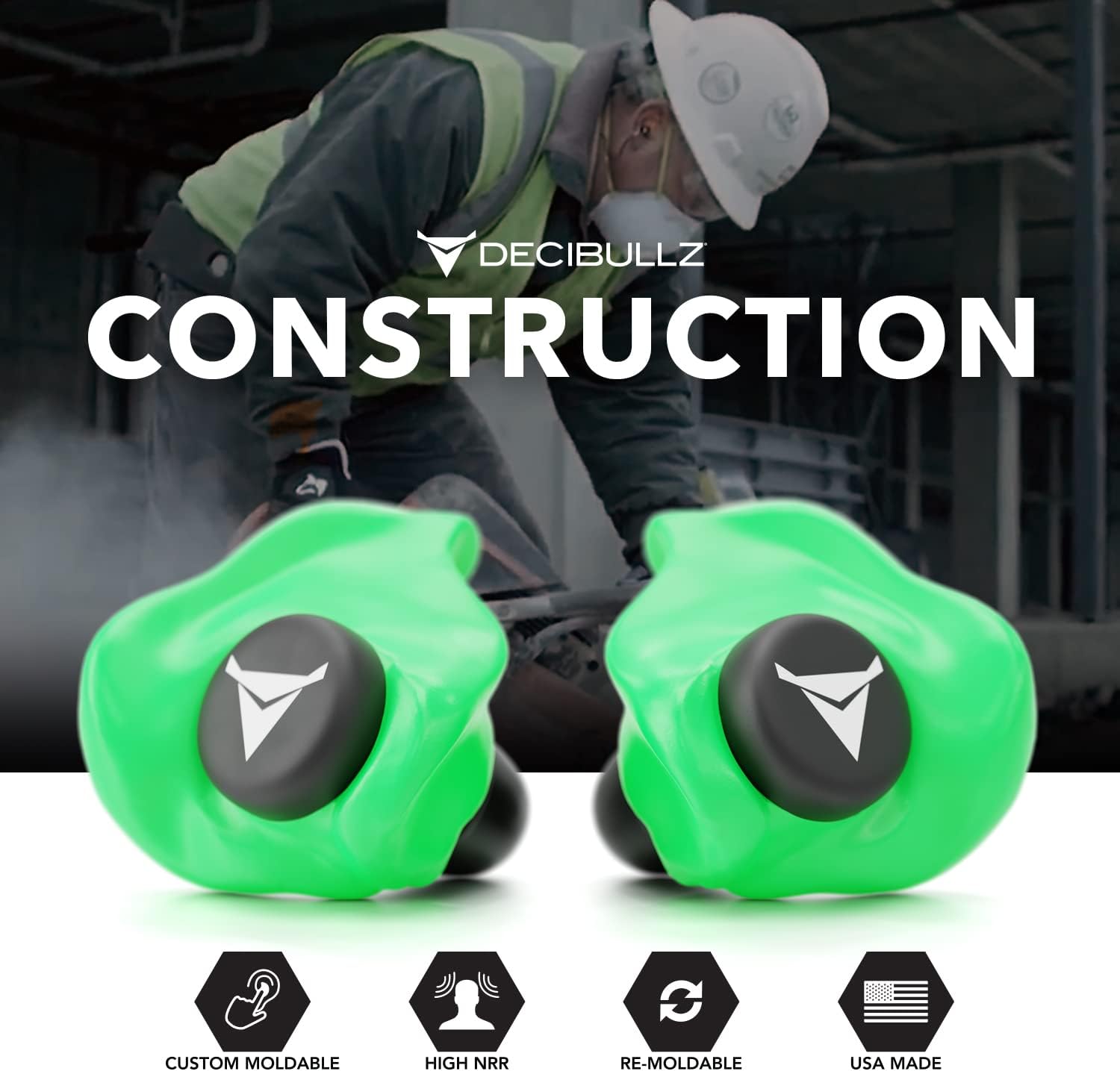


What is wrong with it: the gap between 31 and 25 is 6 dB, which is a factor of four in sound energy, so swapping a tip is swapping a protection class while the box advertises only 31; moulding means boiling water, waiting for it to cool and pressing, and the first attempt usually needs a second; a custom shape guarantees fit, not a seal every single time you insert it; and it is hopeless for noise you need to duck in and out of.
Loop Switch 2
A reusable plug with a mechanical dial and three settings, all published as SNR: Engage 20 dB, Experience 23 dB, Quiet 26 dB. The design goal is not maximum attenuation but one pair covering a whole day — one setting for a meeting, another for the subway: Loop Switch 2 adjustable earplugs.


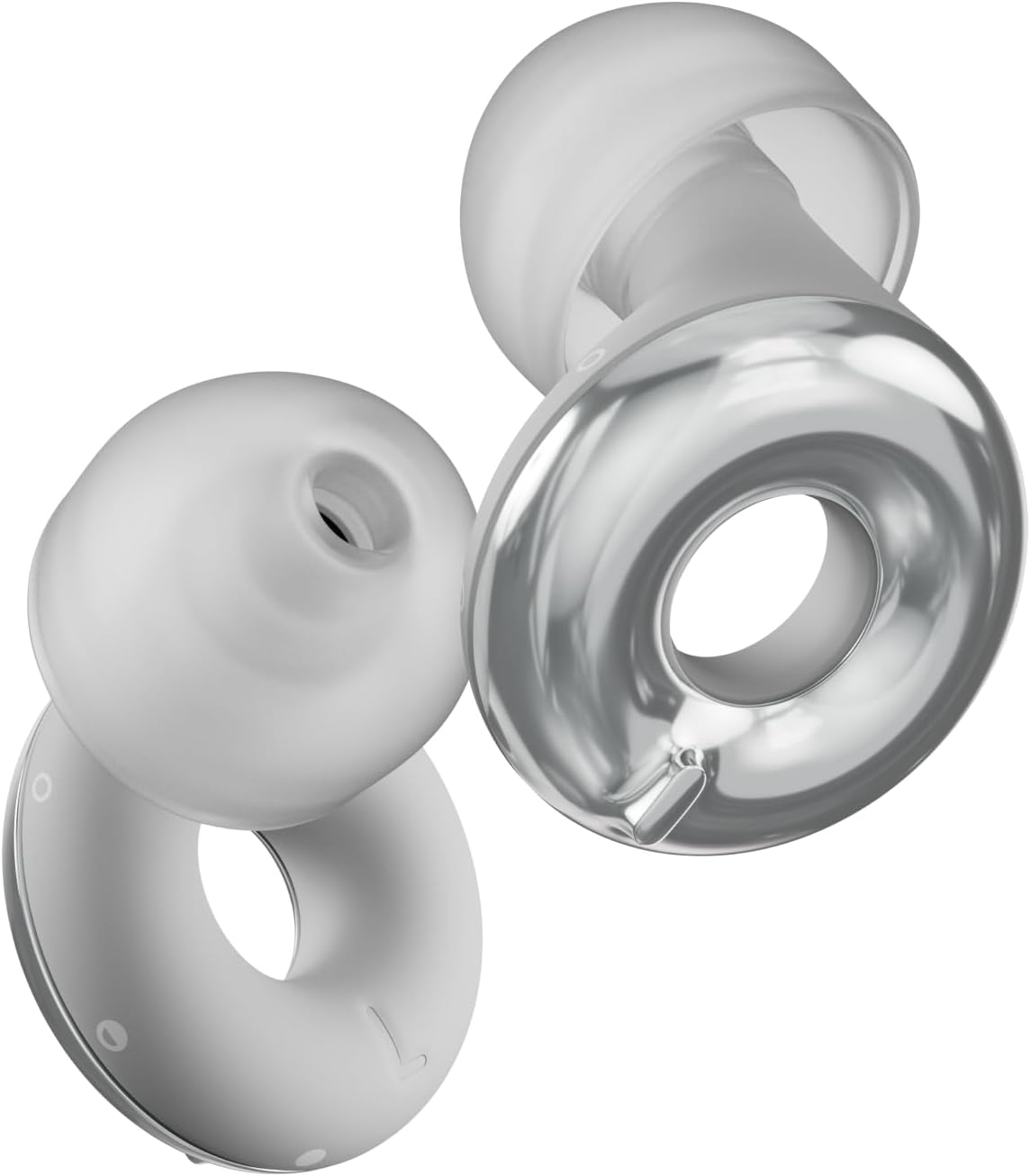


What is wrong with it: SNR only, no NRR, so it cannot go into the same table as US-rated products without a caveat; the official help page states they "aren't recommended for sleeping," so side sleeping is out; 26 dB in a quiet office is overprotection; and the dial is a moving part that adds somewhere for dust to collect and something to wear.
3M PELTOR Sport Tactical 500
Electronic muffs, official NRR 25, clamping impulsive sound while amplifying ambient speech, with Bluetooth and two AA cells. This is the "protect me and let me hear" case — someone calling your name across the shop, or a machine that has started to sound different: 3M PELTOR Sport Tactical 500 electronic earmuffs.
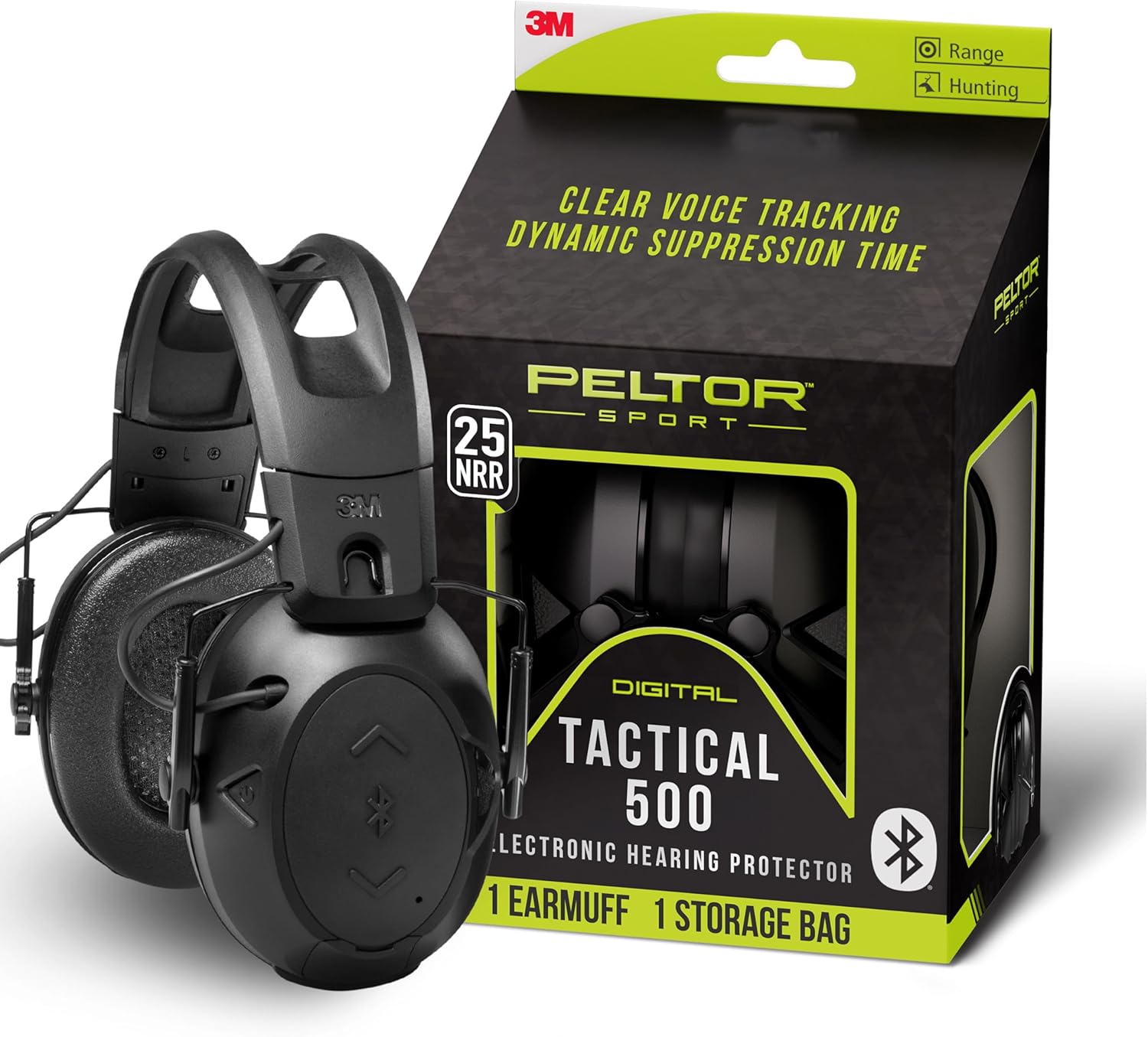


What is wrong with it: NRR 25 is low for passive attenuation — fine in a quiet setting, insufficient in a loud one; two 3M product pages give NRR 25 and NRR 26 for the same model, so both numbers circulate; it runs on batteries that are not included; Bluetooth and the amplifier contribute nothing to attenuation, you are paying for communication; and the cups are cut out for long guns, which means less sealing area than a full cup.
Six defects, side by side
| Product | Label basis | Value | Main defect |
|---|---|---|---|
| Moldex Pura-Fit 6800 | NRR | 33 | Roll-and-insert only; consumable cost |
| 3M PELTOR X5A | NRR 31 / EN SNR 37 | 31 | Heaviest at 351 g; clashes with glasses |
| 3M PELTOR Optime 105 | NRR 27–30 by mount | 30 (headband) | Mount costs 3 dB; not dielectric |
| Decibullz | NRR | 31 foam / 25 silicone | Tip swap drops 6 dB; moulding learning curve |
| Loop Switch 2 | SNR only | 20 / 23 / 26 | No NRR, not comparable; not for sleeping |
| Sport Tactical 500 | NRR | 25 (26 on another page) | Low passive rating; battery dependent |
How to check the fit afterwards
Labels and arithmetic are ceilings; the real attenuation happens in your ear canal. CDC offers a free check: slowly cup and uncup your hands over your ears while counting aloud — if your own voice sounds about the same either way, the plug is sealed.
Where it is available, 3M's E-A-Rfit dual-ear system measures a personal attenuation rating; both the X5A and Optime 105 pages list compatibility. That matches NIOSH's current position too: the 1998 derating factors are described as a previous recommendation, and individual fit testing is now the better check.
One last warning comes from the warning block of the Moldex datasheet, item 3: overprotection is dangerous, and the wearer must be able to hear warning signals. OSHA's appendix closes with the same caveat from the other direction — calculated attenuation reflects reality only to the extent the protector is properly fitted and worn.
FAQ
Is NRR 33 worth paying more for than NRR 31?
Not below 85 dBA, where both are far past what you need. Not above 100 dBA either, where the answer is double protection and 2 dB will not save you. What is worth comparing is form factor: plugs or muffs, and whether you will keep them on.
Can I convert an SNR rating into NRR?
There is no general conversion. The same X5A carries NRR 31 and EN SNR 37 from its own maker, a 6 dB gap, so the "subtract 3" rule fails there. Treat an SNR-only product as belonging to another system and do not put it in the same subtraction.
Do noise-cancelling headphones count as hearing protection?
NIOSH is explicit: ANC reduces noise, but unless the product is labelled with an NRR it should not be considered hearing protection. ANC targets steady low-frequency noise and does almost nothing to an impulse.
Do earplugs plus earmuffs add up?
No. NIOSH recommends double protection at 100 dBA and above, but the combination is far below the sum; training material typically estimates it as the higher NRR plus 5 dB. It buys a ceiling, not a doubled figure.
What goes wrong if I wear NRR 33 foam in an office?
NIOSH warns about overprotection directly: cut too much and you stop hearing colleagues and equipment, you remove the plug, and real-world protection falls to zero. At office levels, about 10 dB is the target.
Last
I did not run sound pressure measurements or a personal fit test for this piece — those need a person and hardware, and no amount of datasheet reading replaces them. What I can stand behind: the label has four readings, NRR and SNR have no fixed conversion, the same manufacturer publishes different numbers for the same product on different regional pages, and no NRR is high enough to compensate for a protector you will not wear.
So the order is reversed from how most people shop: measure the room, decide how many dB you need, and only then read the label. Buying the wrong kind of protection costs more than buying the wrong model.
👉 Join Xiaomi MiMo Platform: Leading AI model platform with cost-effective inference
👉 Join Aliyun AI: Top AI products with exclusive coupons for business innovation
📌 This article was AI-assisted generated and human-reviewed | TechPassive — An AI-driven content testing site focused on real tool reviews
🔗 Recommended Tools
These are carefully selected tools. Using our affiliate links supports us to keep producing quality content:
As an Amazon Associate, I earn from qualifying purchases at no extra cost to you.