Dynamic vs Condenser: Swapping Mics Won't Fix Your Room
An untreated room records hollow. It is the question I get asked most this year, and the reflex answer is almost always "change the microphone": the dynamic camp says a condenser pulls the whole room in, the condenser camp says a dynamic sounds muffled. I actually opened all five official spec pages and the five Amazon listings myself and copied every number that could be matched onto one sheet, and the conclusion turned out to be worth more than the swap itself: changing the microphone does not make the room quieter. It only moves the noise to a different stage of the chain, where it gets amplified.
And once the five spec sheets are laid side by side, only two sets of numbers can be subtracted at all. The rest look comparable and are not.
This article contains Amazon affiliate links; if you buy through them the site earns a commission at no extra cost to you. Prices and stock reflect the listing pages as fetched on 2026-11-20 — check the live page before ordering. I have no microphone hardware here, so every figure below is the manufacturer's published specification, not something I measured. The earlier piece on XLR, phantom power and gain budgets already covered the power side, so this one stays on the room: Dynamic mics in 2026: XLR, phantom power and gain.
TL;DR:
- Self-noise of 4, 12 and 20 dB(A) is directly comparable, but it measures the microphone's own floor. Once your room floor sits above that number, the 16 dB gap is not audible.
- Sensitivity of -32 dB versus -56 dB re 1V/Pa is a 24 dB difference, or 15.8x in voltage. What it converts into is how much preamp gain you must dial in, not how loud the mic sounds.
- Shure states the preamp requirement in the SM7B product copy itself: it "operates best with preamps that provide 60dB of gain". Of the five here, only Shure publishes that threshold.
- The SM7dB's +18 or +28 dB preamp runs on 48V phantom power — a dynamic microphone that ends up depending on phantom power to solve a gain problem.
- Maximum SPL of 142, 144 and 148 dB means nothing alone. Only its difference from self-noise does, and none of the three brands publishes that figure, so you have to subtract it yourself.
A new mic does not change the room, it relocates the noise
Start with the part that has nothing to do with brands. Reflections are a property of the space: walls, desk, ceiling and the distance between your mouth and the capsule. Swapping the microphone leaves every reflection exactly where it was. What changes is the magnitude of two other things.
The first is how much preamp gain you need. More gain means the preamp's own noise gets amplified with the signal; less gain means that noise contributes proportionally less. The second is how quiet a signal the microphone itself can resolve, published as self-noise or equivalent noise. On a spec sheet these sit in two different rows, and they act at opposite ends of the chain: one at the input transducer, one downstream in the preamp.
So "the room sounds hollow" is really three problems wearing one sentence: room reverberation, preamp noise, and microphone self-noise. A spec sheet answers the last two. The first one is answered by positioning and soft furnishings.
There is also a question a spec sheet never answers: between two microphones both marked Cardioid, which one rejects the room better. On all three official spec pages I checked, the polar pattern row contains the single word "Cardioid" and no polar plot data. Dynamic marketing copy says the tight pattern "helps to reject ambient noise" (RØDE's Procaster page). Condenser copy says the capsule is "extremely sensitive — picks up the subtlest sounds in any environment" (Audio-Technica's own definition block). Both statements describe two sides of the same property, and neither is quantifiable.
Five mics on one sheet, and count the empty cells
Everything in this table comes from the official spec pages and the live listings. An empty cell means the manufacturer does not publish that value on that page — not that I failed to look. "Price" is the USD figure shown in the Amazon buybox on 2026-11-20.
| Model | Type | Sensitivity (re 1V/Pa) | Self-noise | Max SPL | Output impedance | Power |
|---|---|---|---|---|---|---|
| Shure SM7B | Dynamic | Not published | Not published | Not published | Not published | Not published |
| Shure SM7dB | Dynamic | Not published (+18/+28 dB preamp) | Not published | Not published | Not published | Preamp needs 48V |
| RØDE Procaster | Dynamic | -56.0 dB (1.60 mV) | Not published | Not published | 320Ω | Not published |
| Audio-Technica AT2020 | Condenser | Not in comparison table | 20 dB(A) | 144 dB | 100Ω | 48V |
| Audio-Technica AT2035 | Condenser | Not in comparison table | 12 dB(A) | 148 dB | 120Ω | 48V |
| RØDE NT1 5th Gen (not linked) | Condenser | -32 dB (25 mV) | 4 dBA | 142 dB | 100Ω | P48 |
The empty cells are the story. Both Shure mics publish nothing for sensitivity, self-noise or maximum SPL, because Shure writes these as broadcast microphones rather than studio recording mics. Which means the SM7B cannot be compared numerically to the other four at all. Any article that quotes a dB figure for its "room rejection" is quoting something the manufacturer never published.
That leaves exactly two subtractions: self-noise between the two Audio-Technica mics (20 versus 12, an 8 dB gap), and sensitivity between the Procaster and the NT1 (-56 versus -32, a 24 dB gap). Those two gaps map onto the two things from the opening.
I have written about this reading discipline before, for instance why a digital caliper splits its error into E_MPE and S_MPE — same method: work out which column measures the same physical quantity before comparing.
Shure SM7B: the manufacturer wrote down "60 dB of gain"
This is the default answer across the podcast world whenever a room is noisy. The informative part of its official page is not the tonal description but the last two sentences of the product copy: "The SM7B is a professional dynamic microphone that operates best with preamps that provide 60dB of gain. Please ensure your audio interface can provide sufficient gain or you may find our SM7dB is a better option with a builtin preamp."
Of the five reviewed here, Shure is the only brand that turns the preamp requirement into a hard number. And 60 dB is not decorative: many entry-level interfaces top out somewhere between 40 and 60 dB of analogue gain, and the exact figure is on the interface's own spec page. If yours delivers 40 dB, the missing 20 dB has to come from software gain — which amplifies everything already recorded into the chain, preamp noise included.
Real defects: no published sensitivity, self-noise or maximum SPL, so you cannot work out how far it sits from a 4 dBA condenser in a quiet room; no built-in preamp, so a gain shortfall means a new interface; no switches at all, so pad and low cut have to be solved upstream.
Fetched price $369.00, status In Stock.
👉 Check the Shure SM7B on Amazon
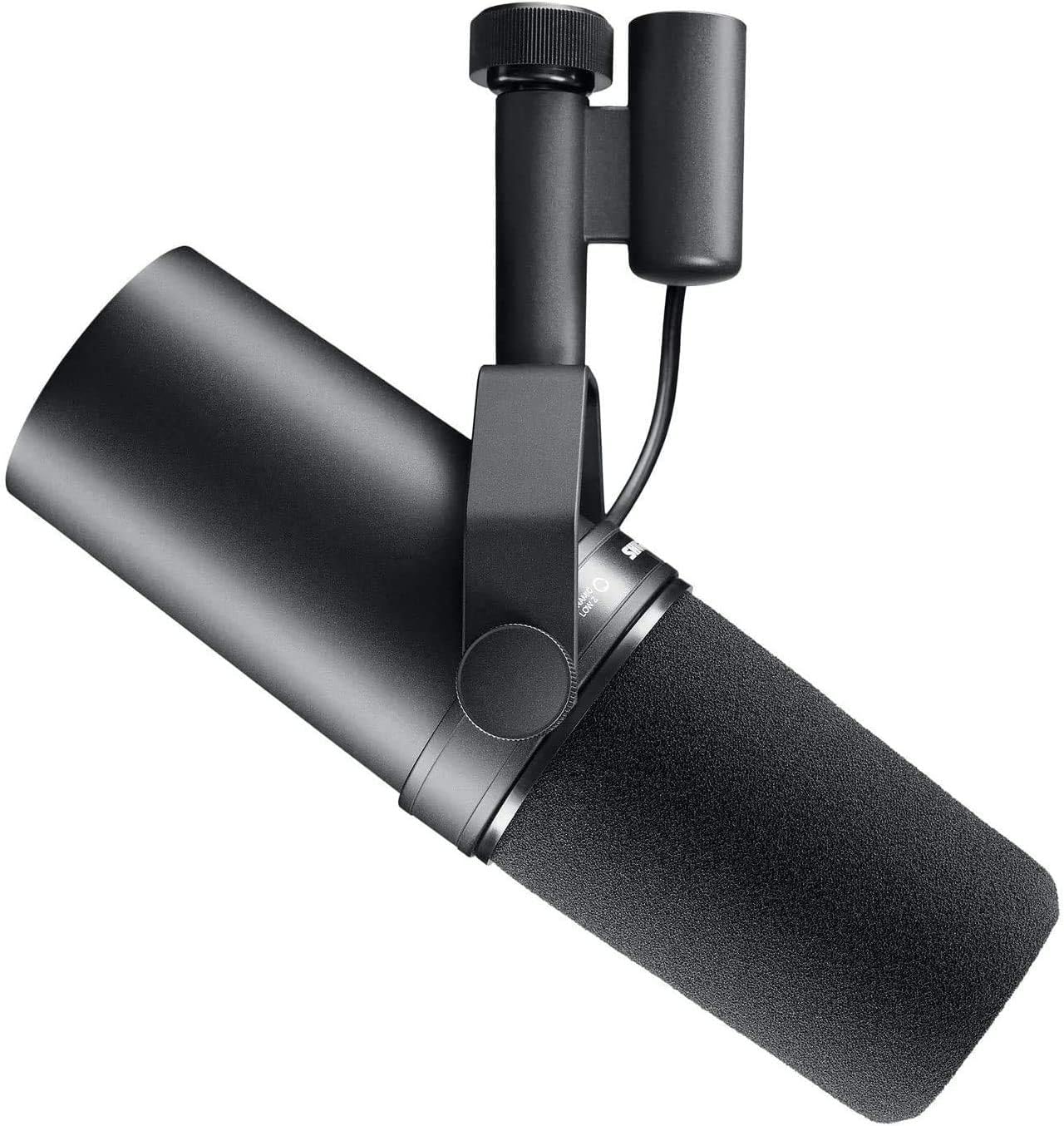


Shure SM7dB: $90 more buys you a 48V dependency
The SM7dB is the same microphone with a preamp inside. Shure's page states "+18dB or +28dB of extra gain", with a bypass. It addresses exactly the 60 dB problem above: when the interface cannot supply the gain, lift the level before the preamp.
Then comes the sentence most people skip: "All you need is an interface or mixer offering +48V of phantom power to operate the preamp." The +18 or +28 dB preamp only works when 48V phantom power is present. This is the most counterintuitive finding in this piece. Dynamic microphones are defined by not needing phantom power — Audio-Technica's own definition block lists "No external power requirements" as a dynamic characteristic — yet this upgraded dynamic adds a phantom power dependency in order to fix a gain problem.
If your interface has no 48V, or the switch is broken, or the rail is already committed elsewhere, the preamp is decoration and the mic reverts to passive behaviour, identical to an SM7B.
Real defects: $90.00 more than the SM7B ($459.00 versus $369.00); the preamp depends on 48V; and the line "all the extra gain you'll ever need" is marketing, not a specification — the sheet still publishes no sensitivity or self-noise, so you still cannot compare it numerically with a condenser.
Fetched price $459.00, status In Stock.
👉 Check the Shure SM7dB on Amazon


RØDE Procaster: a -56 dB broadcast dynamic with the plainest sheet
The Procaster has the most complete spec page of the five, even though it too omits self-noise and maximum SPL: dynamic, cardioid, end address, 75 Hz to 18 kHz, output impedance 320Ω, sensitivity -56.0 dB re 1 Volt/Pascal (1.60 mV at 94 dB SPL), plus or minus 2 dB.
That "at 94 dB SPL" is the load-bearing detail. 94 dB SPL equals one pascal, which is the reference point behind every sensitivity figure and, in the next section, behind the self-noise arithmetic too.
At -56.0 dB it sits 24 dB below the NT1 5th Generation's -32 dB. Since both are quoted at plus or minus 2 dB, the honest statement is a 24 dB nominal gap that could land anywhere between 20 and 28 dB; in voltage terms that is 10 to the 1.2, about 15.8x. A worked example: if your interface reaches a comfortable level on a -32 dB condenser at 36 dB of gain, the Procaster needs roughly 60 dB — the same order as Shure's published threshold for the SM7B. That 36 dB is my illustration, not any manufacturer's number.
Real defects: 320Ω output impedance is higher than the rest (100Ω on the NT1 and AT2020, 120Ω on the AT2035), which matters on long cable runs and with high-impedance preamps; the frequency range stops at 18 kHz rather than 20 kHz; and with no published self-noise or maximum SPL, its behaviour under high SPL cannot be judged from official numbers.
Fetched price $166.55, status In Stock.
👉 Check the RØDE Procaster on Amazon


Audio-Technica AT2020: 20 dB(A), the highest self-noise here
The AT2020 page contradicts itself in a way worth reading closely. The marketing block promises "reliable performance without any unwanted background noise", while the official comparison table on the same page lists its self-noise at 20 dB(A) — the highest of the five.
There is no real contradiction; "without unwanted background noise" describes what its pattern picks up, not its own floor. And 20 dB(A) is perfectly usable in a quiet studio. In your living room it is a different conversation.
The AT2020 is also useful as a ruler. The AT2035 publishes 12 dB(A) self-noise and 82 dB(A) signal-to-noise ratio; the AT2020 publishes 20 dB(A) and 74 dB(A). Both pairs satisfy the same identity: 94 minus the SNR equals the self-noise (94 - 82 = 12, 94 - 74 = 20). That means the two fields in the official table are internally consistent and can check each other. And the 94 is the same one-pascal reference from the section above.
Real defects: the highest self-noise in this comparison; the official feature list shows no pad and no low cut, so high SPL or close-mic bass buildup has to be handled upstream; it is side-address, which is less flexible to place than an end-address mic; and it needs 48V phantom power to operate.
Fetched price $119.00, status In Stock.
👉 Check the Audio-Technica AT2020 on Amazon


Audio-Technica AT2035: 12 dB(A), and an official table with a broken field
The AT2035 is the quieter member of the family: 12 dB(A) self-noise, 82 dB(A) signal-to-noise ratio, 148 dB maximum SPL, 120Ω output impedance, and Audio-Technica explicitly lists a switchable 80 Hz high-pass filter and a 10 dB pad. In an untreated room those two switches matter more than any single number: the low cut removes the bass buildup from the desk and close-mic proximity, and the pad keeps a loud close source away from the ceiling.
Its flaw comes from the official page itself. In the same comparison table, the row labelled "Diaphragm size in mm" is filled with "2 micron" across the columns — the unit is micrometres in a row named millimetres. That is a field and unit mismatch. The trustworthy row is the "Diaphragm Class" line above it (15.4 / 24.3 / 24.3 mm). My handling: quote only fields that cannot be misread, and keep the broken row out of any conclusion. If you see "2 micron" cited somewhere as a diaphragm diameter, that writer copied the misaligned field straight off the vendor page.
Real defects: still requires 48V phantom power; $40.00 more than the AT2020 ($159.00 versus $119.00); the misaligned comparison table means it cannot be copied as a spec sheet, so go back to the model's own specification block; and at fetch time only 12 units were left in stock.
👉 Check the Audio-Technica AT2035 on Amazon


The reference point that is not linked: the 4 dBA NT1 5th Gen
Explaining how low self-noise can go needs an anchor, and that anchor is the RØDE NT1 5th Generation: 4 dBA equivalent noise, -32 dB re 1 Volt/Pascal sensitivity (25 mV at 94 dB SPL), 142 dB SPL maximum, 100Ω output impedance, P48 phantom power over XLR, plus a 32-bit float USB-C digital output.
It is absent from the links for an evidence reason: on 2026-11-20 the buybox for both the silver version (B0BQHHZ1QQ) and the black version showed no price, no add-to-cart button and an empty availability block, which I read as out of stock. The rule here is not to link an unavailable product, so it appears only as a numerical reference.
The value of that 4 dBA is scale: 4 to 20 is 16 dB, 4 to 12 is 8 dB. All three numbers describe how quiet the microphone is, none of them describes how quiet the room is.
Why those 16 dB do not cash out in a real room
Now put both sets of numbers against the same problem.
A self-noise figure of 4 dB(A) means that with no external sound at all, the microphone's output carries a noise floor equivalent to 4 dB SPL. Same for 20 dB(A). The gap is 16 dB.
The problem is that "no external sound at all" clause. Your room has an air conditioner, a fan, a window and a neighbour. Converted to the microphone position, all of that sits well above 20 dB(A). Once the room floor exceeds the microphone's self-noise, the room is what limits the signal-to-noise ratio, not the microphone. The premium you paid for 4 dBA does not cash out in that room; it only pays off in a space where the floor has been pushed far lower.
That is the arithmetic version of "a new mic will not fix the room": a quietness spec only means something when compared against the room floor; on its own it means nothing. I deliberately do not give a room-floor number here, because rooms differ too much for any single figure to be honest. Measure yours once with a phone sound level meter or a handheld meter at the desk.
The dynamic side has the opposite problem, and it is not self-noise but gain. Sensitivity 24 dB lower means the preamp must open 24 dB wider, which amplifies preamp noise by the same amount — while the reflections do not disappear. They only become relatively smaller, and that relative change appears nowhere on a spec sheet, because distance and pattern decide it, not the model number.
Work backwards from your room and your interface in three steps
Step one: measure the room. Take a sound level reading at the desk. If it sits an order of magnitude above the candidate microphones' self-noise, that column has almost no discriminating power for you and is not worth a premium.
Step two: check the interface. Find the analogue gain ceiling on its official spec page and compare it with Shure's 60 dB threshold for the SM7B. If the shortfall is large, look at a version with a built-in preamp such as the SM7dB (and confirm the interface supplies 48V) rather than patching it with software gain.
Step three: look at the switches. An untreated room benefits most from low cut and a pad. The AT2035 officially lists an 80 Hz high-pass and a 10 dB pad; the AT2020 feature list shows neither. This is the one row that can be compared directly across models, and it is more useful than sensitivity.
FAQ
Q: My room is echoey. Will a dynamic microphone help?
A: It changes the gain requirement and the microphone's own noise floor; it does not change reflections. Echo comes off the walls and ceiling, and every spec sheet here prints the word "Cardioid" with no polar plot, so you cannot tell from the sheet which of two cardioids rejects the room better. What does help: speak closer, aim the mic away from the main reflecting surface, and add soft material to the side walls.
Q: Can I hear the difference between 4 dB(A) and 20 dB(A) at home?
A: Only when the room floor is below both numbers. Once the room floor is above 20 dB(A), the room sets the signal-to-noise ratio and both microphones sound equally "noisy". Measure the room first, then decide whether low self-noise deserves a premium.
Q: Will 48V phantom power damage a dynamic microphone?
A: By Audio-Technica's own definition block, dynamics have "no external power requirements". The exception here is the SM7dB, whose built-in preamp officially needs "an interface or mixer offering +48V of phantom power". In other words, a dynamic only wants 48V when a preamp inside it needs to run.
Q: My interface only has 40 dB of gain. Can I still use the SM7B?
A: Shure recommends 60 dB and points to the SM7dB in the same paragraph. If you close the 20 dB gap in software, you amplify everything already captured, preamp noise included. Check the analogue gain ceiling first, then decide whether to change the microphone or the interface.
Q: Why do the prices carry a fetch date?
A: $369.00, $459.00, $166.55, $119.00 and $159.00 are the Amazon buybox prices shown on 2026-11-20, with stock checked the same day (the AT2035 had 12 units left). Microphone pricing moves more than people expect, so the date is more honest than the word "current".
Closing
In an untreated room, a new microphone changes how much gain the preamp must supply and how quiet a signal the capsule can resolve. It does not change reflections. The only two columns you can subtract on a spec sheet are self-noise and sensitivity, and they act at opposite ends of the chain — mix them together and you reach the wrong conclusion.
If your use case is meetings and remote calls rather than recording, the logic shifts entirely; see the 2026 conference speakerphone showdown. And if what bothers you about the room is the air rather than the sound, the CO2 monitor piece covers why range and accuracy should not be read as one number.
👉 Join Xiaomi MiMo Platform: Leading AI model platform with cost-effective inference
👉 Join Aliyun AI: Top AI products with exclusive coupons for business innovation
📌 This article was AI-assisted generated and human-reviewed | TechPassive — An AI-driven content testing site focused on real tool reviews
🔗 Recommended Tools
These are carefully selected tools. Using our affiliate links supports us to keep producing quality content:
As an Amazon Associate, I earn from qualifying purchases at no extra cost to you.