Third Hand Holder: Base, Arm Ratio, Clamp Type
"Third hand" hides what the thing actually is. It is not an extra hand; it is a support system. The base keeps it from tipping, the arm carries the clamp over the joint, and the clamp keeps the board from walking. Those three jobs are spread across two blocks of text on every listing: one block for base size and weight, another for arm lengths and part counts.
So I actually compared the numbers printed on five product pages rather than the feel of the tools in hand, which means every figure below can be traced back to a listing, and anything the listing never states I say so instead of filling it in. Two things stood out after lining the pages up. The first is how rarely the three budgets are calculated together: one listing gives an 11.1 x 7.1 inch base and 2.4 pounds of steel but never says how far the arm can reach before that stops helping, another states 8.34 inch arms and then lists one more arm in the box than in the feature bullets, and a third leaves the base dimension as "X-inch x X-inch" in the middle of a specification sentence.
TL;DR: ① Measure your board and your bench first, pick the clamp mechanism second, and look at arm length third; do it the other way round and you end up with something that grips fine and still tips. ② Base area runs from 16 to 78.81 square inches across these five, and only one listing states a base weight at all (2.4 lb, about 1.09 kg); the rest stop at "heavy duty" or "sturdy". ③ Read arm length against the base's short side: 14.0 ÷ 7.1 = 1.97, 9 ÷ 6 = 1.50, 8.34 ÷ 5.51 = 1.51, so the first carries roughly a third more overhang per inch of support. ④ A magnetic base keeps the arm from sliding, not the base: the force acts between the arm foot and the steel plate, while the plate itself only sits on four rubber pads. ⑤ Kaisiking's title says "with Magnifying Glass", but the parts list says "1 x handheld magnifier" — that lens cannot be mounted over your work.
What the tool is actually holding
The same phrase covers three different jobs.
The first is holding a board: the PCB either stands on pillars or gets bitten at the edge by clamps, which frees both hands for the iron and the solder. The second is holding wires: flying leads, ribbon cable and earphone wire need to be pinned at a fixed height so the joint stops moving. The third is holding parts: SMD resistors, connectors and small hardware need a low jaw and a face that will not leave marks.
Each job wants a different base. Board work adds area and mass over the support, so it wants a big, heavy plate. Wire work only needs a steady jaw, so a small plate is fine. Part work is actively hurt by a large plate, because the plate eats the space where your tweezers go.
The first branch in any purchase decision is therefore not price but which of the three you do most of the time. When someone says the holder "did not work out", this step is usually the one that was skipped.
The base: only one of five pages gives a weight
A base is two numbers: area and weight. Area decides where you can put the arms, weight decides whether a nudge moves the whole thing.
The five bases measure 78.81 (11.1 x 7.1), 54 (9 x 6), 43.36 (7.87 x 5.51) and 16 (4 x 4) square inches, plus one that the listing never states. That is more than a fourfold spread, and yet exactly one page converts its plate into pounds: 2.4 lb and up. The other four pages offer "heavy duty", "heavy steel", "weighted" and "sturdy", and never a pound or a gram figure.
This matters more than it sounds. Soldering a 0.6 mm flying lead puts very little sideways load on a base, but holding a 100 x 80 mm board with two clamps moves the centre of mass out toward the edge of the plate, and at that point 2 lb versus 4 lb is the difference between a wobble and a tip-over. Without the number you are guessing.
There is a workaround: read thickness and material instead. Powder-coated steel plates in this price band are usually 1.5 to 3 mm thick. An aluminium plate has to be thicker to reach the same stiffness and is lighter at the same volume, which is why some aluminium-base models bolt a separate iron plate underneath as ballast.
Arm length has to be divided by the base's short side
Arm length is the best-documented number on these pages and the easiest to misread.
14.0 inches sounds far longer than 9 inches, but what it means depends on how wide the plate is. Divide the arm length by the base's short side and you get an overhang ratio:
- 11.1 x 7.1 base with 14.0 inch arms: 14.0 ÷ 7.1 ≈ 1.97
- 9 x 6 base with 9 inch arms: 9 ÷ 6 = 1.50
- 7.87 x 5.51 base with 8.34 inch arms: 8.34 ÷ 5.51 ≈ 1.51
The larger the ratio, the further the centre of mass moves past the support once you hang a clamp and a load on the far end. The 1.97 model is not defective — it ships with 2.4 lb of plate to compensate — but it shows the trade: a long arm is paid for in ballast, not given away. A short-arm, short-base holder can sit at 1.50 and still have a small working radius, so do not expect it to span a full board either.
One more detail that listings rarely spell out: long and short arms are usually mixed in one box. Pairings like 9 inch with 4.5 inch, or 14.0 inch with 7.5 inch, exist so the far side can reach and the near side can stay stiff. Four long arms is worse than a mix, because gooseneck stiffness falls off with length.
Magnetic is not fixed
This is the misunderstanding that costs people the most time.
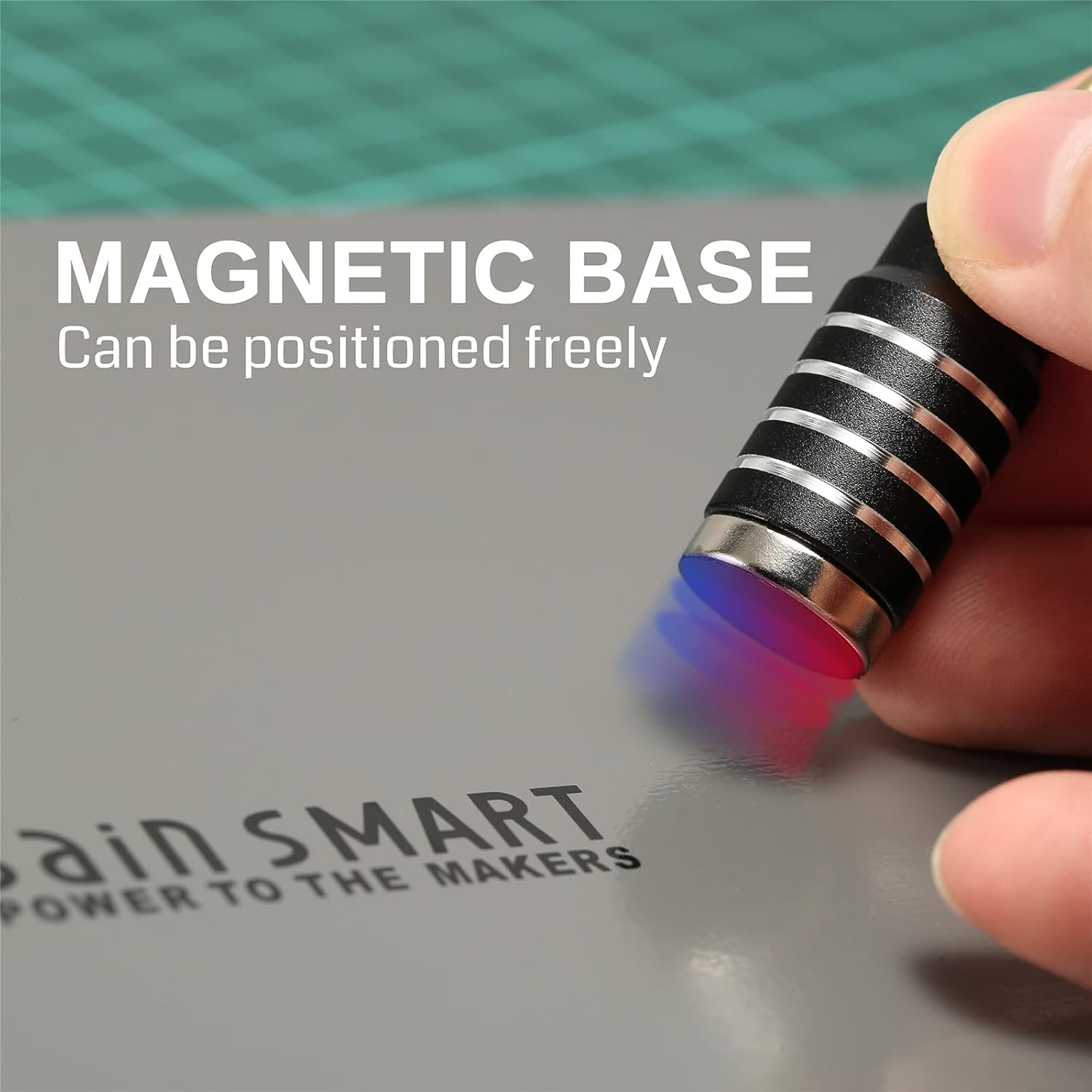
A magnetic model has magnets in the feet of each arm. They hold to the steel plate, so you can reposition arms freely. But the magnetic circuit only spans arm foot to plate. Nothing connects the plate to the bench except friction from four rubber pads. Push an arm with your finger and it holds; push a board with a soldering iron and the load travels through the clamp, the arm, the magnet and into the whole plate — and the thing that slides is the plate.
So the real benefit of a magnetic design is placement freedom, not anti-slip. Anti-slip has three routes: enough plate mass, soft enough pads, or a base you can clamp to the bench edge. It also explains why the expensive magnetic stations add plate weight instead of adding magnets: extra magnets make the arm harder to nudge and do nothing for the plate.
One safety note: a magnetic bench is not ESD-friendly. The magnet itself is inert, but dragging boards across a magnetic plate carries debris with them, and if you already work on an anti-static mat the grounding path needs checking separately. I covered that in the three resistances of an ESD mat.
Five clamping mechanisms and what each can do
Sorted by how they hold, these five products are five mechanisms rather than five brands:
- Magnetic gooseneck arms plus PCB pillars: the arms position the clamps, the pillars lift the board. Good for board work with occasional wire work. The weakness is that a pillar can only press on a board edge or the underside, so a populated edge defeats it.
- Magnetic gooseneck arms with 360 degree clamps: no pillars, the clamps bite the board edge. Fine on thin boards, poor on thick ones.
- Screw-locked fixed arms: arm positions are fixed to threaded holes in the base, so you lose placement freedom, but once tightened the load path is bolted rather than magnetic and feels stiffer.
- Spring parallel clamps: press to open, release to grip, which suits frequent board swaps. The jaws are parallel, so pressure is even, but the clamping height is fixed and nothing can be held in mid-air.
- Aluminium rail with double-joint clamps: clamps slide along a rail and rotate on joints. Fast to adjust, but stiffness along the rail depends on how well the base is pinned down.
Once you see this layer, the price spread stops being mysterious. The $19.45 model solves "hold it"; the $55.99 model solves "hold it, position it in mid-air, and light it". The difference buys arms and pillars, not a brand.
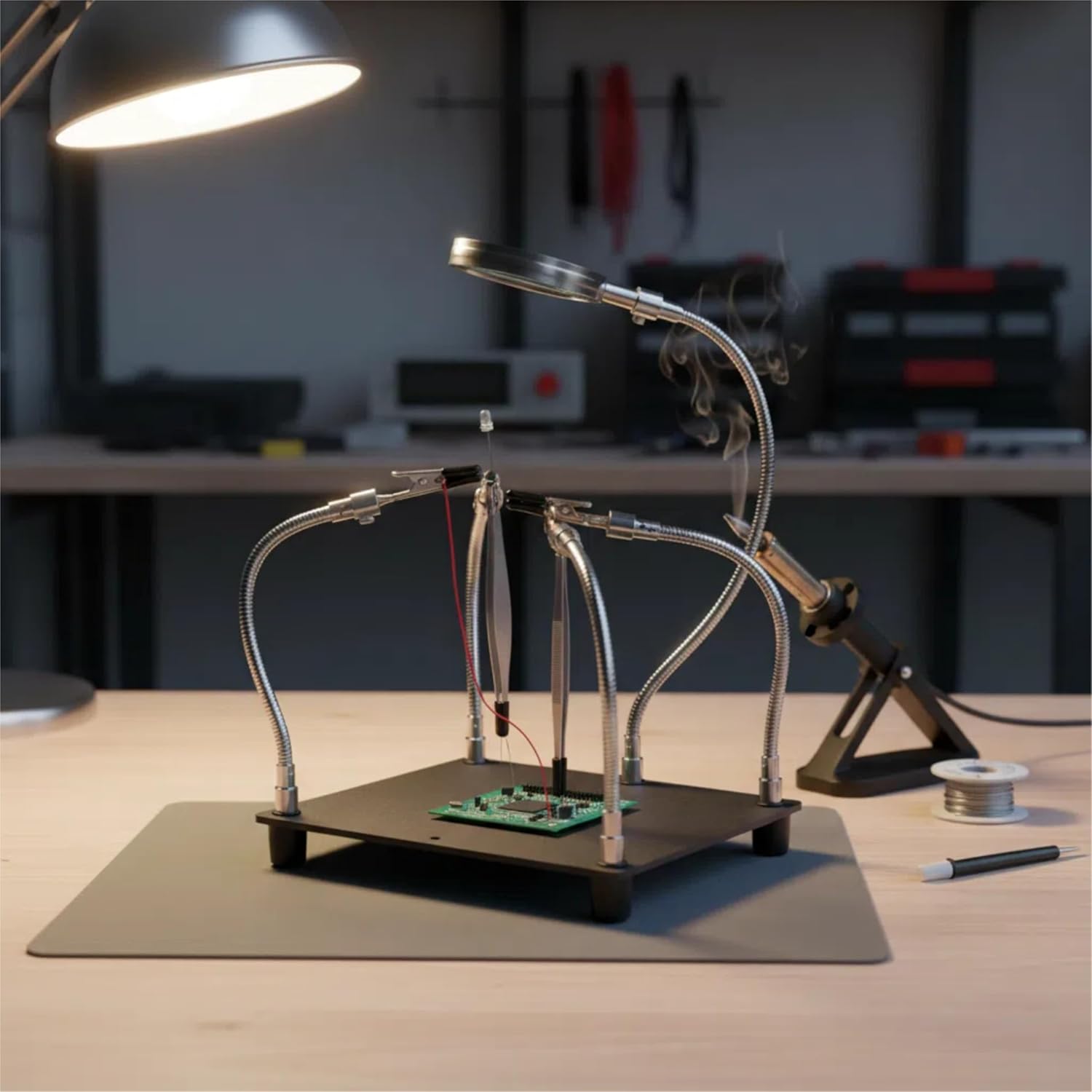
SainSmart: 11.1 x 7.1 inch base, 2.4 pounds of steel
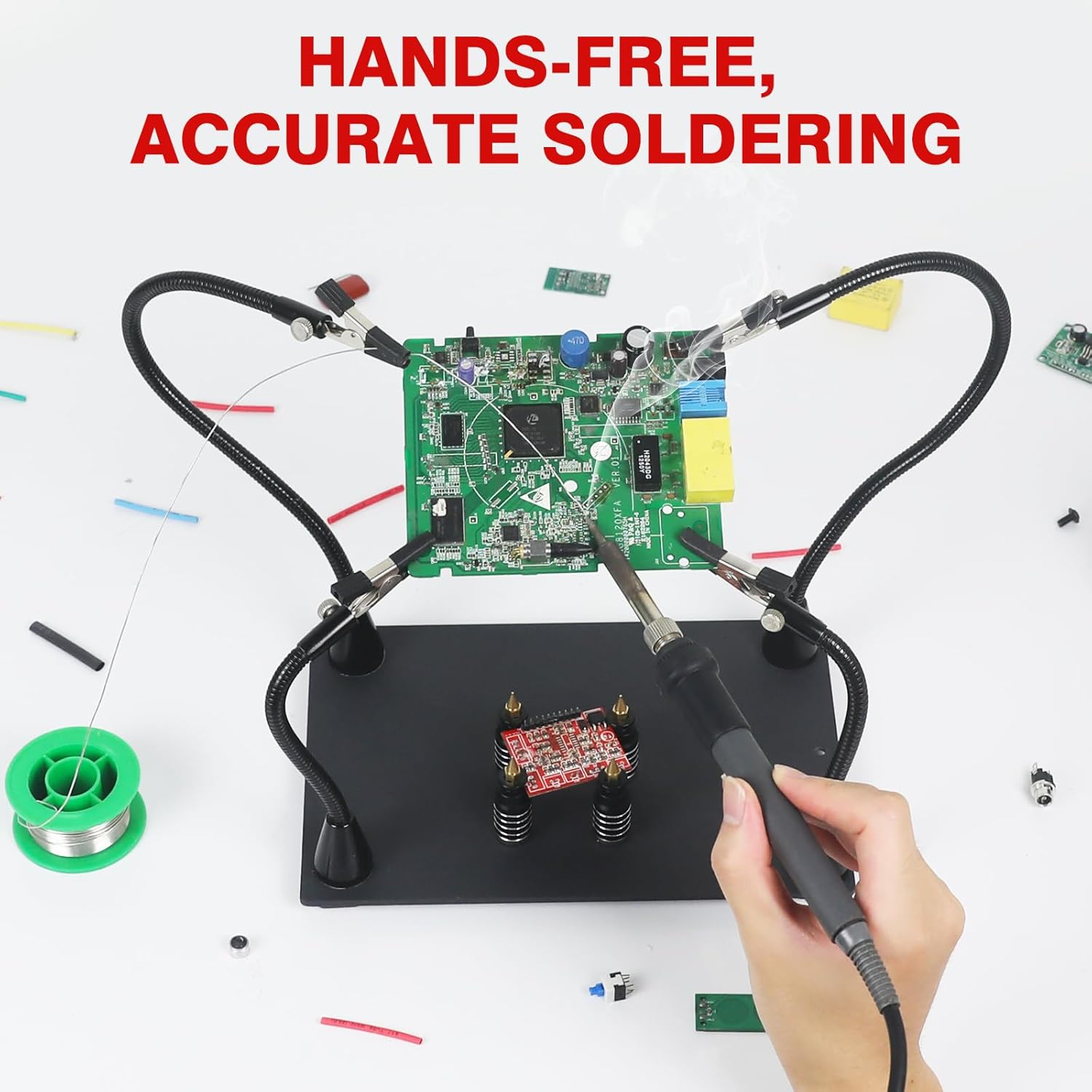
This is the one that puts a number on its ballast: an 11.1 x 7.1 inch powder-coated steel base weighing over 2.4 lb, with four non-slip pads underneath. The arms are mixed — two at 7.5 inches, two at 14.0 inches — plus four PCB pillars and a 5x LED magnifying lamp with three colour temperatures and ten brightness levels. The price was $55.99 when I pulled the page; the listing is here.
The defects need saying plainly. First, this is the previous generation: the brand's own store now sells a second-generation station on the same 11.1 x 7.1 base, with a soldering iron holder and a mini crocodile clip holder added, five colour temperatures, and the cable routed inside the lamp body, while this Amazon listing is still the four-arm, three-temperature version. Second, the brand page cannot count its own arms: the title says "6 Adjustable Gooseneck Arms" and the description on the same page says "three adjustable gooseneck arms (7.5", 13.6", 3.6")" — six and three in one document, with three lengths listed. Third, 14.0 inch arms against a 7.1 inch short side give an overhang ratio near 2, so hold the plate down before hanging anything heavy on the far end. Fourth, the four pillars have no thread lock; they locate magnetically, so a board that shifts takes the pillars with it.




Four-pillar magnetic holder: a 9 inch arm on a 9 x 6 base
This one follows the same thinking with less of everything: a 9 x 6 inch steel base, two 9 inch arms and two 4.5 inch arms, four magnetic pillars, and 360 degree clamps locked with knurled thumb nuts. The price was $39.99 when I pulled the page; the listing is here.
Its defects are equally clear. First, there is no magnifier and no lamp; the word "lamp" does not appear on the page at all, so if you want to see while you solder that cost sits outside this purchase. Second, the page says "heavy steel base" and never gives a weight, so the 1.50 overhang ratio of a 9 inch arm on a 6 inch short side has no stated ballast behind it. Third, the four pillars locate magnetically with no thread lock. Fourth, stock showed 17 units left when I checked, so restock timing is not something you can plan around.
What it does well is the clamp lock. A knurled nut takes more torque than a thumb screw, and a 360 degree head that locks means you are not holding the board steady with one hand while tightening with the other.





Kaisiking: the magnifier in the title is a handheld one
This is the cheapest of the five: a 7.87 x 5.51 inch rectangular painted steel base, 8.34 inch gooseneck arms, and a 2.5x lens. The price was $20.99 when I pulled the page; the listing is here.
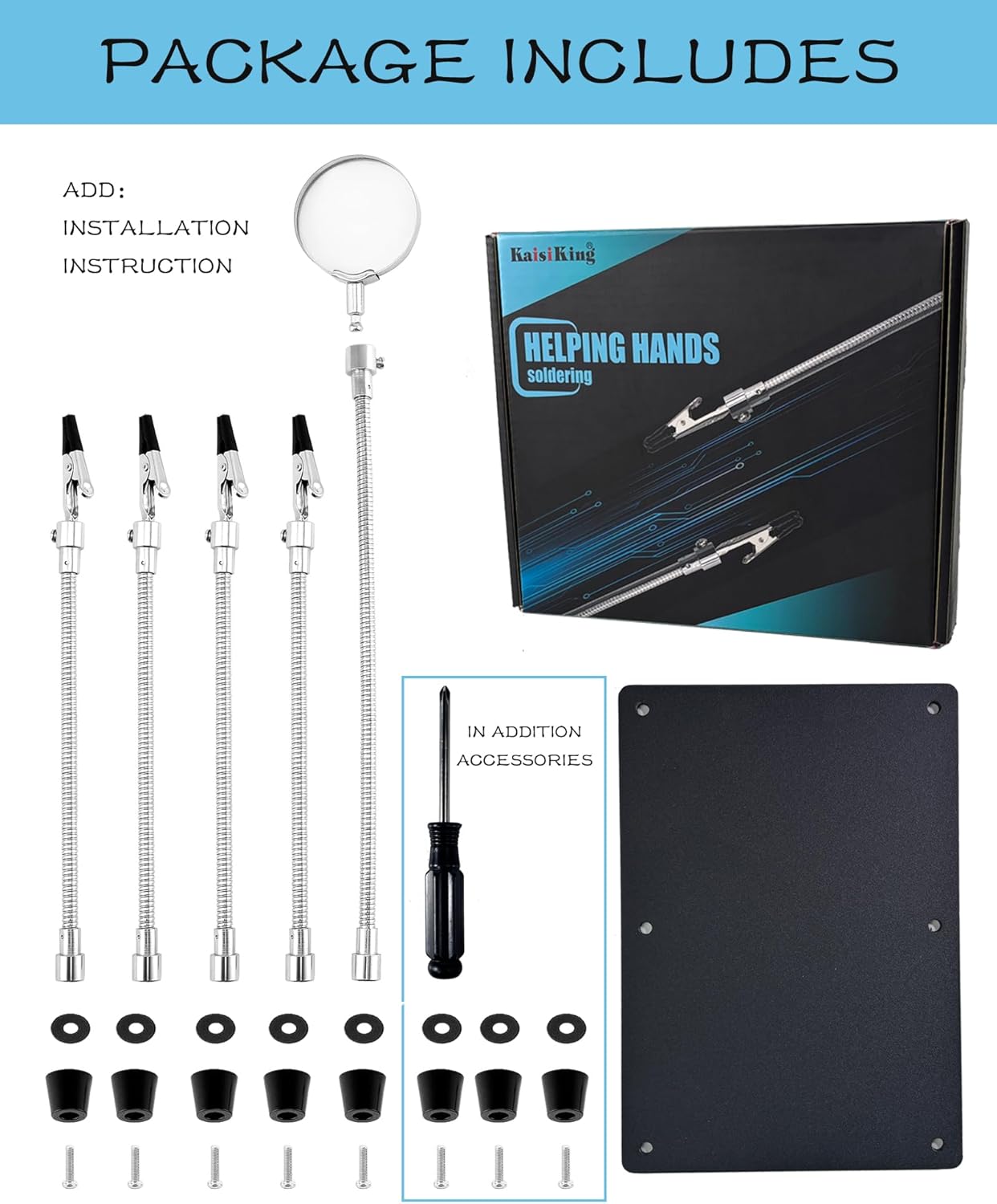
Start with the part that matters most. The title says "Soldering Station with Magnifying Glass" and the parts list says "1 x handheld magnifier". A handheld magnifier cannot be mounted over the work — you have to hold it with a hand you do not have. It is a different product from a lamp-mounted magnifier, so do not read the title as the latter.
The second contradiction is the arm count. The third bullet says "4 adjustable 8.34 inch metal gooseneck arms", the parts list on the same page says "5 x flexible metalarms", and the clip count is four. Four arms, five arms, four clips, three numbers that do not agree, and nothing on the page explains where the extra arm goes.
Third, this is a screw-locked design rather than a magnetic one: arm positions are fixed to threaded holes, so there is no free placement. That is not all bad — the brand deliberately notes that turning the arm against the screw direction tightens rather than loosens it — but four holes on a 7.87 x 5.51 inch plate leaves very little room. Fourth, there are no PCB pillars, so board work depends entirely on the clamps biting the edge. The pad count also drifts: one bullet says five anti-slip pads, the parts list says eight rubber feet plus eight screws.





EOOKU spring clamps: what a 4 x 4 base can hold
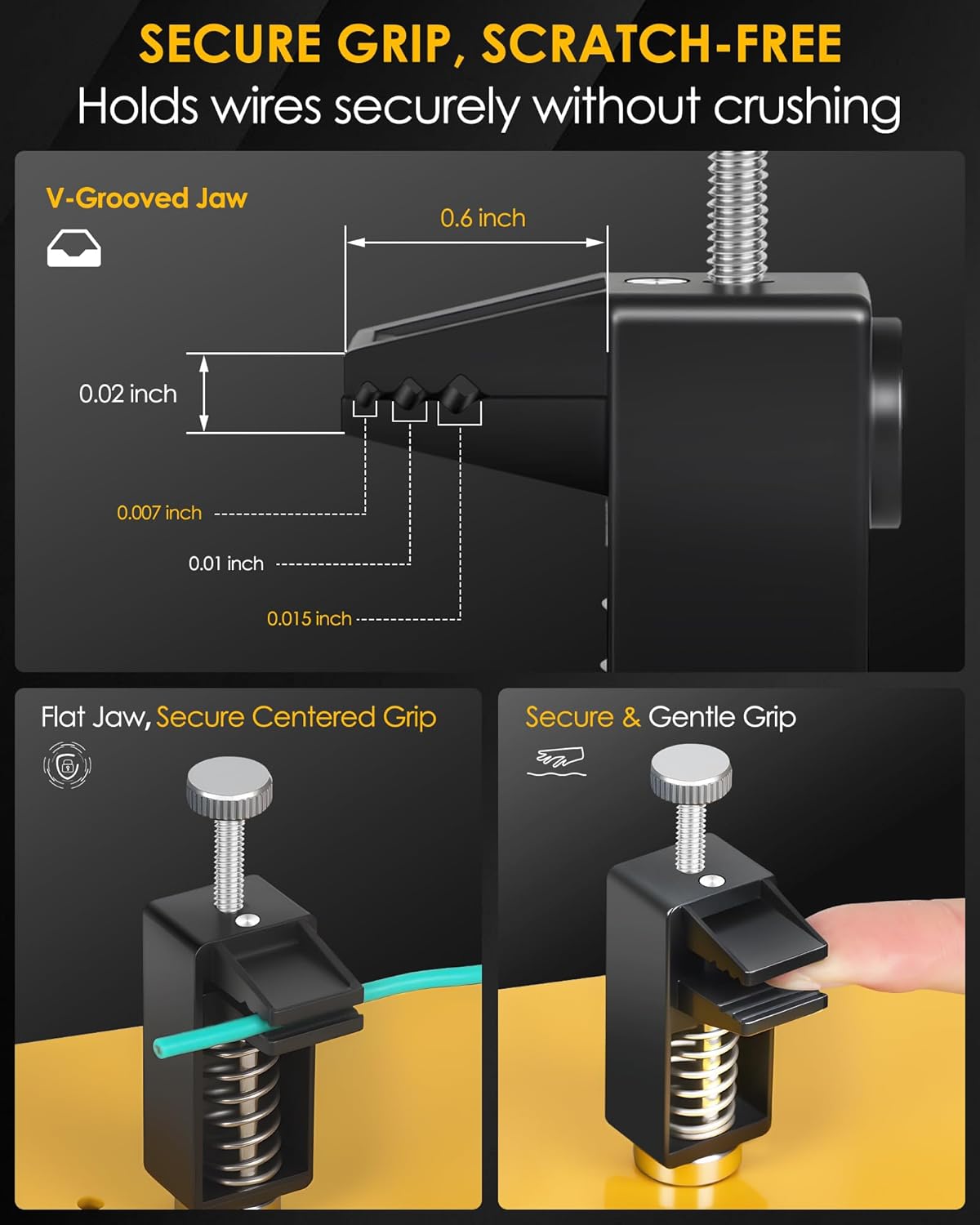
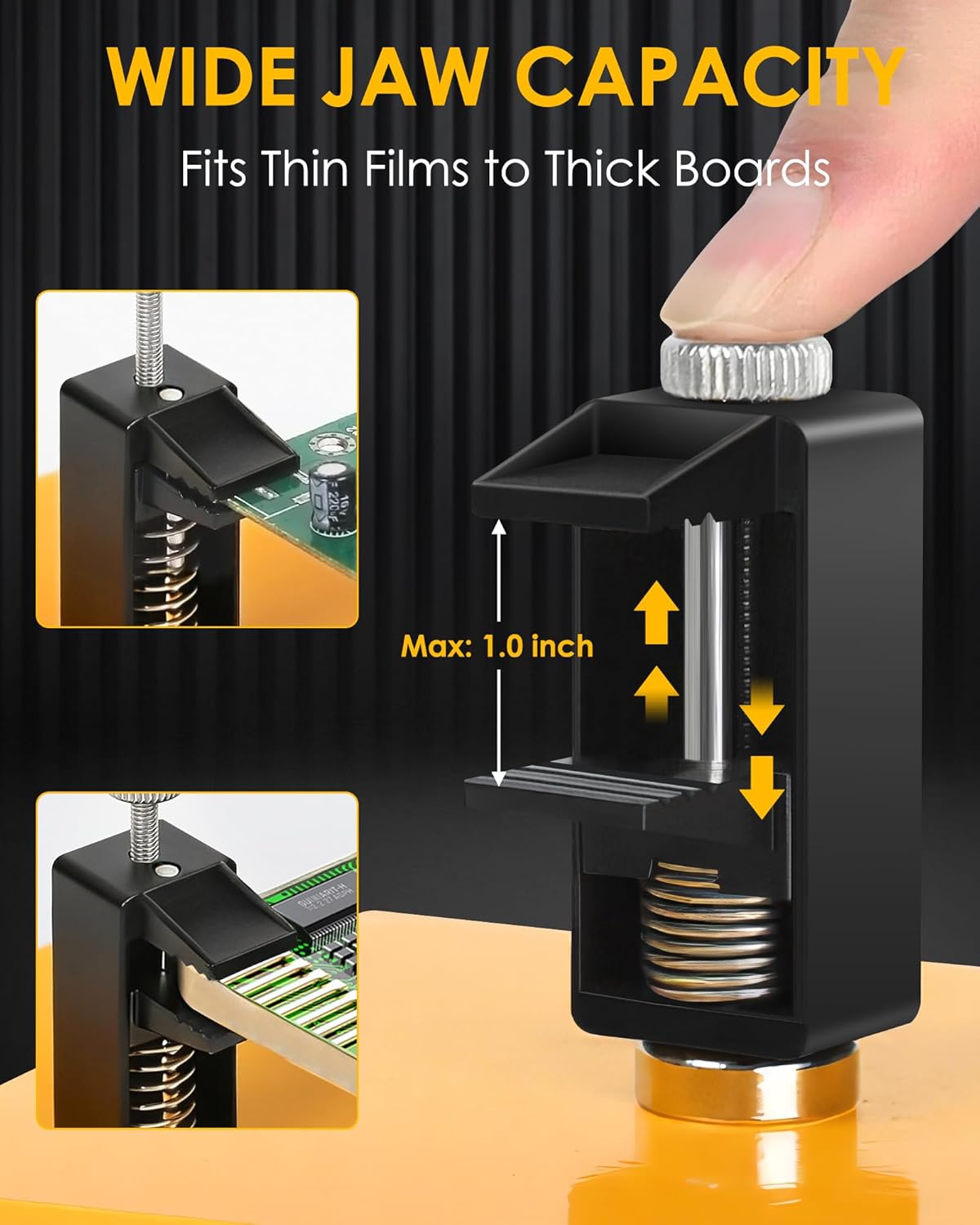
This is a different class of object from the first four. There are no gooseneck arms: two spring parallel clamps sit on a 4 x 4 inch steel plate. The price was $19.45 when I pulled the page; the listing is here.
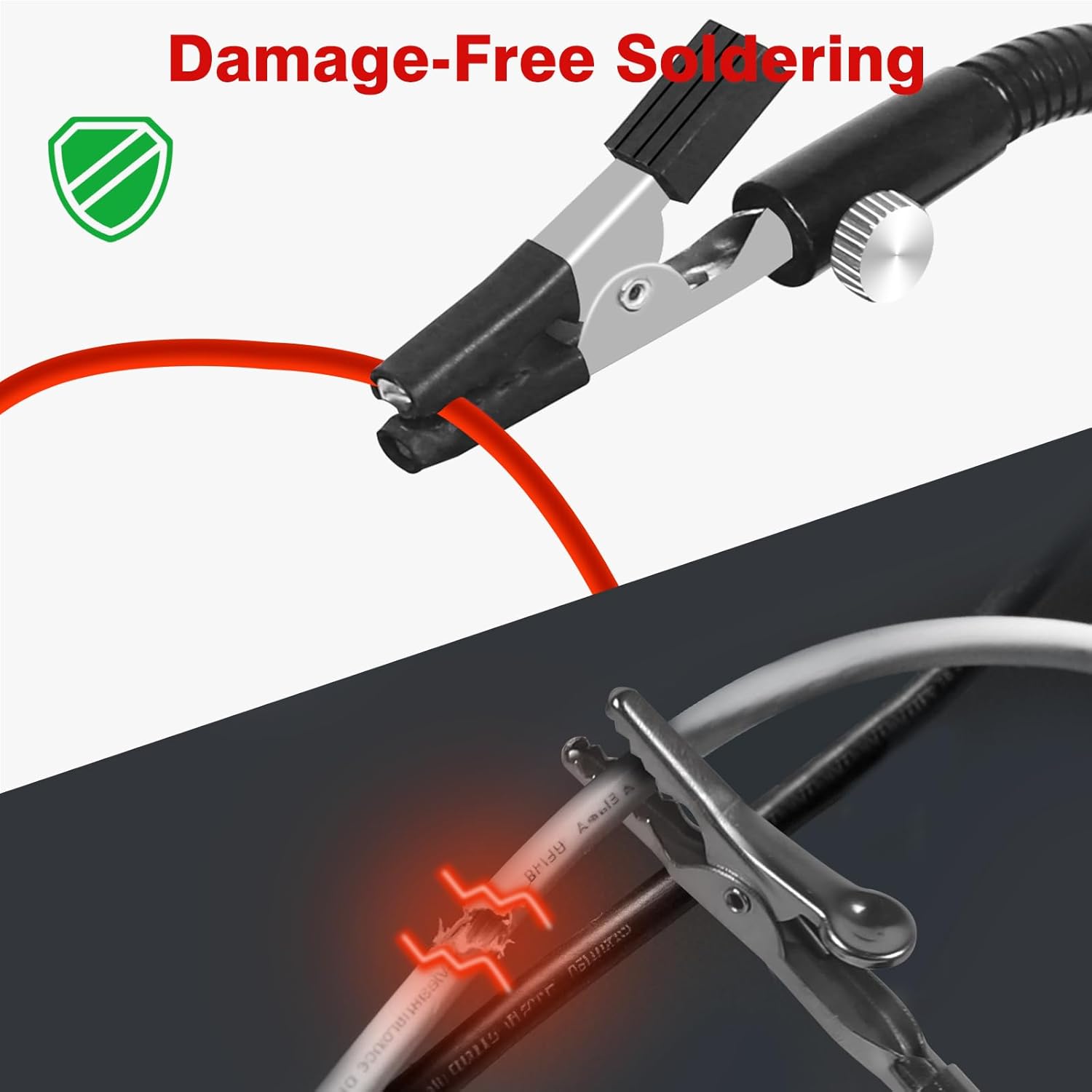
What it solves is the "press once and it holds" motion. One hand presses to open and releasing grips, so board swaps are quick; parallel jaws apply even pressure; and there are built-in grooves so a ribbon or a single wire stays in a channel instead of sliding. The jaws carry silicone covers, so they do not bite insulation or scratch pads.
Three defects. First, jaw width appears twice with two different numbers: "1.0" Parallel Jaws" in one place and "0.6" x 0.6" NON-MARRING JAWS" in another. A 40 percent difference, with no explanation of whether those are two parts or two versions. Second, 4 x 4 inches is the smallest base here at 16 square inches, which puts the centre of mass almost directly over the jaws and leaves no real placement freedom. Third, no arm means no mid-air positioning: parts can only be held near board height, so anything that needs lifting or angling is out of reach. And the magnets only work on steel or iron, so on a wooden or aluminium bench this is a steel plate with magnets in it.



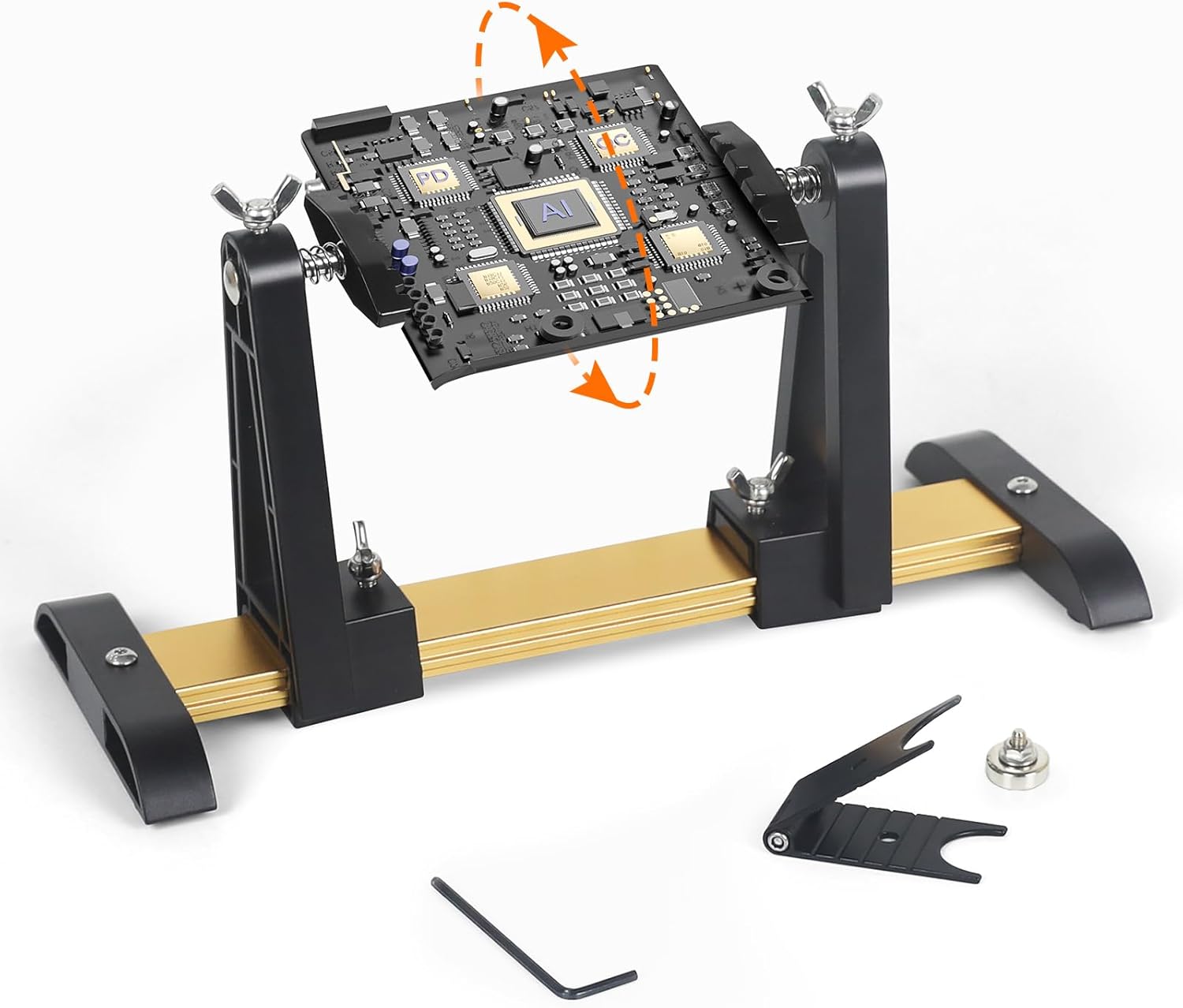
Aluminum rail clamp: the spec sentence still says X-inch
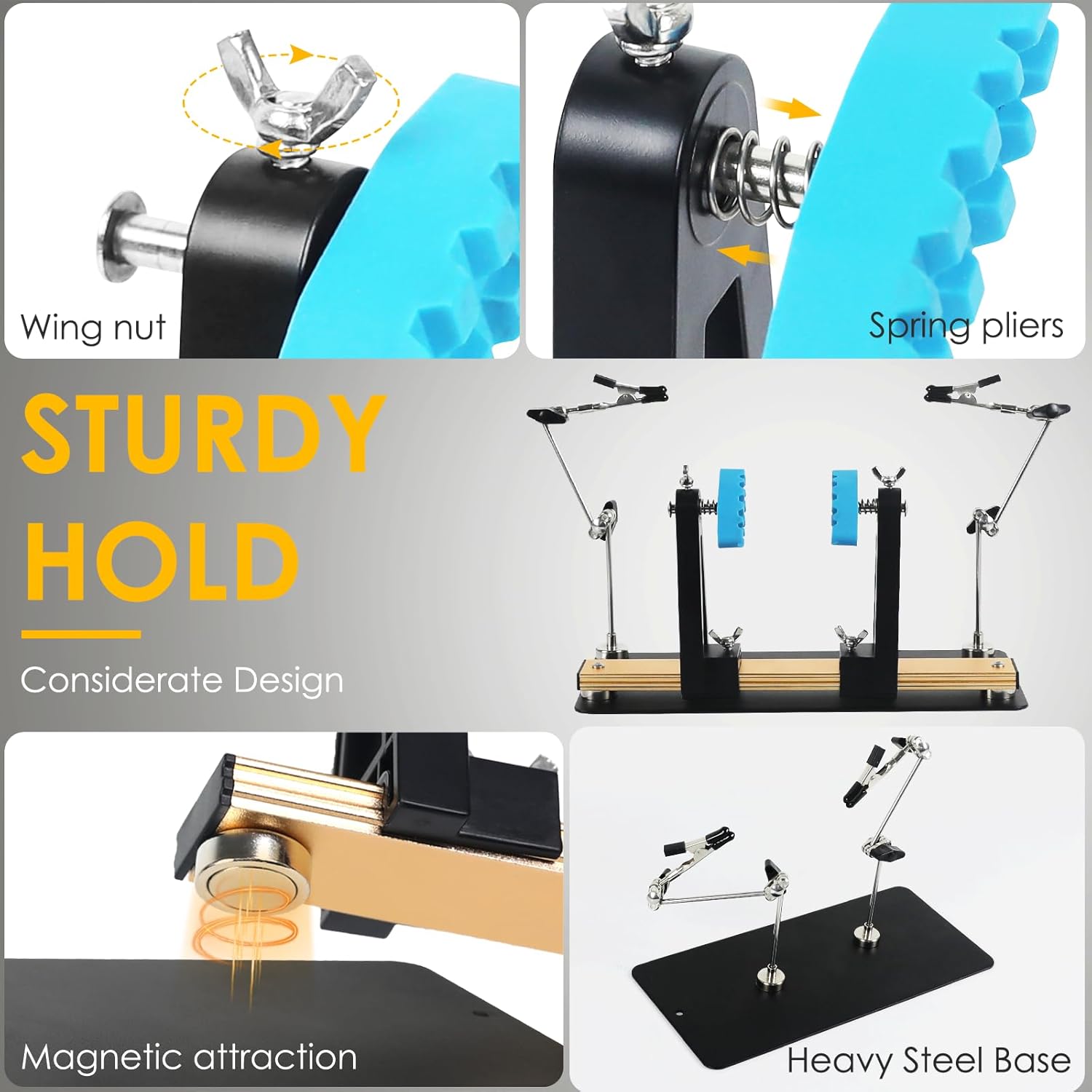
This one is an aluminium base with a rail, two double-joint clamps that slide along it and rotate through 360 degrees. The price was $29.98 when I pulled the page; the listing is here.
Its specification sentence deserves a separate look: the brand writes "two powerful magnets plus a heavy X-inch x X-inch iron Base". X-inch is an unfilled placeholder, which means the size of the iron plate that provides the ballast is not stated anywhere on the page. That kind of residue means the listing was not proofread; the title's "2Helping Hands" missing a space is the same kind of trace.
The structure tells you how it works: two magnets hold to an iron plate, and the plate in turn holds to the bench by its own weight or by sticking to a metal bench top. So "strong magnetic" describes the clamps holding to the plate, not the assembly holding to the desk. On a non-metallic bench the plate is still what slides.
The remaining defects: two clamps only, no PCB pillars, no magnifier; rail travel is not stated, so usable range has to be measured after delivery; and aluminium parts flex slightly when clamping a thick board, which is normal at this price but worth knowing.






Pick by station: three situations, three paths
Situation one: you mostly solder whole boards larger than 80 x 60 mm. Go with a large base, magnetic arms and PCB pillars. The 11.1 x 7.1 model's 2.4 lb is the one ballast figure you can verify here, and the long-arm-plus-pillar combination covers the "lift the board, then bite the edge" motion.
Situation two: you mostly solder flying leads, ribbon cable and earphone wire. The jaw and the wire groove matter, the base does not. The spring clamp model is one-handed and fast to swap; on very thin wire, check that the silicone jaw does not flatten the insulation.
Situation three: small boards, dense parts, and you need to look while you solder. Here magnification and lighting outrank the base. The model with the 5x LED lamp is the most complete package for that; the Kaisiking unit is cheaper but its lens is handheld, so it does nothing over the bench. I wrote the magnification-versus-working-distance arithmetic separately in how to read a magnifier lamp spec and will not repeat it here — the one-line version is that higher magnification means shorter working distance and less room for the iron.
If you are still choosing tools for the desoldering step itself, how to read the three numbers on a desoldering pump and the two melting points of removal alloy are up and downstream of this one on the same bench.
Five things to check before you order
- Measure the short side, not only the long side: arm length divided by short side is the overhang ratio, and 1.5 versus nearly 2 is two different feels at the bench.
- Search the page for weight: look for lb, pound, kg and gram. If none appear, the ballast cannot be verified.
- Check whether the arms are mixed: two long and two short is the normal kit; all long is worse, not better.
- Read the parts list section: titles and bullets contradict it regularly, and the parts list wins. This article flags four such disagreements.
- Confirm the mechanism: screw-locked cannot be repositioned freely, magnetic cannot stop the base sliding, spring clamps cannot hold anything in mid-air. Three different limits.
One more note: a better holder does not improve your air. Fume extraction is a separate decision, covered in how to read solder fume extractor specs.
FAQ
Q: Can a magnetic base stick to an aluminium or wooden bench? No. The magnetic circuit needs a steel or iron plate; aluminium and wood do not carry flux. You either put a steel plate underneath or buy a model with a bench clamp. Among these five, the aluminium-base model relies on a separate iron plate for ballast, and its magnets hold the clamps to that plate, not to the desk.
Q: Is higher magnification always better? No. Magnification and working distance are inversely related, so as the number goes up the lens has to sit closer to the joint and the iron and tweezers lose room. 5x is enough for parts below 0603; for pin headers, 2.5 to 3x is easier to work under. The conversion and its relation to lens diameter is in the article linked above.
Q: Pillars or clamps — which gets used more? Pillars for boards, clamps for wires and parts. A pillar does not block the board face and can support from underneath, but it fails on a populated edge. If you buy only one holder, a model with both is the more forgiving choice.
Q: Why do these pages avoid stating base weight? My reading is that the models with less ballast have nothing to gain from publishing it; steel plates in this band generally run 1 to 2.5 lb, and once the number is out the comparison becomes blunt. When the weight is missing, judge by base area and plate thickness and assume the lighter end.
Q: What should I check when it arrives? Three things: extend every arm fully and push the base sideways with a finger to see whether it slides; clamp a scrap 1.6 mm board and see whether the clamp rotates on its own; press each rubber pad to find whether one corner is hanging.
Scope and disclosure
The Amazon links in this article are affiliate links. If you order through them this site earns a commission, and the price you pay is unchanged.
Every dimension, arm length and part count comes from the product pages and the brand site as captured on the day of writing, and prices are the figures shown on those pages at capture time, valid as of publication; stock and price move, so treat the listing as the final word. I did not unbox these tools, so there are no hands-on claims about grip force or durability — wherever a judgment depends on use, I have written it as an inference and named the basis. Where pages contradict each other or themselves, I list both numbers in the text rather than picking one on the manufacturer's behalf.
👉 Join Xiaomi MiMo Platform: Leading AI model platform with cost-effective inference
👉 Join Aliyun AI: Top AI products with exclusive coupons for business innovation
📌 This article was AI-assisted generated and human-reviewed | TechPassive — An AI-driven content testing site focused on real tool reviews
🔗 Recommended Tools
These are carefully selected tools. Using our affiliate links supports us to keep producing quality content:
As an Amazon Associate, I earn from qualifying purchases at no extra cost to you.