Hot Air Rework: Why the Same Station Has Six Wattages
Between $43 and $916, hot air rework listings share one script: high power, fast heat-up, adjustable airflow. I actually pulled five live product pages and set them beside Hakko's own spec sheet, and the word "power" turned out to carry six different meanings across those five listings.
This piece only covers what the pages state and what they leave out: where a wattage number comes from, why airflow is the denominator, what a temperature ceiling actually buys, and which piece each of the five is missing. No hand-feel claims, and no verdict on whether any of them is "worth it".
A counter-example: six wattages, one machine
On Hakko's FR-810B specification page, power consumption is not one line but six: 700 W at AC100 V, 840 W at AC110 V, 820 W at AC120 V, 1,100 W at AC220 V, 1,200 W at AC230 V and 1,300 W at AC240 V. The handpiece column splits the same way, 670 W at 100 V through 1,270 W at 240 V.
Same machine. It did not get stronger, it got plugged into a different socket. So when a listing says "1000 W high power", that number is missing a qualifier: the voltage it was measured at. Three of the five listings here print 1000 W and none of them breaks the figure out by input voltage.
The reverse case is messier. Hakko's own product page headline reads 670 W, which is the handpiece figure at 100 V; in the US the station is 820 W with a 790 W handpiece. One side markets the lowest-voltage number, the other markets the highest. Neither is lying, but you cannot compare the two numbers side by side.
TL;DR
🥇 Just get the job done under $50: WEP 858D, 700 W, 100-500 C, airflow knob with no scale. Workable, not repeatable.
🌟 Presets and auto cool-down on a budget: YIHUA 959D-Digital, 700 W, three memory channels, a "120L" figure with no denominator.
💻 Paying extra for closed-loop control you can write into a process sheet: 861DW and ATTEN ST-862D both claim 1000 W. The first has the larger spec gap, the second prints two airflow scales on one page.
🔬 600 C ceiling and vacuum pickup: Hakko FR810B-05, 50-600 C, 5-115 L/min, $916.80, one unit left at the time of capture.
Prices are as captured; stock moves. Each product section below points to its listing, so check the page before ordering.
Wattage: one number, six readings
Line the five up: 858D at 700 W, 959D at 700 W, 861DW at 1000 W, ST-862D at 1000 W, FR810B-05 at 820 W on 120 V. Read only that column and the conclusion is "1000 W beats 700 W by 43 percent".
The error is treating electrical power as hot-air capability. A rework station pushes air through a heater; the outlet temperature equals ambient plus power divided by (mass flow times specific heat). Power sits in the numerator, airflow in the denominator. A 43 percent larger numerator against a denominator twice as large ends up cooler.
Using air density 1.2 kg/m3 and specific heat 1.005 kJ/(kg*K): at FR-810B's maximum 115 L/min the mass flow is about 0.0023 kg/s, and 670 W of heating lifts the air by roughly 290 K. In other words, 600 C and 115 L/min do not happen at the same time. That is exactly why the official sheet splits temperature ceiling and airflow ceiling into two fields while listings like to merge them into one sentence.
The other direction is worse for the hardware. Turn airflow down to the 5 L/min minimum and only about 58 W is needed to take that stream to 600 C; the remaining six hundred watts can only be dissipated by switching the element on and off. The lowest airflow setting is where the heater cycles hardest, and where these machines tend to burn out a heating element.
Airflow is the denominator: 5 to 115 L/min and its footnote
Only Hakko states all three airflow facts: unit (L/min), range (5-115) and basis (free flowing). Under the table there is a footnote: airflow capacity is rated as free flowing, and restrictions created by various nozzles may reduce the maximum.
That footnote explains why "115 L/min" and "130 L/min" cannot be compared directly. One may have been measured bare, the other through a small nozzle, and neither page says which. The desoldering pump line hit the same trap: that machine quotes 81 kPa together with "measured at the filter case suction port", which is the same kind of qualifier. The two pieces read well side by side: the pump and FR-301 numbers.
Now the dial. Hakko's airflow runs 1 to 9 mapping to 5 to 115 L/min. Mapped linearly that is 13.75 L/min per step, so step 5 is about 60 L/min, not "the fifth of nine, therefore 55 percent". The number on the knob is a step index: not a percentage, not a flow rate.
The temperature ceiling is headroom, not capability
Ranges across the five: FR810B-05 is 50-600 C, ST-862D is 100-480 C, 959D is 100-500 C, 858D is 100-500 C, and 861DW prints none.
A 100 C difference in the ceiling reads like a capability gap but behaves like a headroom gap. Lead-free solder melts around 217-227 C; to push a joint past that on heavy copper, a thermal pad or a multilayer board, the outlet has to sit well above the melting range. Less headroom means you cannot open the airflow, because more air drops the temperature. That is why a 480 C station feels weak on a large pad: not a shortage of temperature, but the inability to hold temperature and airflow at maximum simultaneously. The melting ranges themselves are broken down in the Sn63Pb37 piece.
The floor matters too. Starting at 50 C means FR-810B can preheat, shrink tubing and pre-bake before rework. The four 100 C units can only approximate that by feel.
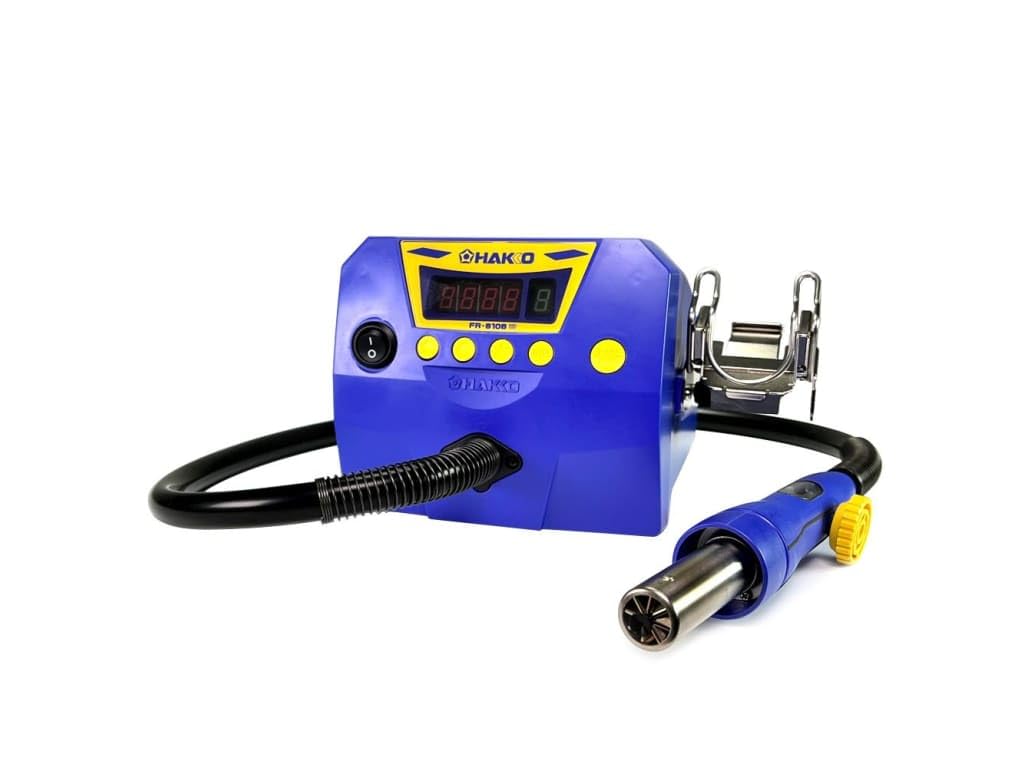
Hakko FR810B-05: the $916.80 reference point
Official specs: 50-600 C, airflow steps 1-9 (5-115 L/min), N51-02 4 mm nozzle standard, five presets plus a chained preset function of up to five steps, vacuum pickup with a pickup indicator, auto cool-down in the holder. Handpiece 250 mm and 180 g; station 160 x 145 x 220 mm.
The value is not the wattage, it is those three qualified lines: a temperature floor of 50 C, an airflow unit, and an airflow basis. Only with all three can you reason backwards about what 600 C actually requires.
Real drawbacks: the product page headline says 670 W, the 100 V handpiece figure, while the US 120 V configuration is an 820 W station and 790 W handpiece, and the page never explains the shift; the 115 L/min figure is free-flow rated and the listing still prints it as a headline; using conventional nozzles requires a conversion adapter on the heater pipe, and Hakko writes that the adapter shipped with the FR-810, without saying whether the FR-810B includes one; this Amazon listing exposes a single main image and no detail shots; one unit left in stock at capture. The listing is here.
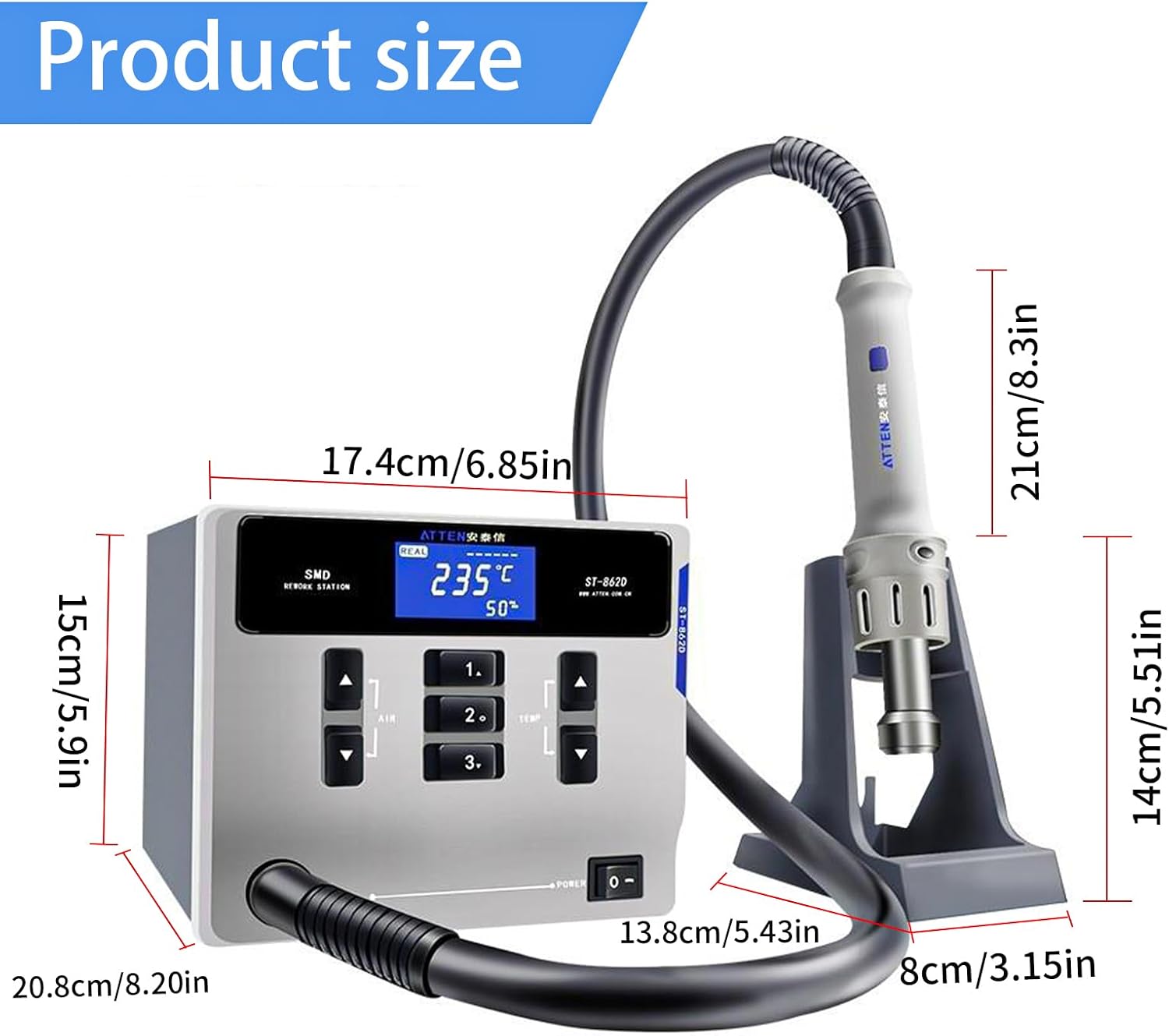
ATTEN ST-862D: two airflow numbers on one page
1000 W, 100-480 C, brushless blower, four nozzles, a cold-air mode, sleep when docked, password lock, three quick temperature keys.
Two airflow scales live on the same page. The bullet block says "Air volume adjustment range 1-120" with no unit; the Product Parameter table says "Hot air flow: 130L/min (Max) 20L/min (Min)". These are not contradictory, they are the two ends of one knob: dial 1 maps to 20 L/min, dial 120 maps to 130 L/min. Mapped linearly, dial 60 is about 74.5 L/min. So the "120" on the panel is not 120 L/min, the real maximum is 130, and the low end carries a 19 L/min offset.
Real drawbacks: the two scales sit in separate blocks and no sentence on the page says they describe the same knob; input voltage is listed as both 230 V/50 Hz and 110 V/60 Hz while power is given as a single 1000 W with no per-voltage split; the 480 C ceiling sits 20 C below three of the others with no explanation; the 20 L/min minimum is a step above Hakko's 5 L/min, leaving less margin on tiny parts; 14 units left at capture. The listing is here.



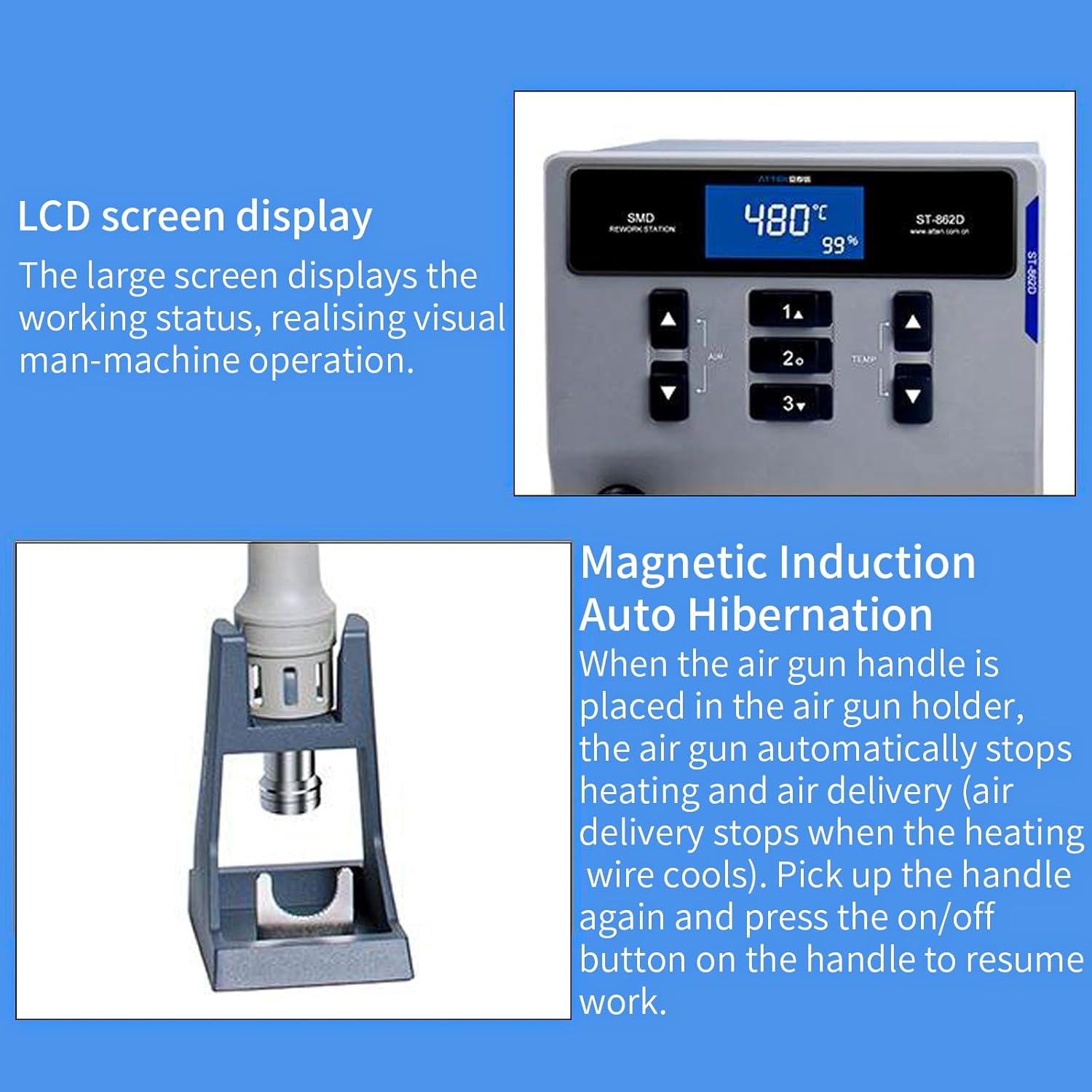


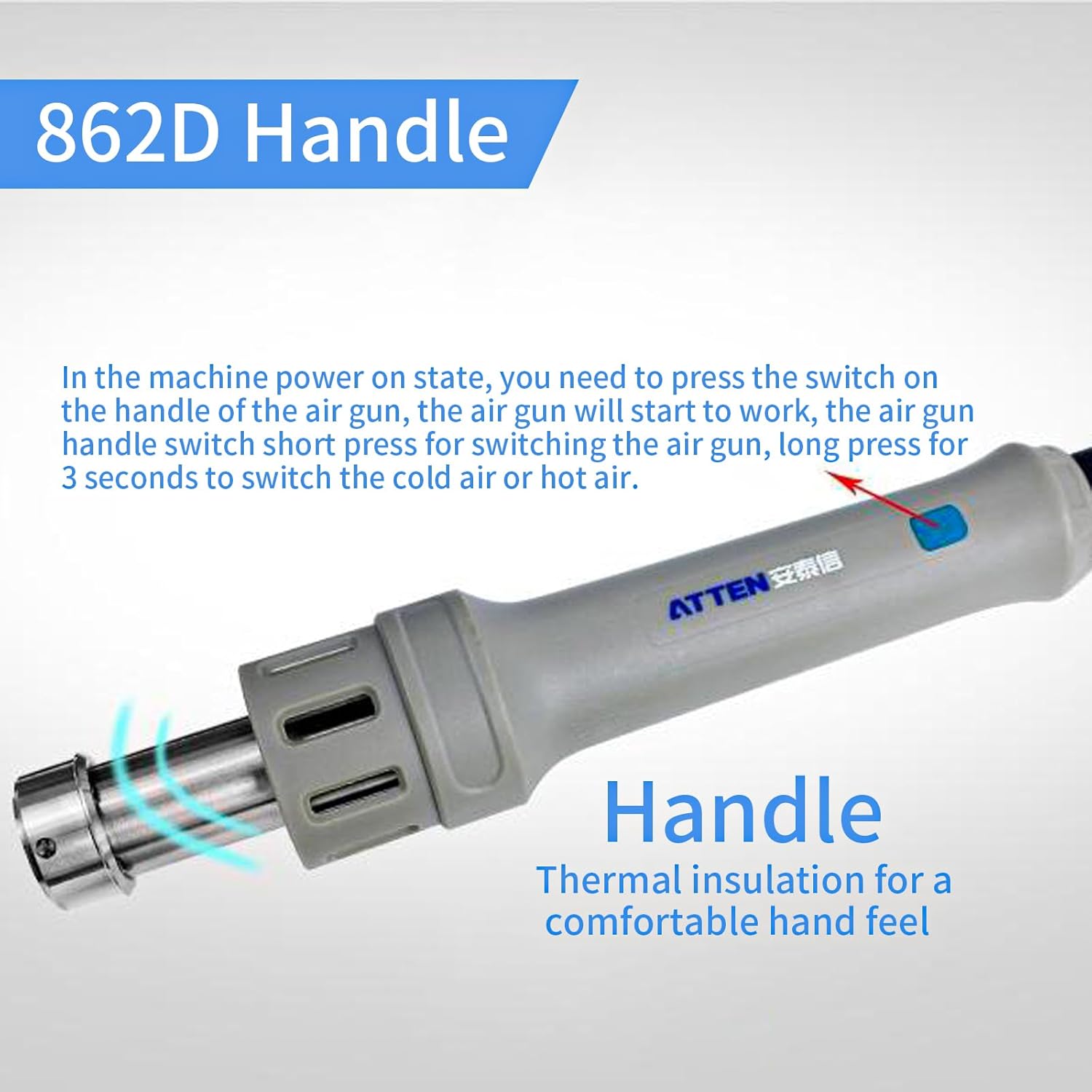

861DW: closed loop is stated, the numbers are absent
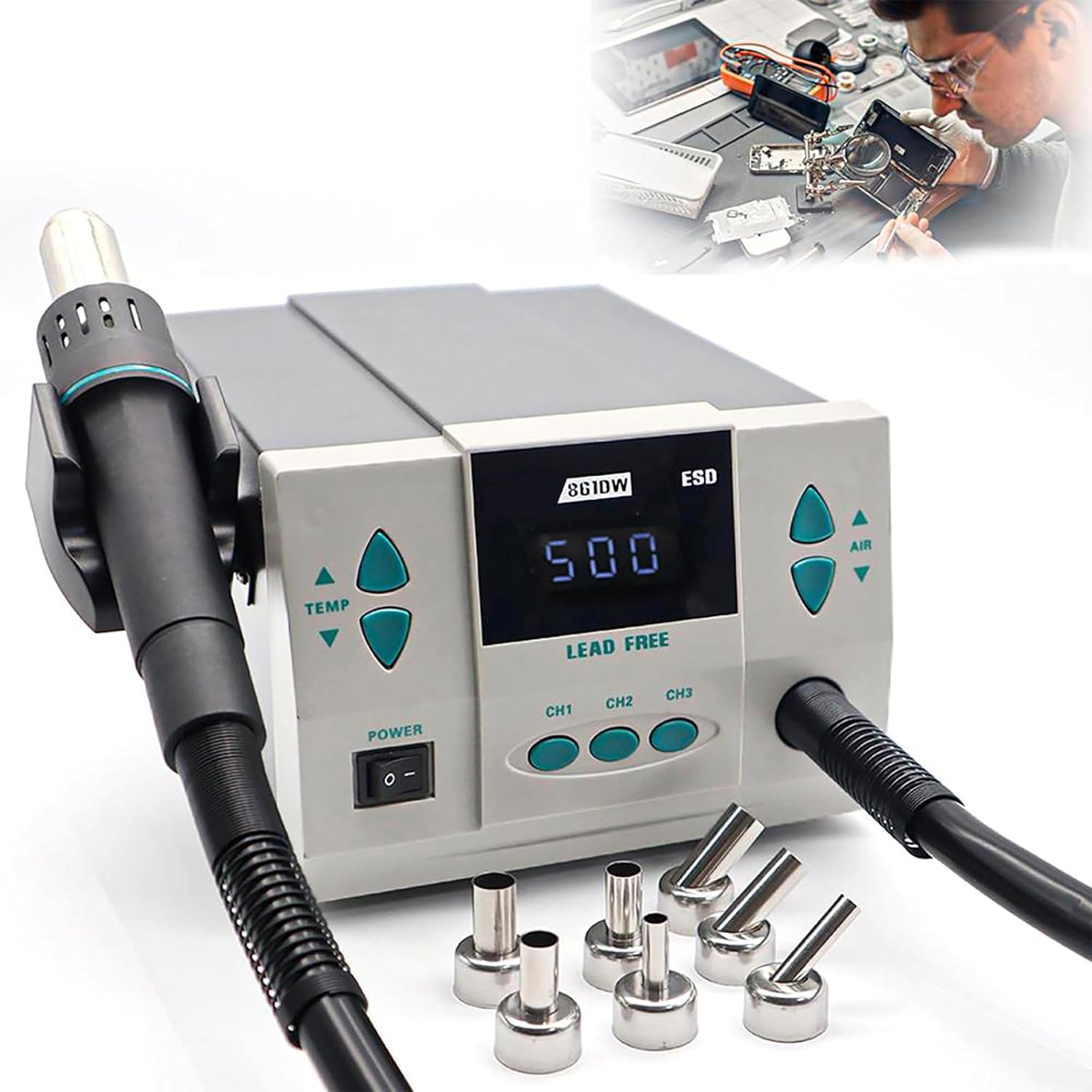
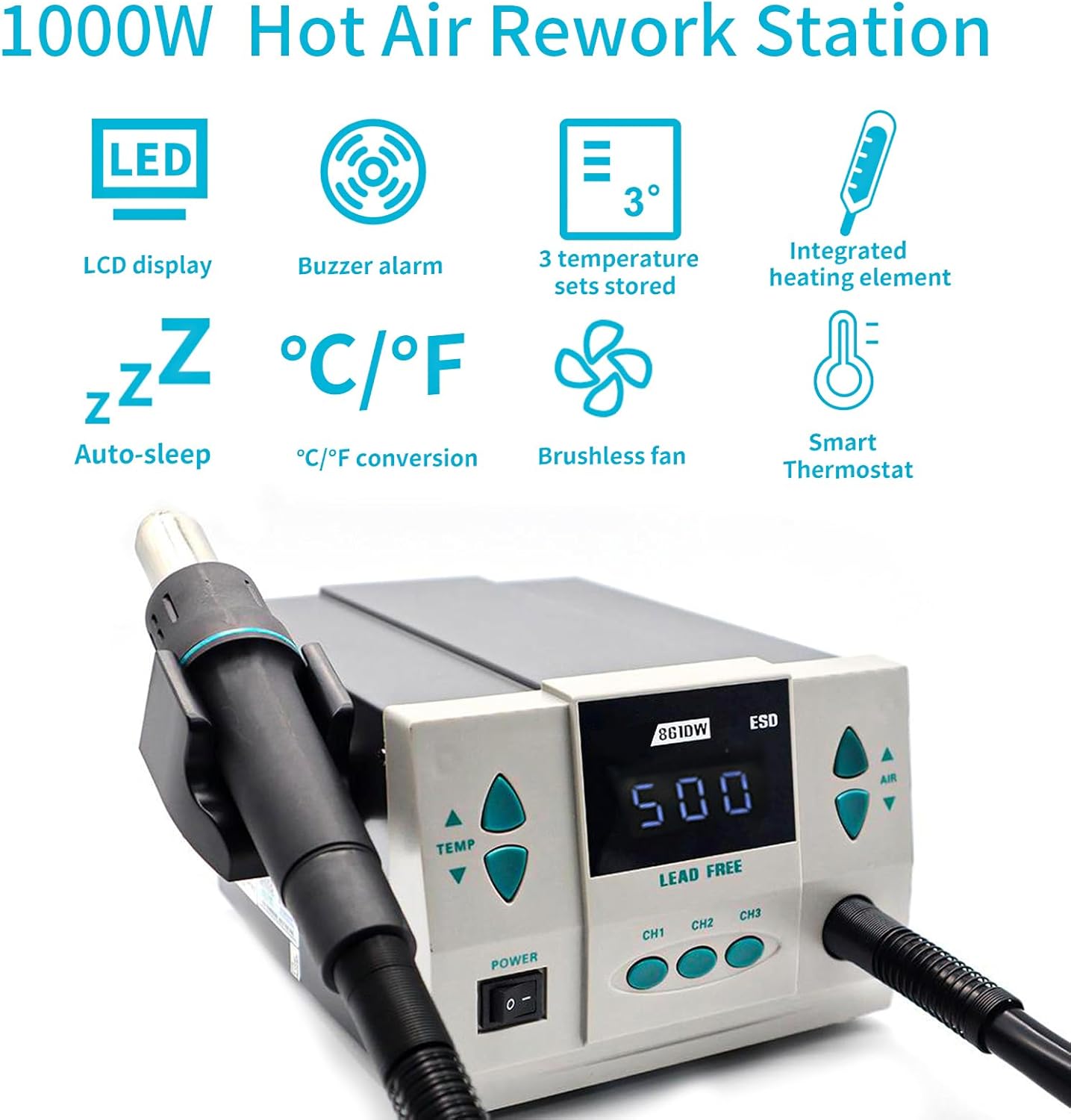
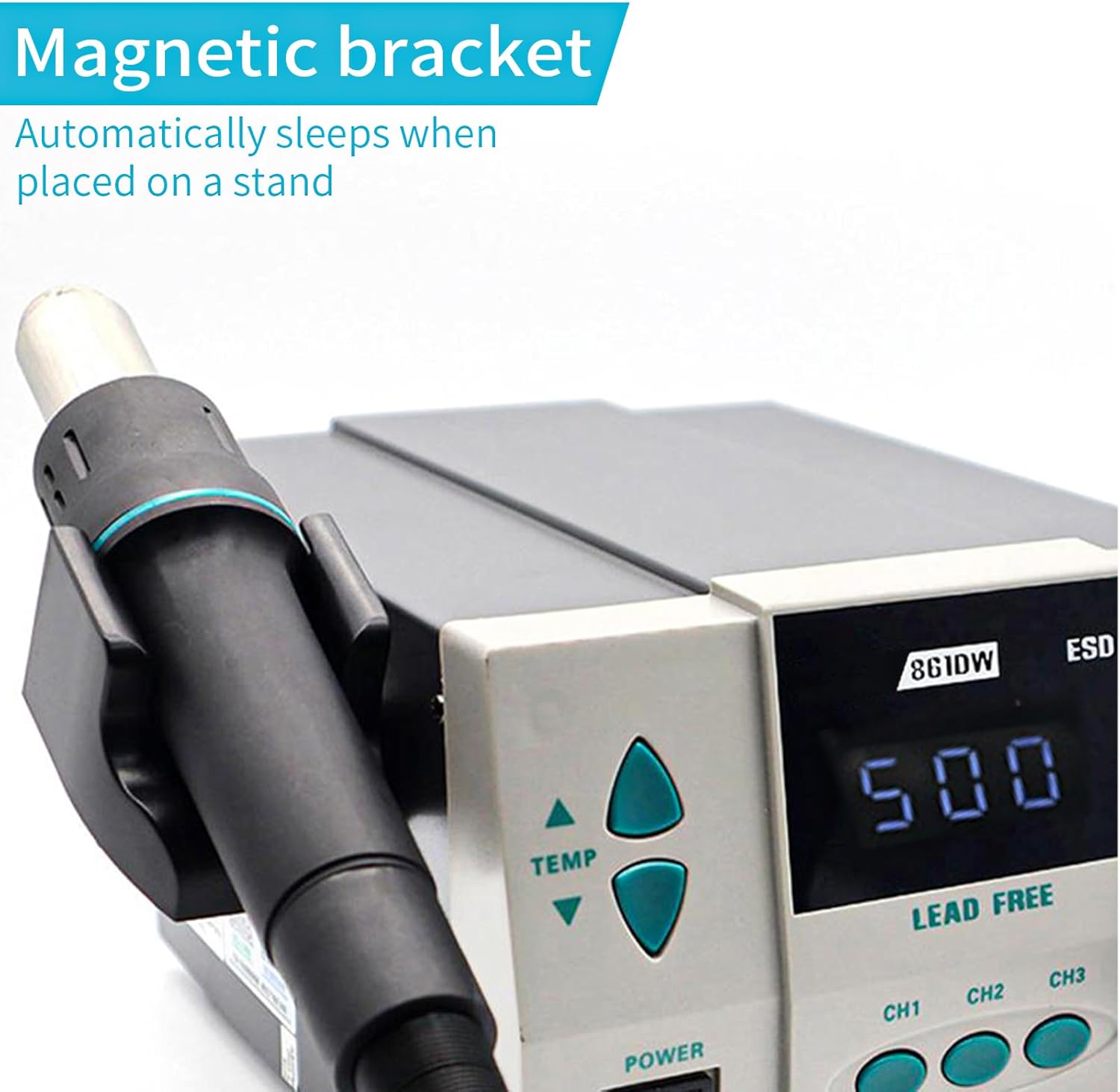
1000 W, three channels (CH1/CH2/CH3), closed-loop microcomputer temperature control, brushless DC vortex blower, password and key lock, magnetic standby, C/F switching.
The one verifiable architectural claim is closed loop: the page states closed-loop microcomputer temperature control, meaning a sensor participates in regulation rather than a fixed duty cycle. Three channels store temperature and airflow separately, the same idea as ATTEN's three quick keys.
Real drawbacks: the page contains no temperature range and no airflow figure, only "adjustable", so nothing beyond 1000 W can be compared with the other four; the title says "110v", which concedes it is not a wide-voltage unit; the title starts with a model number and carries no brand, so the listing alone cannot confirm the manufacturer; "softer airflow" is never quantified; 14 units left at capture. The listing is here.





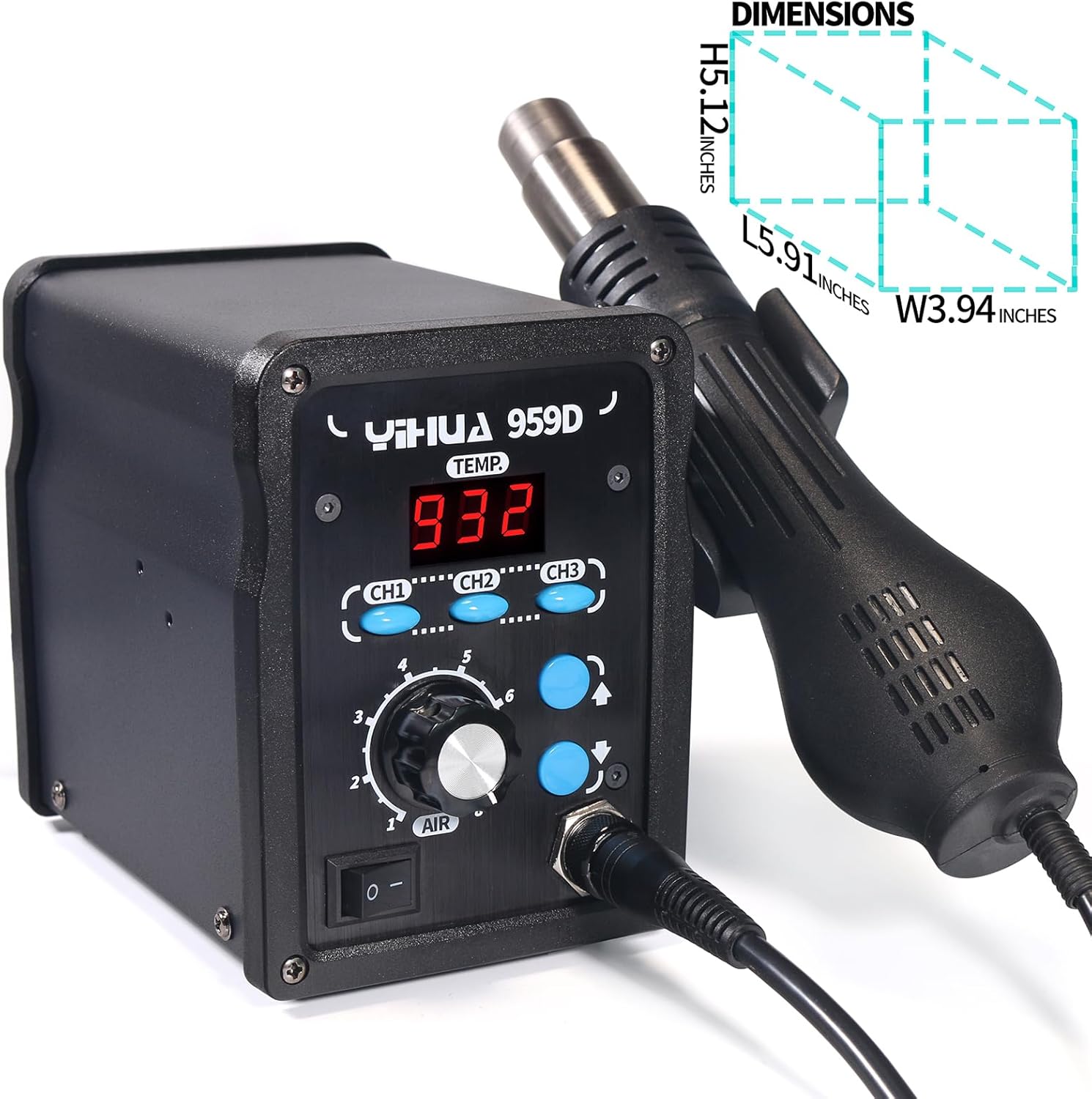
YIHUA 959D-Digital: 120L without a denominator
700 W, 100-500 C (212-932 F), three presets, heat on pickup, cool-down to 212 F on the stand before shutdown, brushed aluminium panel, overheat protection and a fail-safe function.
It sells "120L" as the headline, and that is precisely the field missing a denominator: 120 L per minute, per hour, or some accumulated figure under an unstated condition. Elsewhere the same page says "maximum stabilized temperature of 932 F" - the temperature carries a unit, the airflow does not.
Real drawbacks: airflow exists only as a bare 120L with no unit and no basis; "Airflow Efficiency" in the title is undefined; the floor is 100 C, so there is no 50 C low range; 700 W matches the $43.99 858D, which means the price difference buys a panel and presets rather than heating capacity; the page never says whether the three presets can be named; In Stock at capture. The listing is here.



WEP 858D: the $43.99 entry line
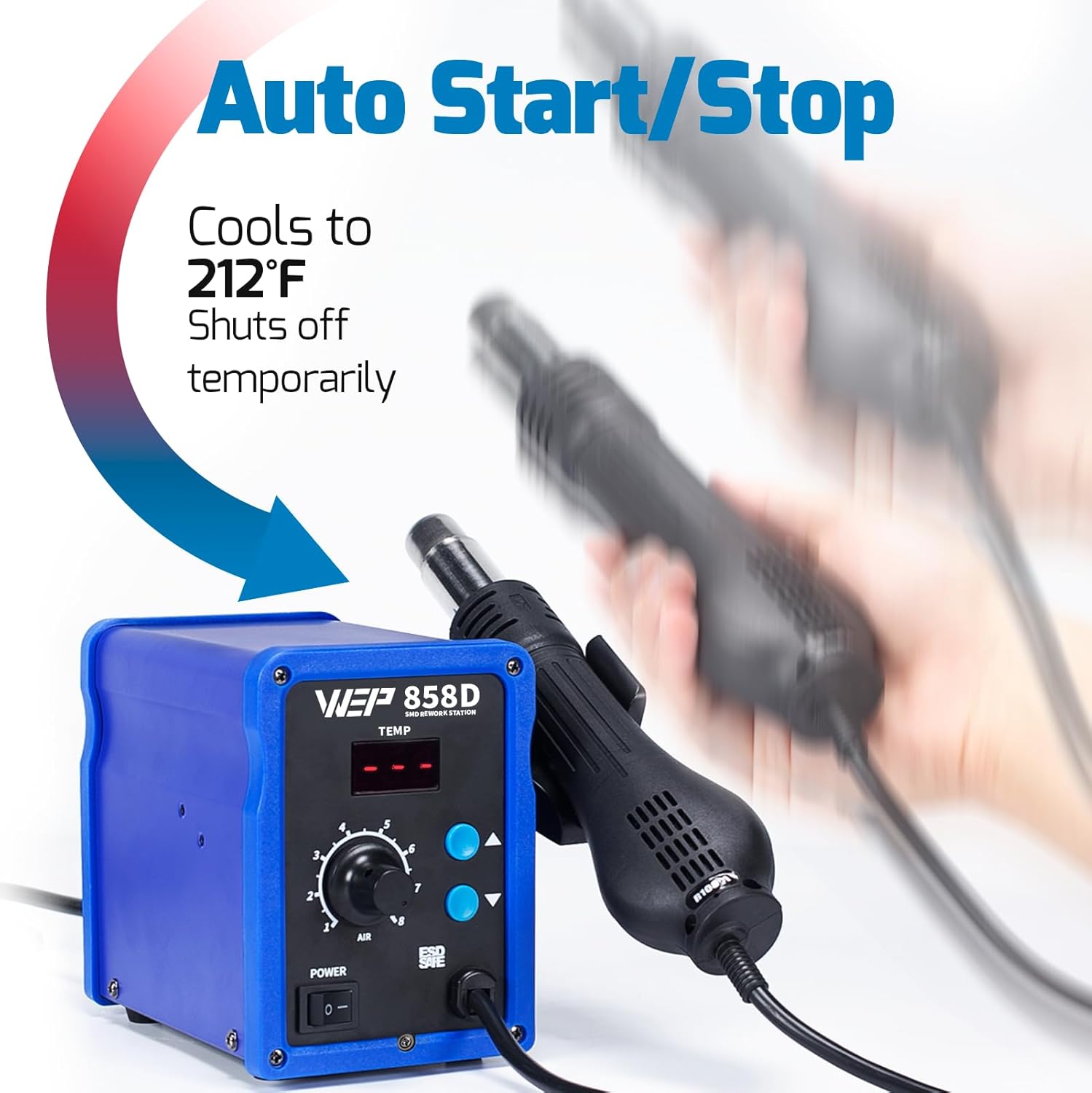
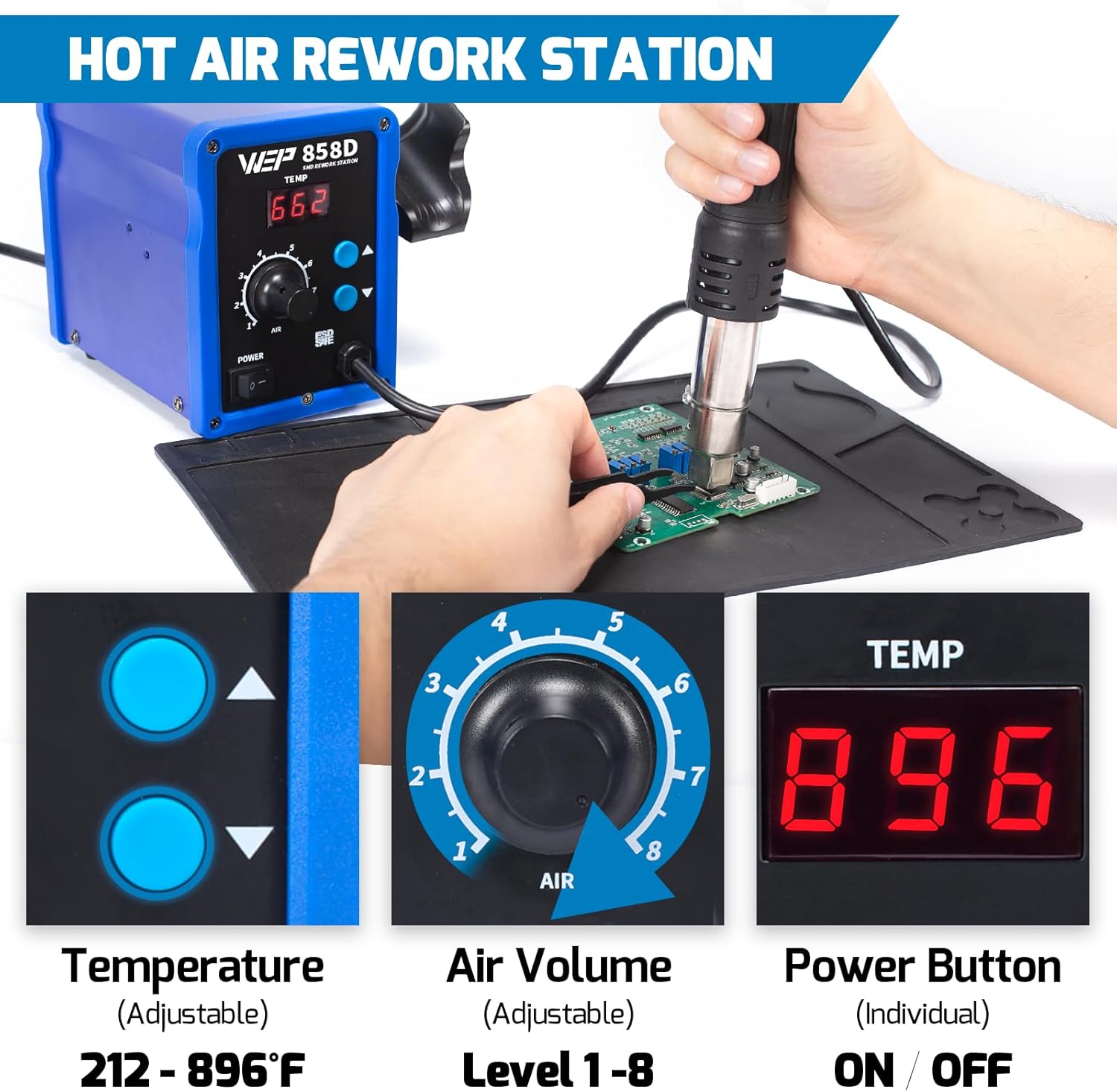
700 W, 100-500 C (212-932 F), PID stabilisation, ceramic heating element, airflow knob, four nozzles, cool-down to 212 F on the stand, explicitly rated 110-127 V only.
It carries the least information of the five: the airflow knob has neither L/min nor an abstract 1-120 scale, just "adjustable". What the page can confirm is the temperature range, PID and the element type.
Real drawbacks: airflow is entirely unquantified, so a nozzle swap or a different operator produces a different result and no reproducible process record is possible; the page states "Do not connect this iron to a 220V power socket", so there is no wide-voltage option; "patented cylindrical ceramic heating element" comes with no patent number; the four nozzle diameters are not in the copy, only in the images; temperature accuracy and calibration are not mentioned. The listing is here.



Why an 1800 W hair dryer cannot get there
Run the same formula the other way: outlet temperature equals ambient plus power divided by (mass flow times specific heat). More power raises it, more airflow lowers it, and a hair dryer moves an order of magnitude more air than a rework station.
An estimate: assume an 1800 W dryer moving 40 L/s (a typical domestic magnitude, model dependent), mass flow about 0.048 kg/s, all power going into the air gives a rise near 37 K, so roughly 55 C at the outlet. To reach 300 C at that flow you would need about 13.5 kW. The heater is not the problem; the air is leaving too fast.
A rework station inverts it: throttle to 1.9 L/s and the same power takes the air past 300 C. The two are not interchangeable. The dryer's problem is not a small wattage, it is a large denominator, and on top of that it has no closed loop, so outlet temperature swings with distance and angle.
That is also why low-melting alloy is a separate route: stop fighting airflow and change the alloy to one that melts at 58 C. The two kit versions and their two melting ranges are in the Chip Quik piece.
Cold air and idle cool-down: the third control
A hot air station has two knobs, temperature and airflow, but the action that decides its service life is a third one: when you stop the air.
The five differ. FR-810B cools automatically once the handpiece is back in the holder and powers off after 30 minutes idle; ST-862D has a dedicated cold-air mode that blows without heating; 959D and 858D drop to 212 F on the stand before the blower and element stop; 861DW uses magnetic standby.
The difference shows up in the last ten seconds of a rework. Cutting power immediately leaves the element and nozzle cooking in residual heat; keeping airflow and dropping the setpoint for fifteen seconds carries that heat away. Without a cold-air mode the routine is minimum temperature, maximum airflow, a short blow - which is another reason a very low minimum airflow setting is not a feature.
The fume extraction on the same bench is the mirror-image problem, where airflow, filter and noise trade against each other: reading Hakko and Weller fume absorber specs.
Choosing by task: three decision points
First, what are you removing? Two-terminal passives, SOT-23 and small SOPs have little thermal mass, and a 700 W 858D or 959D is enough because what you need is controlled low airflow, not high temperature. BGAs, shields, multi-pin QFP and power boards with heavy copper are where 1000 W and a usable maximum airflow start to matter.
Second, do you need repeatability? If the result has to be written into a process sheet and reproduced by a second person, you need numbers you can store and read back: three presets (959D, 861DW, ST-862D) or five presets plus chained presets (FR-810B). For a one-off job done by feel, presets do nothing.
Third, how much do you trust the page? Of the five, only FR-810B can serve as a baseline, because it has a unit, a basis and a footnote; everything else needs the maker's site or the manual before you can compare. Fixturing is the other half of the same problem, since a board that slides when the air hits it ruins the work: the three numbers behind a third hand.
FAQ
Q: What is the real difference between 700 W and 1000 W?
A: It is how much temperature rise is left at the airflow you actually use. At equal airflow a 43 percent power advantage gives a 43 percent higher rise; but 1000 W units usually move more air, which cancels part of it. Wattage alone cannot answer the question - you also need the airflow unit and basis.
Q: Is more airflow always better?
A: No. More air means faster heat transfer and a more even soak, but also a harder time holding temperature, small parts blown off the pads and flux scattered away. The practice is to pick the nozzle by component size, the airflow by thermal mass, then trim with temperature.
Q: Why do most listings omit L/min?
A: Because printing it forces you to state the basis. Hakko prints 115 L/min together with a note that it is free-flow rated and that nozzles reduce it. No unit means no obligation to explain where it was measured. When you see "120L" or "1-120", ask what the denominator is.
Q: Can a hair dryer or a paint-stripping heat gun substitute?
A: The airflow is off by an order of magnitude and there is no closed loop. Per the estimate above, 40 L/s needs roughly 13.5 kW to reach 300 C. A heat gun has the power, but its outlet temperature is set by a step switch rather than a loop, and its airflow is also large - fine for heat shrink, wrong for a solder joint.
Q: Do I need vacuum pickup?
A: Only for packages where the solder melts but the part stays on the pads, such as BGA and QFN. Its value is turning "the moment the solder melted" into an observable event instead of prying with tweezers; a lifted pad costs more than the price gap to a better machine.
Q: Is 480 C enough?
A: For most lead-free joints, yes, but with little headroom. On a large thermal pad you have to cut airflow to hold temperature, which slows the heat-up and lengthens the soak on nearby parts. A 600 C unit is more comfortable in that case.
Scope and disclosure
Every specification here comes from one of two page types: Hakko's official specification sheet (www.hakko.com, captured 2026-11-24) and five amazon.com product pages captured the same day. Prices and stock are a snapshot and will change. The temperature-rise figures are estimates under ideal conditions (air density 1.2 kg/m3, specific heat 1.005 kJ/(kg*K), no losses); they are not measurements and not manufacturer performance data.
Product links in this article are affiliate links: this site earns a commission if you buy through them, at no extra cost to you. Every drawback listed is traceable to the page it appears on, with no third-party review claims used.
👉 Join Xiaomi MiMo Platform: Leading AI model platform with cost-effective inference
👉 Join Aliyun AI: Top AI products with exclusive coupons for business innovation
📌 This article was AI-assisted generated and human-reviewed | TechPassive — An AI-driven content testing site focused on real tool reviews
🔗 Recommended Tools
These are carefully selected tools. Using our affiliate links supports us to keep producing quality content:
As an Amazon Associate, I earn from qualifying purchases at no extra cost to you.